Category: Irish saints in Europe

  • Saint Fiacre

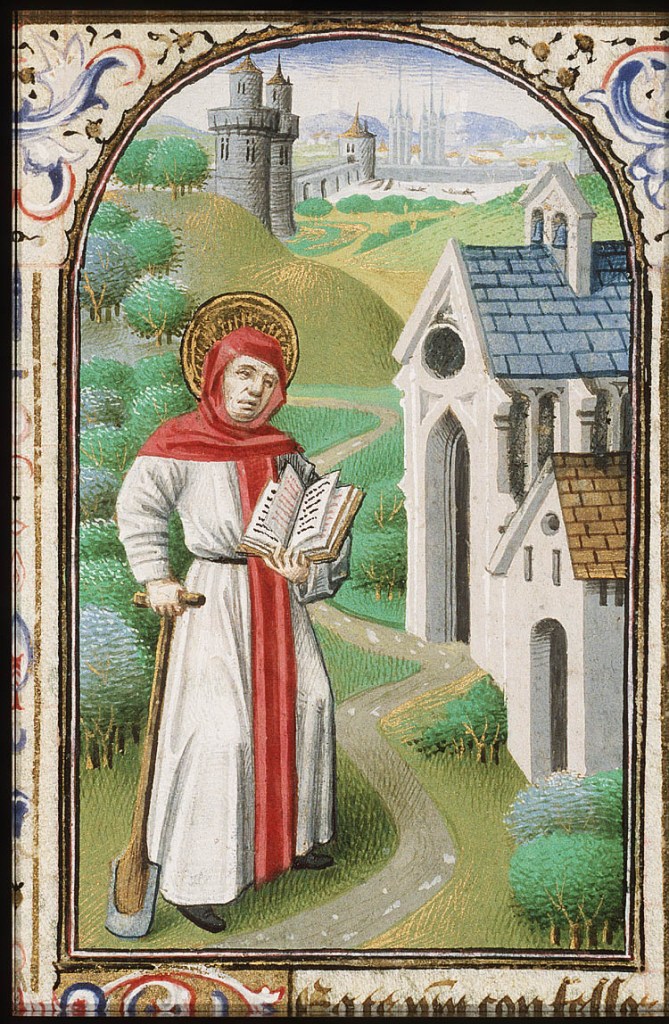
    August 30 is the feast of Saint Fiacre of Breuil, today one of the more widely-known Irish saints who laboured in continental Europe. But as the mid-nineteenth century article below shows, this was not always the case. The anonymous author ‘S.G.’ admits that he had never heard of Saint Fiacre at home and only encountered his name and history in ‘a remote corner of France’. He alludes to the saint’s patronage of gardening and muses on the communion of saints as well as on France’s revolutionary past. There are some fuller accounts of Saint Fiacre available at the blog here and here plus a 1904 poem on the saint’s Irish hermitage here:
    THE IRISH MISSIONARY SAINTS.

    A friend in France has sent us the following sketch of the life, labours, and shrine of one of those illustrious pilgrims, whom Ireland has sent forth in such abundance to pioneer the Cross through the world. The Irish Saints who have given to other lands the benefits of their learning or sanctity form a proud and brilliant galaxy. The name of Ireland became thereby “great among the nations;” and yet, after all, one cannot help being a little discontented with those holy men who set the example of “absenteeism” to the great of a modern day, and moreover left their shrines in perpetuity to glorify a foreign soil. Saints Columbanus, Colman, Killian, Fursey, and a host of others, are perhaps better known and more devoutly honoured at this day upon the Continent than here in “the Island of the Saints;” in fact, some of them have been appropriated altogether—the fate of everything Irish which is at all worth the process I But it is to be hoped that a day will come when, with the spirit of the Crusaders, we shall rescue our holy memories from the keeping of strangers, and guard them thenceforth with care and fervour. I first became acquainted with the name and history of St, Fiacre in a remote corner of France. While in Ireland I had never heard him even spoken of, though of course he is mentioned in many books. Unlike Columbanus, his career has little of interest or variety, for he belonged to that contemplative class, who. fled from the weary scenes of active life to dwell in undisturbed communion with God, amidst the sands of the desert, or on the shores of some solitary lake, whose still cold waters, like their own bosoms, reflected no lights or shadows but those of Heaven above them.

    The French biographers of this Saint tell us, that he was of a noble Irish family, that he received an early and pious education under some of the celebrated men of his own country ; and that, dreading the dangers of his youth and rank, he left his home and friends, and passed into France to seek a retreat. There he was received with paternal affection by St. Faro (a disciple of St. Columbanus), who was then Bishop of Meaux. He gave him a solitary spot in the forest of Breuil, which was the bishop’s own patrimony. Breuil—and, indeed, the entire of Brie—is one of the most beautiful and picturesque parts of ” la belle France” and in this forest the young anchorite cleared a space of ground, on which he built a cell and an oratory to the Virgin. He also enclosed a garden, which he cultivated himself to procure his support. From this circumstance, I suppose it is, that the gardeners of France have chosen him for their patron. It does not appear that this ascetic life closed his heart against his fellowmen, for we are informed that the rich came to him for counsel, and the poor for relief; and that these favours were freely bestowed. He built an hospital at some distance from his cell, for the reception of pilgrims and strangers; and in this we recognize the true spirit of poor Ireland—proverbial hospitality. Our saint never left his “forest sanctuary;” and, there, after a life which is still regarded as a model of charity and self-denial, “he fell asleep in the Lord.” and was buried in his own oratory. His shrine soon became the resort of pilgrims of all ranks and conditions, from the humble peasant to that fair Queen, with whose faults and follies novelists delight to embellish their pages.

    St. Fiacre being the patron of gardeners, his fete is truly “a day of flowers.” Indeed,the sternest follower of Calvin or Knox might be softened if chance brought him into some of those old churches—”la poesie en pierre”—where the memory of our Saint is still honoured. The quantity of shrubs and flowers brought as offerings—all fresh and blooming in the vases where they grew—from the garden to the sanctuary,, give to the latter the semblance of paradise, while the light of the August sun, streaming through the stained windows, tinge the snowy bells and delicate petals with a thousand rainbow hues of unearthly brightness. The poor man kneeling before the altar, surrounded by his family all full of faith and hope, imploring the blessing of Heaven upon the fruits, of. his labour, completes the picture.. The attachment of the peasants of France to their Saints, through so many changes, might well surprise a superficial observer, and confound those who are constantly taxing them with levity and inconstancy. “Le peuple n’est ni sot ni bete,” was the reply of the brilliant Sevigne, at a time when the people of France were the mere vassals of the proud aristocracy to which she belonged, I will add to this, that the people are neither fickle nor ungrateful. The Saints have been the friends of the people, whether of princely lineage or plebian birth. The Gospel has had more true democrats than all the eloquence of modern philosophers.

    Let us study the lives of the Saints, and then we shall see how many among them were the consolers and supporters of the people in the times of calamity and affliction: nay, often the uncompromising champions- of their rights, as the history of many a tyrant of the dark ages can attest. Therefore, the people through the holiness of tradition, still revere their memories, still invoke their protection in danger, and their blessings in prosperity, and regard ” the communion of the Saints’, as the golden link between the suffering mortal and the great Creator. The people in France are not to be confounded with that furious monster the mob. The difference between the two is strikingly exemplified in the history of the revolution of ’93. The people rose in La Vendee to defend their homes and altars, and carried to the combat a self-devotedness and chivalrous bravery which Napoleon, in his own energetic language, characterised as ” La Guerre de Geans :” whilst the mob perpetrated, in the bloody September, the most disgusting and atrocious crimes that ever stained the page of history.

    But I have strayed from the peaceful shrine of our Saint. Yet I was still in the company of his friends,, for Fiacre is decidedly a popular Saint—and a naturalized Frenchman —to which fact even the many beautiful bouquets, I received so often in his honour, have failed to reconcile me, for although we might certainly afford to give away a few saints or songs, I would protest against their being appropriated without a fair and grateful acknowledgment.

    S.G.

    ‘Tis said the name fiacre was given to hackney-coaches, because they were first used for the conveyance of pilgrims who went from Paris to visit the shrine of the Saint. The inn where those coaches were hired was known by the “Sign, of St. Fiacre.”

    —From the Dublin Nation.

    THE IRISH MISSIONARY SAINTS. (1851, February 1). The Irish Exile and Freedom’s Advocate (Hobart Town, Tas. : 1850 – 1851), p. 4.
  • Irish Saint Patron of French Herds

    I have been perusing the newspaper archives of the National Library of Australia. Its aptly-named Trove resource contains a wealth of articles on the Irish saints, mostly syndicated from other contemporary publications, presumably aimed at the Irish ex-pat community. As I read the 1928 article below on Saint Etto of Dompierre, I wondered just how many people in Ireland would have been aware of this Irish agricultural patron whose memory was cherished in both France and Belgium. One Irishman who was aware, of course, was Canon O’Hanlon, who included a full account of Saint Etto (called Etton here) in the July volume of his Lives of the Irish Saints at the saint’s feast day, July 10, which can be read at the blog here . Our anonymous Australian correspondent below provides a brief summary of the main details of Saint Etto’s life and career:

    IRISH SAINT PATRON OF FRENCH HERDS.

    PARIS, June 10

    In telling of a pilgrimage to the relics of St. Etton, honoured in the little village of Dompierre, Department of the North, La Croix reveals that this saint, an Irish prelate, is invoked throughout France for protection of the herds. Only one column and a small niche remains of the hermitage founded by St. Etton at Dompierre when he came from Ireland in the seventh century. An inscription carved thereon reads: “In the year 654, July 10; the blessed St. Etton was buried here. I pray that you preserve us and our animals from all sickness.” The cult of the good bishop was perpetuated and when, towards the year 1600, some monks carried his remains to Belgium, the population of Dompierre began proceedings to recover the relics of their saint. In 1789, when the revolution broke out, the matter had not been settled. The peasants of Dompierre, faithful to the end and taking advantage of general conditions, marched to Belgium and returned in triumph bearing the relies of St Etton. Since that time, a pilgrimage to his shrine occurs annually.

    IRISH SAINT IS PATRON OP FRENCH HERDS. (1928, October 4). The Age (Brisbane, Qld.: 1892-1921; 1923; 1925-1926; 1928-1929), p. 32. Retrieved July 31, 2026, from http://nla.gov.au/nla.news-article291812515

    .

  • Ivrea and 'A Bishop of McCarthy's Royal Name'

    To mark the feast day of Blessed Thaddeus McCarthy, below is an 1897 article on Ivrea, the Italian town whose people took this fifteenth-century Irish bishop to their hearts and reintroduced him to his own countrymen. It’s poignant to read how the Bishop of Ivrea in ‘black ’47’, the worst year of the Great Hunger, not only sent money for famine relief but documents relating to the humble Irish pilgrim who had died in Ivrea in 1492. A post on the translation of the relics of Blessed Thaddeus, which also took place in 1897, can be read at the blog here:

    IVREA.

    THE present writer — who is not the writer of the following paper but only of these few introductory words — claims the credit of having been the first to sing in English the praises of the Blessed Thaddeus whose connection with Ivrea procures for that Italian town the distinction of being now commemorated in an Irish Magazine. It happened thus. In 1847, the Bishop of Ivrea, in northern Italy, sent Dr. Murray, Archbishop of Dublin, forty pounds for the famine-stricken people of Ireland; and he also took the opportunity of enclosing documents about an Irish pilgrim who had died at Ivrea in 1492, and was revered there from that day till now as a saint and worker of miracles. These documents were given to the learned President of Maynooth, Dr. Laurence Renehan. Among them was a copy of an epitaph written in Gothic characters on parchment. About the year 1854, or 1855, Dr. Renehan gave this to one of the students of the diocese of Dromore, to be translated metrically, as it was written in Latin hexameters. The translation lay among the old President’s papers, till they came, after his death, into the care of Dr. Daniel MacCarthy, afterwards Bishop of Kerry. In the first volume (1864) of The Irish Ecclesiastical Record, page 377, Dr. MacCarthy published in his account of Blessed Thaddeus MacCarthy, the following lines which the Editor of this Magazine claims as his own across an interval of more than twice twenty golden years.

    ‘Neath marble tombs in this the Virgin’s shrine
    The bones of many a saint in peace recline.
    Thaddeus here. From Erin’s shore he came,
    A Bishop, of McCarthy’s royal name;
    At whose behest were wondrous cures oft made.
    Still Latium, Genoa, invoke his aid
    Dying, he mourned that not on Irish soil,
    Where sped his youth, should close his earthly toil;
    Nor Cloyne, nor Kerry, but Ivrea owns
    (For God so willed) the saintly Bishop’s bones.
    ‘Tis meet that they, in marble shrine encased.
    Should be within the great cathedral placed.
    Like Christ, whose tomb was for another made,
    He in Eusebius’ cenotaph is laid.

    Soon sacred prodigies his power attest,
    And all the earth proclaims him pious, blest.
    ye who hither come, our saint assail
    With prayers and votive gifts; nor, traveller, fail
    To greet with reverence the holy dead.
    Since Christ was born a thousand years had fled,
    Four hundred then and ninety-two beside
    Had passed away, when St. Thaddeus died.

    A city, which tradition points out as the place where our national apostle, St. Patrick, was raised to episcopal rank, as a prelude to his evangelisation of Ireland, and which for over four hundred years has been the faithful guardian of the remains of that strangely persecuted Irish Bishop, now known to the Catholic world as the Blessed Thaddeus, whose beatification Ivrea celebrated last September in so memorable a manner — this city of Ivrea deserves fuller notice than has been accorded to it in the Irish press. But beyond this special interest for Irish readers, its history is in itself sufficiently curious.

    It was known to Pliny, Ptolemy, and Cicero, as Eporedia, and in various public records down to the year 1200, as Iporegia, Iporiensis, Civitas, and Eporeja. This subalpine town, now named Ivrea, was originally a Roman Colony, founded during the sixth Consulship of Caius Marius, 664 years after the foundation of Rome, and about a hundred years before the birth of Christ. Lying as it does, upon the left bank of the river Dora Balta, the Romans founded it as an outpost to confine the aboriginal Salassians in the valleys to which they had driven them back.

    From a colony Ivrea rose to be a municipality with its full staff of decurions, ediles, questors, and other Roman officials. On the break-up of the Roman Empire it shared the same fate as the rest of Italy, and passed through the hands of many masters until A.D. 572, when the Lombardians made it a ducal seat, which it continued to be until 773, when it became subject to Charlemagne who placed a Marquess to rule over it. Several of the Marquesses of Ivrea held kingly rank elsewhere. After the death of the Marquess Arduin, the city was for a time governed by its bishop: from whom it passed under the yoke of the Emperors of Germany. These held it till 1248, when they made it over to Thomas II., third son of Thomas I., Count of Savoy, whose successors acquired further rights over it in 1313.

    Ivrea was not yet done with its changes of government. In 1543 it was occupied by the Spaniards, who built in it a castle for its defence. In 1554 came the French; but five years later it was restored to Duke Emmanuel Philibert. In 1641 it fell, for the second time, into the hands of the French, who, after abandoning it for a while, again got hold of it in 1704. In 1796 they captured it for the last time ; and from May, 1800, Ivrea was the capital of a French department, till the fall of Napoleon in 1814. Since that time it has remained an appanage of the House of Savoy.

    Ivrea was once a city of fifty thousand inhabitants, but through wars and pestilence its population has dwindled to ten thousand. It is healthy, and possesses attractive surroundings — castles and convents, vine-clad hills, valleys, and exquisite lakes.

    Long established as an Episcopal See, Ivrea has its cathedral and other churches, two seminaries, besides flourishing schools and orphanages, with institutions for the poor and sick. The Cathedral was once a pagan temple and circular in form, as was generally the case with pagan temples dedicated to the sun. About A.D. 350 it was purged of paganism and consecrated to the service of the true God under the patronage of the Blessed Virgin assumed into heaven, whence it became known as St. Mary’s Ivrea. In course of time much of the building was demolished and its form altered. Of the older portion nothing remains but the two campanili, some tombstones, and a fresco on a pillar of the choir. The church was enlarged in 1854.

    In this Cathedral were deposited the remains of the now beatified Thaddeus MacCarthy, Bishop of Cork and Cloyne; and it also possesses the bodies of several other saints and martyrs. In the garden behind are portions of the ancient cloister, dating from the days when the members of the chapter lived together and formed one community, as was the rule till about A.D, 1240.

    Near the Cathedral stands the fifteenth century Church of the Confraternity of St. Nicholas of Tolentino, the interior of which is richly ornamented. Behind its high altar of marble is the choir, containing thirty stalls of carved wood representing scenes in the life of St. Nicholas. It contains also a beautiful old painting of the Madonna and Child, with St. Nicholas the Bishop, and St. Nicholas of Tolentino at each side.

    In another part of the city is a beautiful church-tower, known as St. Stephen’s, which is all that remains of the Benedictine Abbey of that name founded at Ivrea by the Bishop in 1041. This abbey flourished till the fifteenth century, but in the next century it was partially demolished, and in 1757 all except this tower was taken down. Some manuscripts that had belonged to this abbey are preserved in the Cathedral Archives.

    This church-tower would appear from its materials to have been built out of the ruins of the old Boman amphitheatre of Ivrea. Amongst other Roman remains is the one-arch bridge across the Dora, which was almost totally destroyed by the French in 1706, during a siege which did immense damage to the churches and other buildings of the town. The bridge was restored by Victor Amadeus, King of Sicily, in 1716, and still further improved a century later by King Charles Felix, in 1830. There are also various urns of baked clay dating from the third century before Christ, and a beautiful marble Sarcophagus, erected in the time of Augustus to receive the remains of Caius Valerius Atticus who died at Ivrea.

    Prominent amongst the mediaeval monuments, is the castle of the Four Towers, which was built in 1368, in the highest part of the city. In 1676, one of the towers containing eight hundred barrels of gunpowder, was struck by lightning and destroyed, a hundred and seventy persons perishing under the ruins. The castle of the Four Towers is now used as a prison.

    The chief of the modem public monuments is one raised in memory of General Perrone de San Martino, a native of Ivrea, who lost his life on the battlefield of Novaro in 1849.

    In the times when stage-coaches and railways were as yet undreamt of, Ivrea stood on what was then the highway between Italy and France; and to this circumstance it owed much of its former importance. It owed to it also the distinction of having been visited at dates widely apart by great military commanders like Hannibal, Charlemagne, and the First Napoleon. This fact also accounts for St. Patrick passing through Ivrea, as is said, in the year 431, and St. Malachy of Armagh, the friend of St. Bernard, in 1139. This moreover made it the scene of the lonely but glorious death of the Blessed Thaddeus in 1492, while making his way homeward on foot as a poor and unknown pilgrim.

    Nothing now remains of the Hospice of the Twenty-one Pilgrims in which he died. It was erected in the year 1005 at the suggestion of St. Bernard of Mentone, and stood on the spot now called the Cassinali di S. Antonio on the old Aosta road outside the city. It derives its name from the fact that members of the Solerio family endowed it with funds for the support of twenty-one passing pilgrims. It was destroyed during the Franco-Spanish war in 1644; but the church, then rebuilt, is still standing.

    That Ivrea has not ceased to venerate the remains of the Blessed Thaddeus was proved by the sacred festivities of last September, in which the Bishops of Cork, of Cloyne, and of Ross took part in response to a pressing invitation, as the successors of their saintly countrymen. One of these prelates, Dr. Fitzgerald of Ross, has since been taken from us suddenly by death.

    A foremost part in these solemnities was taken by Canon Saroglia, the learned and pious Vicar-General of the diocese, on whom chiefly had devolved the laborious researches which prepared the way for the beatification of Thaddeus, Bishop of Cork and Cloyne. From his writings, especially his Album of Ivrea, the present paper has with his kind permission been compiled. He is now engaged upon a large work devoted to the religious history of Ivrea, to be published under the title of “Eporedia Sacra.”

    James Coleman.

    The Irish Monthly, Vol. 25, No. 285 (Mar., 1897), pp. 146-150.

    Content Copyright © Omnium Sanctorum Hiberniae 2012-2024. All rights reserved.