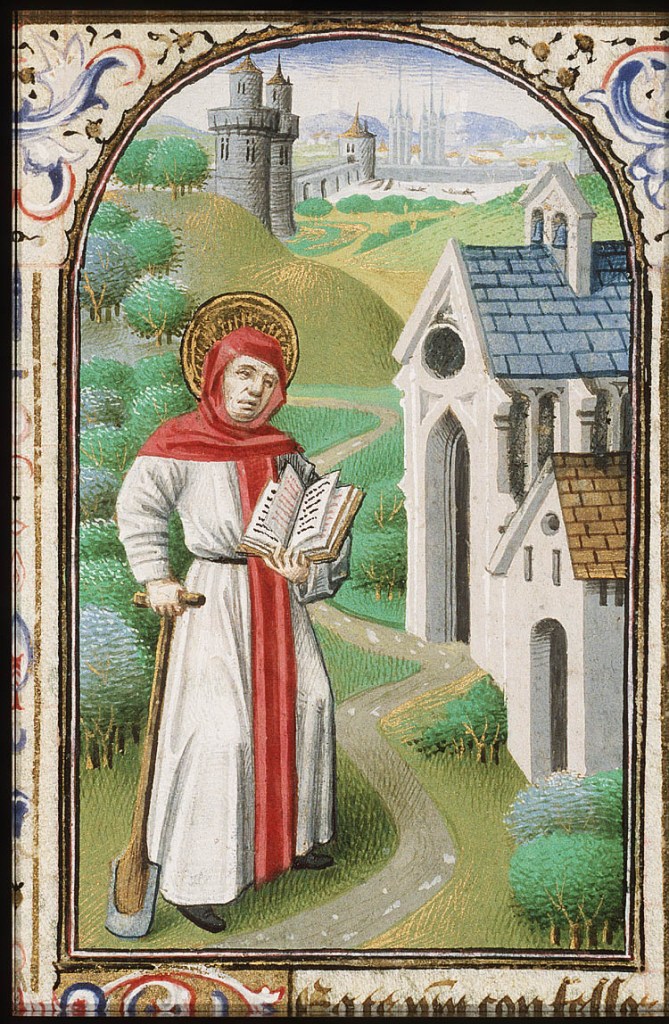
August 30 is the feast of Saint Fiacre of Breuil, today one of the more widely-known Irish saints who laboured in continental Europe. But as the mid-nineteenth century article below shows, this was not always the case. The anonymous author ‘S.G.’ admits that he had never heard of Saint Fiacre at home and only encountered his name and history in ‘a remote corner of France’. He alludes to the saint’s patronage of gardening and muses on the communion of saints as well as on France’s revolutionary past. There are some fuller accounts of Saint Fiacre available at the blog here and here plus a 1904 poem on the saint’s Irish hermitage here:
THE IRISH MISSIONARY SAINTS.
A friend in France has sent us the following sketch of the life, labours, and shrine of one of those illustrious pilgrims, whom Ireland has sent forth in such abundance to pioneer the Cross through the world. The Irish Saints who have given to other lands the benefits of their learning or sanctity form a proud and brilliant galaxy. The name of Ireland became thereby “great among the nations;” and yet, after all, one cannot help being a little discontented with those holy men who set the example of “absenteeism” to the great of a modern day, and moreover left their shrines in perpetuity to glorify a foreign soil. Saints Columbanus, Colman, Killian, Fursey, and a host of others, are perhaps better known and more devoutly honoured at this day upon the Continent than here in “the Island of the Saints;” in fact, some of them have been appropriated altogether—the fate of everything Irish which is at all worth the process I But it is to be hoped that a day will come when, with the spirit of the Crusaders, we shall rescue our holy memories from the keeping of strangers, and guard them thenceforth with care and fervour. I first became acquainted with the name and history of St, Fiacre in a remote corner of France. While in Ireland I had never heard him even spoken of, though of course he is mentioned in many books. Unlike Columbanus, his career has little of interest or variety, for he belonged to that contemplative class, who. fled from the weary scenes of active life to dwell in undisturbed communion with God, amidst the sands of the desert, or on the shores of some solitary lake, whose still cold waters, like their own bosoms, reflected no lights or shadows but those of Heaven above them.
The French biographers of this Saint tell us, that he was of a noble Irish family, that he received an early and pious education under some of the celebrated men of his own country ; and that, dreading the dangers of his youth and rank, he left his home and friends, and passed into France to seek a retreat. There he was received with paternal affection by St. Faro (a disciple of St. Columbanus), who was then Bishop of Meaux. He gave him a solitary spot in the forest of Breuil, which was the bishop’s own patrimony. Breuil—and, indeed, the entire of Brie—is one of the most beautiful and picturesque parts of ” la belle France” and in this forest the young anchorite cleared a space of ground, on which he built a cell and an oratory to the Virgin. He also enclosed a garden, which he cultivated himself to procure his support. From this circumstance, I suppose it is, that the gardeners of France have chosen him for their patron. It does not appear that this ascetic life closed his heart against his fellowmen, for we are informed that the rich came to him for counsel, and the poor for relief; and that these favours were freely bestowed. He built an hospital at some distance from his cell, for the reception of pilgrims and strangers; and in this we recognize the true spirit of poor Ireland—proverbial hospitality. Our saint never left his “forest sanctuary;” and, there, after a life which is still regarded as a model of charity and self-denial, “he fell asleep in the Lord.” and was buried in his own oratory. His shrine soon became the resort of pilgrims of all ranks and conditions, from the humble peasant to that fair Queen, with whose faults and follies novelists delight to embellish their pages.
St. Fiacre being the patron of gardeners, his fete is truly “a day of flowers.” Indeed,the sternest follower of Calvin or Knox might be softened if chance brought him into some of those old churches—”la poesie en pierre”—where the memory of our Saint is still honoured. The quantity of shrubs and flowers brought as offerings—all fresh and blooming in the vases where they grew—from the garden to the sanctuary,, give to the latter the semblance of paradise, while the light of the August sun, streaming through the stained windows, tinge the snowy bells and delicate petals with a thousand rainbow hues of unearthly brightness. The poor man kneeling before the altar, surrounded by his family all full of faith and hope, imploring the blessing of Heaven upon the fruits, of. his labour, completes the picture.. The attachment of the peasants of France to their Saints, through so many changes, might well surprise a superficial observer, and confound those who are constantly taxing them with levity and inconstancy. “Le peuple n’est ni sot ni bete,” was the reply of the brilliant Sevigne, at a time when the people of France were the mere vassals of the proud aristocracy to which she belonged, I will add to this, that the people are neither fickle nor ungrateful. The Saints have been the friends of the people, whether of princely lineage or plebian birth. The Gospel has had more true democrats than all the eloquence of modern philosophers.
Let us study the lives of the Saints, and then we shall see how many among them were the consolers and supporters of the people in the times of calamity and affliction: nay, often the uncompromising champions- of their rights, as the history of many a tyrant of the dark ages can attest. Therefore, the people through the holiness of tradition, still revere their memories, still invoke their protection in danger, and their blessings in prosperity, and regard ” the communion of the Saints’, as the golden link between the suffering mortal and the great Creator. The people in France are not to be confounded with that furious monster the mob. The difference between the two is strikingly exemplified in the history of the revolution of ’93. The people rose in La Vendee to defend their homes and altars, and carried to the combat a self-devotedness and chivalrous bravery which Napoleon, in his own energetic language, characterised as ” La Guerre de Geans :” whilst the mob perpetrated, in the bloody September, the most disgusting and atrocious crimes that ever stained the page of history.
But I have strayed from the peaceful shrine of our Saint. Yet I was still in the company of his friends,, for Fiacre is decidedly a popular Saint—and a naturalized Frenchman —to which fact even the many beautiful bouquets, I received so often in his honour, have failed to reconcile me, for although we might certainly afford to give away a few saints or songs, I would protest against their being appropriated without a fair and grateful acknowledgment.
S.G.
‘Tis said the name fiacre was given to hackney-coaches, because they were first used for the conveyance of pilgrims who went from Paris to visit the shrine of the Saint. The inn where those coaches were hired was known by the “Sign, of St. Fiacre.”
—From the Dublin Nation.
THE IRISH MISSIONARY SAINTS. (1851, February 1). The Irish Exile and Freedom’s Advocate (Hobart Town, Tas. : 1850 – 1851), p. 4.


Leave a Reply