Tag: Irish Saints

  • Saint Tiopraite of Magh-ratha, December 27

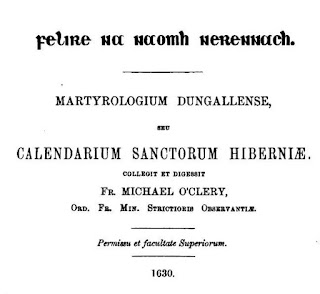
    We have another of the many obscure Irish saints commemorated on December 27. In the case of Tiopraite of Magh-ratha, the locality associated with him brings its own problems of identification. The Martyrology of Donegal records:

    27. D. SEXTO KAL. JANUARII. 27.

    TIOPRAITE, of Magh-ratha.

    whilst the earlier Martyrology of Gorman says, rather more poetically:

    27. d. 

    Tipraite fail findnoem

    Tipraite a fair, holy fence
    The index of places attached to the Martyrology lists a number of possible locations for Magh-ratha:
    Mag Ratha, Dec. 27, gl. 2, now Moira, co. Down? or Moyra Glebe, in co. Donegal? or Moyrath, in Meath  or Moyra, in co. Longford?

    A nineteenth-century antiquarian made a case for identifying Magh-ratha with Moira, County Down, a
    locality said to have been the site of a famous eighth-century battle. He mentions our saint in passing:

    It also appears by the Calendar of Donegal, December 27, that there was another church in Magh Rath, dedicated to St. Tiopraite, but nothing more of it is known…

     
    But since the writer does not provide conclusive proof that Moira, County Down is the Magh Rath spoken of in the sources, it remains equally likely that the church of Saint Tiopraite was located at one of the other suggested sites. The website Place Names NI sums
    up the latest scholarly thinking on the derivation of this place name,
    which is not as straightforward as it might at first sight appear.  
     
    So, all we can say for sure is that the name of Saint Tiopraite is recorded on December 27 in two
    of the later Irish Martyrologies but when and where exactly he
    flourished remains open to question.

    Content Copyright © Omnium Sanctorum Hiberniae 2012-2015. All rights reserved.
  • Saint Maolán of Tullaghmelan, December 25

    Among the Irish saints who celebrate their feast days on the Feast of Christ’s Nativity is Saint Maolán of Tullaghmelan. Not much is actually known of him save that he is remembered as the founder of the church of Tullaghmelan. Diocesan historian, Father Patrick Power, writes of this locality:

    Tullaghmelan Parish

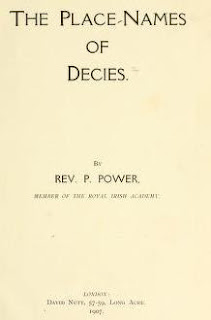
    THE Parish, which is about average size, lies on the north bank of the Suir along the Co. Waterford boundary line. Its name Tulaigh Maoláin (“Maylon’s Height”) does not appear ecclesiastical, yet it is the tradition of the locality that Maolan was the founder of the church. In fact, an effigy of stone still preserved in the precincts of the ruin is said to be his.
    Rev. P. Power, The Place Names of Decies, (London, 1907), 353.
    The Irish calendars record the saint at December 25 with the Martyrology of Donegal listing:

    25. B. OCTAVO KAL. JANUARII. 25.

    MAELÁN, Bishop.

    whilst the Martyrology of Gorman describes him as ‘great Maelán, void of weakness’.
    The earlier Martyrology of Tallaght lists ‘Melani episcopi’ on this date, along with three other native saints.
     
    Content Copyright © Omnium Sanctorum Hiberniae 2012-2015. All rights reserved.
  • Saint Mochua of Timahoe, December 24

    The Irish Calendars commemorate Saint Mochua of Timahoe on the eve of Christmas, although for some reason the Bollandists commemorated him on January 1. Below is a brief account of his life which quotes the Irish Martyrologies:

    TIMAHOE
    This place, which was originally styled Teach Mochua, derives its name from St. Mochua, who founded a monastery here in the seventh century.

    St. Mochua was venerated on the 24th of December, at which date the Martyrology of Donegal has the entry: “Mochua, son of Lonan, of Tigh Mochua in Laoghis, in Leinster. He was of the race of Eochaidh Finn-fuathairt, from whom Brighit is (descended). Fineacht, daughter of Loichin, son of Dioma Chiret, of Cill Chonaigh, was his mother.”

    The Feilire of Aengus thus refers to him:- ” 24 Dec. A waiting on Lucianus with my-Cua, a fair couple. Lonan’s son chances (to come) to us on the night before Christmas.” To which the gloss in the Leabhar Breac, adds:- ” ‘My-Cua,’ i. Mo-chua, son of Lonan, of Tech-Mochua in Leix of Leinster, and of Daire Mis (?) in Sliab Fuait; i.e. of Teach Mochua in Leix, i.e. Mochua, son of Lonan, son of Senach, son of Aengus, son of Lugna, son of Breg-dolb, son of Art-Chorb, son of Tiacha, i.e. son of Feidlimid Rechtmar.”

    This saint died – according to the Chronicon, Scottorum – in 654, “A.D. Mochua, son of Lonan, quevit,” but in 657, according to the Four Masters.

    Rev M Comerford” Collections relating to the Dioceses of Kildare and Leighlin” Vol. 3 (1886)

    There was also a northern link to Saint Mochua and the Armagh diocesan website has this account of the holy well dedicated to the saint:

    St Mochua’s Well, Derrynoose, Co Armagh

    St Mochua’s real name was Cronan Mac Lonain. His father was Lonan and his mother Fineachta, daughter of Loichin. He was born in 567. His pedigree can be traced to Eactach Finn Fuaith Airt. He was of Connacht origin, belonging to the tribe of Lugne, in Co. Sligo. In early life he was a soldier and perhaps a pagan. He gave up his military career to become a Christian cleric at the age of about 30. He established a monastery in Co. Laois where he spent another 30 years. When about 60 years old and wishing for great seclusion he set out for the north. He landed in the land of the Airgialla and finally settled in Derrynoose in Co. Armagh. There he built a church and spent the remainder of his life, dying aged 90 on Christmas Eve, 657. A Holy Well is located close by the ruins of that Church and has been associated with the Saint through the centuries to the present day.

    St Mochua’s well is located on the Fergot Road about half a mile south of Derrynoose Church. Today it is frequently visited by those with devotion to St Mochua, to bathe in the waters in hope of a cure. St Mochua is said to be powerful in the cure of eye complaints. Pilgrims arrive on three successive evenings after sunset, bathe in the waters and make devotion to the Saint. It is customary to leave some article at the well, generally the piece of cloth used in bathing.

    Tradition or folklore tell us that the well was formerly on the opposite or south side of the road to where it is currently located but that some “malefactors” filled it with filth, whereupon it burst out on the opposite side of the road. It is also said that there is no spring in the well but that it has never been known to go dry even in periods of prolonged drought as in the drought of 1976.

    (Abstracted from the Souvenir Brochure of the Official Opening of Páirc Naoimh Mochua, Derrynoose, 10 July, 1983.)

    Content Copyright © Omnium Sanctorum Hiberniae 2012-2015. All rights reserved.