The Irish Calendars for December 31 agree in commemorating two saints, Lochan and Enda of Kilnamanagh. The Martyrology of Oengus reads:
31. Lochan and Endae.
Silvester, noble desire!
from their feast – no very feeble leap
let us strive to step to the calends (of January).
The scholiast notes:
31. Lochan and Enda, in Cell na manach in Hui Dunchada are those two, and in Cell maic Cathail in Hui Bairrchi, i.e. in Belach Giabrain.
The later Martyrology of Donegal concurs:
31. A. PRIDIE KAL. JANUARII. 31.
ENDA and LOCHAN, of Cill-na-manach, in Ui-Dunchadha, or of Cill-mac-Cathail, in Ui-Bairche; and of Bealach Gabhrain. Lochan was of the race of Dathi, son of Fiachra.
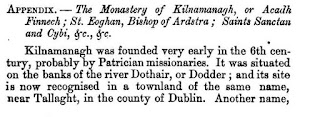
I haven’t been able to discover a great deal about these two saints but they are mentioned in a nineteenth-century paper by Father J.F. Shearman. He produced a most interesting series of articles looking at places associated with Saint Patrick under the title Loca Patriciana and attached an appendix on the Monastery of Kilnamanagh to part ten. He writes:
Lochan, son of Cathal, the grandson of Oilill, K.I., 463-483, son of Dathi, K.I., 405-428, and Enda were connected with Acadh Finnech (December 13th, “Martyrology of Donegal”). Lochan was also connected with a church in the diocese of Leithglin, now Kilmacahil (Cill Mic Cathail), in the county Kilkenny. The Abbot Garbhan, the friend of St. Kevin, was of this monastery.
Rev. J. F. Shearman, Loca Patriciana – Part X, Journal of the Royal Historical and Archaeological Association of Ireland, 4th series, Vol. 4, (1876-8) 88-9.
I think the writer has accidentally transposed the date from the Martyrology of Donegal to read December 13 instead of 31.
However, more recent scholarship has established that Saints Enda and Lochán are associated with the tribal grouping of the Dál Messin Corb, the people of Saint Kevin of Glendalough and thus with Kilnamanagh near Tallaght, County Dublin. Indeed, they comprise two of the ‘three holy seniors’ to whom St Kevin went as a boy “that he might be brought up to Christ in their cell.” Scholar A. P. Smyth comments:
The names of Kevin’s earliest monastic tutors – Éogan, Lochán and Énna – identify their base as being at Cell na Manach (Kilnamanagh, near Tallaght, Co. Dublin) rather than at Kilnamanagh near Glenealy in Co. Wicklow. Significantly, we find from the earliest Rawlinson genealogies, that Kevin’s tutors, like their pupil, were all from the Uí Náir, a sept of the Dál Messin Corb.
Alfred P. Smyth, ‘Kings, Saints and Sagas’ in K.Hannigan and W. Nolan eds., Wicklow: History and Society – Interdisciplinary Essays on the History of an Irish County (Dublin, 1994), p. 49.
Note: This post, first published in 2015 was revised in 2024 to correct the identification of these saints with Kilkenny and to establish them at Kilnamanagh near Tallaght as the earliest tutors of Saint Kevin of Glendalough.
Content Copyright © Omnium Sanctorum Hiberniae 2012-2024. All rights reserved.