Tag: Irish Saints

  • Saint Cruimther Connrach, February 23

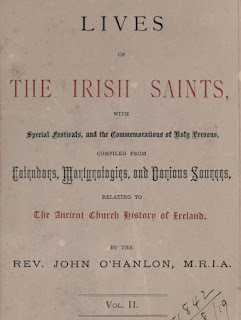
    The Irish calendars at February 23 have a number of saints listed about whom little else is known. One of these is a Saint Cruimther Connrach (Conry or Conrius). His name is listed on both the Martyrology of Tallagh and the Martyrology of Donegal where a later commentator has added in Arda to his name. This would place him in the Ards area of County Down. Canon O’Hanlon in his account of this holy man in Volume II of his Lives of the Irish Saints, records the conclusions of the seventeenth-century hagiologist, Father John Colgan:

    Colgan identifies this saint as a nephew of the great Saint Columcille whose third sister, Sinecha, was mother to Saint Cruimther Connrach. Indeed, she was mother to a number of holy men, one of her sons, Aidan, was a monk, another was Cucuimne, Abbot of Iona, while the other was our saint, Conrius Mocukein. Colgan believed that Saint Cruimther/Conrius was also a disciple of his famous uncle at the Columban monastery of Durrow.

    Content Copyright © Omnium Sanctorum Hiberniae 2012-2015. All rights reserved.

  • Saint Maelbrighde of Armagh, February 22


    The Irish calendars commemorate on February 22 a ninth/tenth-century saint, Maelbrighde (Moel-Brigid), who held the see of Armagh during some rather turbulent times. The calendars and annals list him as not merely a successor to Saint Patrick at Armagh, but also a successor to Saints Columcille and Adamnan. The Martyrology of Donegal reads:22. D. OCTAVO KAL. MARTII. 22.

    Maelbrighde, son of Dornan, successor of Patrick and of Colum Cille ; a man full of the grace of God, and a vessel of the wisdom and knowledge of his time. He was of the race of Conall Gulban, son of Niall. Saerlaith, daughter of Coulebaith, son of Baothghel, was his mother. A.D. 925.

    Canon O’Hanlon takes up the life of Saint Maelbrighde:

    This distinguished saint was son to Tornan, who was descended lineally, and the twelfth in generation, from Conall Gulban. He was thus of the same royal stock as St. Columkille himself. The mother of Moel-Brigid was Soerlathia, daughter to Culebaith, and she was also of noble birth. The name given to him signifies “the servant of Brigid,” or “the tonsured of Brigid,” or ” the consecrated to Brigid,” or “the Brigidian.”

    Our saint soon became greatly distinguished, for his virtues and learning. In consequence of an opinion entertained, respecting his varied merits and accomplishments,he was appointed comorban or successor of St. Adamnan, most probably as Abbot over Raphoe. He was elevated, also, to abbatial dignity —probably at a later period— over the church of St. Columba, at Derry, according to Colgan.

    …After enjoying those dignities, our saint was elevated to the Primatial See of Armagh. On account of his great zeal for religion, and the exercise of eminent wisdom and virtue, he obtained a name and repute for being, ” Head of Religion in Ireland, and of the greater part of Europe.” There is a difference of opinion, among our Irish Annalists and modern writers, regarding the order of succession, in Armagh See, as, also, with regard to the names of its incumbents. Maelcoba Mac Crunnvail, Abbot of Armagh, is said to have died, at an advanced age, A.D. 885, or 887. It is thought our saint, as his immediate successor, then promoted to the coarbship.

    During the time of this Archbishop’s administration, a great riot took place in Armagh Cathedral Church, between the Hy Nialls of Kinel-Eogain or Tyrone, and the people of Ulidia or East Ulster. Flaithbheartach, son to Murehadh, was chief over the former faction, and Atteidh, son to Luighne, chieftains over the latter. This riot, which occurred, about Whitsuntide, in the year 889, was appeased by the Archbishop’s influence and exertions. This prelate induced both parties to abstain from violence, and to make due reparation to Almighty God, whom they offended, and to atone for the violation of St. Patrick’s law. He is said to have been a man remarkable for his inflexible justice. From the Ulidians, Moel-Brigid obtained hostages and an offering of thirty times seven cumhals to the church; while, four Ulidians, the chief instigators of this riot, after being proved guilty were hung. In like manner, the Kinel Eogain rioters repaired those outrages committed by them, and as many more of these were hung. An act of violence is recorded, as having taken place in Armagh, during this Archbishop’s administration. In the year 907, the privileges of the Cathedral of Armagh were violated by Kernach Mac-Dulgen, by dragging a captive out of the church, who had taken sanctuary there, and by drowning him in Loch-Kirr, west of the city. But, this violation was retaliated on Kernach, by Neall Glundub, then King of Ulster, and afterwards of Ireland, who drowned him in the same lough. Several serious disasters and disturbances occurred in Armagh, during the term of our saint’s incumbency. We read, that the Archbishop took a journey towards Munster, A.D.  908, to procure the liberation of a strange Briton, who being a pilgrim in the country, had been unjustly detained there as a captive. Respecting the result of Moel-Brigid’s mission, we are not informed. While he sat in this See, Armagh was three times taken and plundered by the Danes, namely, in 890, 893, and 919; and, it was once set on fire in the year 914. According to the most reliable accounts, Moel-Brigid ruled over Armagh Metropolitan See for a duration of forty years; so yet, the Calendar of Cashel gives him only twenty-nine years of rule. He departed this life, at a good old age, on the 22nd of February.

    The Annals of the Four Masters recorded the death of Saint Maelbrighde thus:

    A.D. 925 : “St. Maelbrighde, son of Tornan, successor of Patrick, Colum Cille, and Adamnan, head of the piety of all Ireland, and of the greater part of Europe, died, at a good old age, on the 22nd of February, in commemoration of whose death it was said :

    On the eighth of the calends of noble March,
    Maelbrighde, most gifted of the brave Gaedhil [died]
    Since the Divine Son of God was born
    Upon the earthly world in carnal shape,
    Five years and twenty, nine hundred,
    To the death of Maelbrighde in evil hour.
    It was not a year without events;
    Premature the death of the Abbot of Ard-Macha,
    Maelbrighde, head of Europe.”


    Content Copyright © Omnium Sanctorum Hiberniae 2012-2015. All rights reserved.

  • Saint Fintan Corach, February 21

    The Irish calendars commemorate a Saint Fintan given the title ‘Corach’ at February 21. Canon O’Hanlon says that this word has a variety of meanings depending on context, it may mean the “volatile,” the “giver of a promise,” or the “melodious.” The entry in the Martyrology of Oengus reads:

    21. The calling of quireful
    Fintan, post contemptum mundi,
    on the fair feast with splendour
    (?) of Verulus (and) Jucundus.

    and the notes add:

    21. Finntan Corach i.e. on his pilgrimage he went into Connaught, and they took pledges from him to come again, alive or dead. And in Lemchoill in Tir lia nDuach and Laigis is Finntan Corach: or in Cluain Aitchen in Laigis, or in Brenainn’s Clonfert he is. i.e. Coir ‘choruses’ are sung at his grave, and not praise. Corach, i.e. a pledge whether alive or dead to come back again. Or the shrine wherein were his relics made turns of it (?). Or ’tis he that made adjustments (cora) in the order of the new rite, ut Sancti etc.
    Vel quod uerius, in Cluain eidnech are the four Finntans. Finntan Corach, Senach the rough, friendly Colman son of Comgall, a trio of them with valorous warfare, one after the other in the abbacy.

    The Leabhar Breac adds:

    “Fifteen years and six score (was) the age of Finntan, a-chanting lasting melodious psalms over the brink of a fountain.”
    The Martyrology of Tallaght, at this date, has the entry:

    “Finntani Coraighi Illeamchoill vel Cluaineidneach,” i.e., the Feast of Fintan Corach of Lowhill, or of Clonenagh.

    The Martyrology of Donegal records:

    21. C. NONO KAL. MARTII. 21.
    FIONTAIN CORACH, Bishop, of Cluain-ferta-Brenainn ; and he is at Cluain-eidhnech, also

    This dual location for Saint Fintan Corach, linking him to both Clonfert, the monastery of Saint Brendan, and Clonenagh, the monastery of Saint Fintan, whose feast we have just celebrated on the 17th of February, has led to some confusion. As O’Hanlon explains, the lack of an extant Life of the saint makes placing when and where he flourished difficult:

    Although ruling over many churches and monasteries, according to our native Martyrologists, this saint has not been distinguished, in any biographies or Acts, whereby some doubts regarding him could more easily be dissipated. Colgan has an unsatisfactory account, at the 21st of February [where] it is said, that he presided over Leamchuill church, within the boundaries of Kilkenny County. Fintan was either buried, or venerated, at this place, as some of our Martyrologists relate. We next find it mentioned, that he presided over Clonenagh Monastery; yet, it is difficult to reconcile this statement with subsequent accounts regarding him. It has been asserted, that our saint flourished, towards the close of the sixth century. However, as this holy man cannot be confounded with Fintan Maeldubh, who, being successor to the great St. Fintan, died in the year 625, nor with that other St. Fintan Munnu, who again succeeded, and who died in 634. Dr. Lanigan suggests, that a chronological difficulty might be avoided, by supposing our saint to have been a simple monk, living at Clonenagh.

    Some authorities state, that he either founded or governed a church at Cluain-aithchen, or Clonkeen, in Leix. A very probable conjecture has been hazarded, that this latter place may have been mistaken for Clonenagh ; and, if such be the case, a difficulty which arises by placing him at Clonenagh, might disappear. Colgan gives us to understand, that having abandoned Ciuain-aithchin, according to a promise made, he returned to Clonenagh Monastery, or, at least, that he was buried, at this latter place. It is said, that our saint discharged the double office of Abbot and Bishop, over the monastery and see of Clonfert. Our Fintan became bishop, it has been supposed, after the death of Moenninnius. Nevertheless, Dr. Lanigan does not assert, that our saint was his immediate successor. According to the same authority, he followed St. Brendan, as Abbot ; and, our saint was afterwards succeeded at Clonfert, by the Abbots, Colman, the son of Comgall, and by Senach Garbh.

    It is said, that St. Fintan acquired the surname, Corach, either on account of his continual charge of place and residence ; or, because of a promise, given to his brethren, that he should return to Clonenagh or, perhaps, because of his melodious voice, by which he was distinguished for exactitude and devotion, whereby he performed sacred chaunts in celebrating Divine praises. It is said, our saint also introduced, among his monks, a new style for singing psalms and sacred canticles…

    The exact date of his death is not known ; but, it is a conjecture of Colgan, that he flourished, about the end of the sixth century. Our Martyrologists place his festival, at the 21st of February; thus, St. Oengus the Culdee in his “Feilire,” the Martyrology of Tallagh, the Martyrology of Donegal, Duald Mac Firbis, enter Fintann Corach. In the ancient Martyrology of the Cathedral Church of the Holy Trinity, Dublin, the festival of St. Fintan, Confessor, occurs, at the ix. of the Kalends of March— 21st of February—although it is not in the prefixed Calendar. Even, in Scotland, he was reverenced. Thus, at the ix. of the March Kalends— which is the 21st of February—the Kalendar of Drummond relates, that the Natalis of St. Fintan was celebrated on this day, in Ireland. A considerable share of doubt appears to have existed among writers, respecting the place of his death and sepulture. Leamchuill, now Loughill, or Lowhill, Cluain-aithchin, Clonenagh and Clonfert or Clonfert Brendain are severally named by our Martyrologists, in connection with the anouncement of his festival, or of his departure, or of the place where his remains had been deposited. It may be supposed that our saint died towards the close of the sixth, or during some earlier part of the seventh, century: his immediate successor, in the Monastery of Clonfert, having departed this life in the year 620.

    Content Copyright © Omnium Sanctorum Hiberniae 2012-2015. All rights reserved.