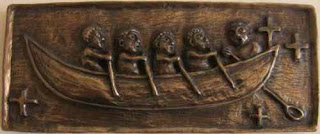
Saint Enna, a possible companion of Saint Brendan the Navigator and his successor at Clonfert is commemorated on February 26 on the Irish calendars. There is some discrepancy, however, between the Irish Annals recording the death of this saint at 1st March and his feast being celebrated on the 26th February according to the calendars. Canon O’Hanlon explains:
Various denominational forms have been applied to this saint, and it has been conjectured, that he was originally called Ena, Enna, or Ennius. Thence it was probably resolved into Mo-Ena, Mo-Enna, or Mo-Ennius. He has also been called Moenus and Mainus. Among the old Irish oe and ai had a like sound, and Mo is merely a prefix, which indicates some special affection. This saint is also called Moinne, Moune, Muinni, or Moen. He is said to have been a Briton, who accompanied St. Brendan of Clonfert, on his return to Ireland, after that celebrated seven years navigation of the ocean, during which he visited the great Western Island, or Continent, and after he had lived some time in Armoric Britain. In the Island of Inis-mac-Hy Chuinn, both master and disciple are said to have dwelt. Whether or not, Moena had been elevated to the episcopal dignity, before leaving the country of his birth, may be questioned ; but, when seventy-seven years old, St. Brendan is said to have founded Clonfert. St. Moen lived with him, and during his sojourn there, a certain youth, who had come with his parents, died. Three days after this occurrence, and when the body was quite rigid, St. Brendan said to Bishop Moena, “Place my staff on the body of the dead brother.” Obeying this command, the youth came to life, and thus miraculously preserved, that brother, confirmed in the faith, was sent home to his native country in Britain. Colgan makes St. Brendan the founder and first Bishop of Clonfert, about the year 553, and he says, that St. ‘Brendan abdicated, having placed St. Moena in his room’. Other writers make St. Moena the first bishop, over this see. A great pestilence, called in the Irish language, Samthrusc, Samthrose, or Sawthrusc, prevailed, in the year 551 or 553, according to various Irish Annals, and it is generally resolved into a Lepra or Leprosy. It might have been that disease, which carried off the youth already mentioned.
It is very probable, that our St. Enna or Moen was Bishop of Clonfert. Yet, a difficulty occurs, from his festival having been marked, not at the 1st of March, but at the 26th of February. In the “Annals of the Four Masters,” in the third year of Aedh, Monarch of Ireland, we find the death of St. Maeineann, Bishop of Cluain-fearta-Breanainn, recorded at A.D. 570, and it is said to have occurred, on the 1st of March. We find, in the Ulster Annals, under A.D. 571, the death of the first bishop of Clonfert thus remarked, ‘ Moena, Bishop Clonfert-Brenain, went to rest.” St. Brendan, it is stated, was then alive,and this agrees with most of our Annalistic accounts. The Annals of Tighernach state, at A.D. 572, that Maenu, Bishop of Cluanfert Brendan rested. The day of Moena’s death is placed, on the 1st of March. Under the form of Monan, Bishop Forbes assigns him a festival, at the latter date, or at the 26th of February; while, at the same time, a doubt of his identity is properly expressed. In the Martyrology of Tallagh, we find St. Moenna venerated, on the 26th of February. A Manuscript Antiphonarium, classed B. i, 4., belonging to Trinity College, Dublin, at this day, Kal. iiii. Martii, notes him as a Bishop and Confessor, in the Calendar, with an Office of Nine Lessons. In the Martyrology of Donegal, Maonna occurs, at the same date. In that Calendar, prefixed to the Martyrology of Christ Church, Dublin, this holy man is commemorated as a bishop. His feast was celebrated with an Office, consisting of Nine Lessons, as we are there likewise informed.
Attempts have been made, to shew that the cultus of this saint had extended to different parts of Ireland. A St. Moenna is venerated in Jesu-Mond, diocese of Ossory, on the 26th of February. This concurrence would seem to make the present saint its patron.
Content Copyright © Omnium Sanctorum Hiberniae 2012-2015. All rights reserved.


