Category: Saints of Tipperary

  • Saint Elair of Monahincha, September 7


    September 7 is the commemoration of an island-dwelling saint of County Tipperary, Elair of Monahincha. This site was one of those visited in person by Canon O’Hanlon who explored Monahincha in May 1870 as part of his research for the Lives of the Irish Saints. Saint Elair’s island retreat has links with two other saints of the Irish church, Cronan of Roscrea and Canice of Kilkenny, as Canon O’Hanlon explains:

    St Elarius or Helair, Patron, Anchoret and Scribe of Monahincha, near Roscrea, County of Tipperary. (Eighth and Ninth Centuries.)

    The published Martyrology of Tallaght records a festival in honour of Elair of Locha Cre, at the 7th of September.

    This, however, does not accord with the ii. of Nones for this month— although thus set down—and as found in the Book of Leinster copy. The situation of Lough Crea is said first to have attracted the notice of the celebrated St. Cronan before he commenced the erection of his chief religious establishment at Roscrea. In the midst of this “Stagnum Cree” there was an “insula modica,” or moderately-sized Island—now known as Monahincha— and here St. Cronan,it is said, first built a cell. Monahincha lies towards the left, on the high road leading from Borris-in-Ossory to Roscrea; but, the old church is hidden from view, owing to ornamental plantations which surround it in various directions. The greater religious establishment, however, seems to have been fixed at Roscrea —even in the time of St. Cronan— when it is probable Monahincha became a dependent on it, about the beginning of the seventh century. Already have we referred to some remains of antiquity in this town, formerly a place of considerable historic importance, especially in our ecclesiastical annals. After St. Cronan, the earliest saint recorded as having connexion with Inis Loch-Cre, is Coluim or Colum—resolvable into Columba. His period, however, has not been determined; but, it is probable, he preceded the present holy superior in point of time.

    St. Elarius or Helair is called the son of Fintan, sprung from the race of Kein, and his brothers are said to have been Saints Aidan and Conrach. His mother is called Sinacha, third sister to the great St. Columbkille. This latter statement of Colgan must be rejected, if we take into account the date assigned for the death of Elarius. While Sinacha must have been born in the earlier part of the sixth century, the birth of this present Elarius took place, it is probable, at least two hundred years later. The feast of St. Hilair is found in the Martyrology of Marianus O’Gorman, at the 7th of September. In one place, Colgan notes a St. Hilarius Mocukein, a monk of Durrow, to whom he assigns a feast at the 7th of September. We cannot be assured, however, that he was identical with the present Elarius or Helair. On the contrary, he and his brothers, St. Aidan and St. Conry or Conrachus —stated to have been of Kevin’s race —must have lived in the sixth century, if their mother was Sinecha, the sister of St. Columkille. The present saint was undoubtedly of a different family, and he was principally venerated at the place, now known as Monahincha, which the neighbouring people still call The Holy Island. It lies in the parish of Corbally, barony of Ikerrin, and County of Tipperary.

    The lough is now for the most part dried up, but a bog occupies its former site. The old ruins of Monahincha are remarkably beautiful in their architectural peculiarities. Moory soil still extends around, notwithstanding that the waters of the lake have been completely drawn off; while the land is thoroughly drained and reclaimed into fine pasturage, and meadow. Rich grass grows over the soil. Its remarkable old church is covered with a luxuriant growth of ivy, around the whole exterior; but this has been removed from the interior, where all the wall surfaces may be seen. There are two most beautiful doors yet remaining, and almost entire; one of these enters the nave, and the other a small choir. They are semi-circularly headed and elegantly jointed along the jamb-stones, with zig-zag carving around the arches. The fluted columns are surmounted by curious old sculptured heads. Through the ivy on the exterior corners of the nave may be traced projecting columns of rounded and chiselled stones. The ruins stand in a tolerably well preserved state, in the centre of a grave-yard, overcrowded with human remains. The interior of the old church nave is occupied by a family tomb, and around it the floor has been levelled and gravelled; while the landed proprietor of the estate, on which the ruins are situated, seems to have taken special pains to preserve the existing remains. Beside the old Church of Monahincha are some ruins of an ancient monastery.

    Not far from the ruins, some portion of the former extensive lake may be seen; but the inhabitants of the surrounding country have a tradition, that all the vast tract of bog, now extending for several miles towards a range of distant hills, was formerly covered with water, which circled the Holy Island.

    The Church of Inis Lough Cre was dedicated to the St. Helair or Hilarius, whose festival is celebrated on this day, as we are informed. The terms by which he is distinguished in our records indicate, that while he led a life of strict observance and asceticism, he was also the writer of some works, which at present seem to be unknown. Perhaps, he belonged to that band of Coelicoli or Culdees, that lived on the smaller island —as distinguished from the greater —and of which no clear traces now remain; yet, it is recorded, that the passage from one island to the other, in the twelfth century, was made by means of a boat. Helair flourished after the middle of the eighth, and beginning of the ninth century. The death of this Elarius, Anchoret and Scribe, of Lough Crea, is entered in the Annals of the Four Masters, at 802; in those of Clonmacnoise, at 804; in those of Ulster, at 806; but, as we are told by Dr. O’ Donovan, recte, it should be 807. His age at the time of his departure is not known. His name and festival are entered on this day, in the Martyrology of Donegal. In the table appended to this latter work, the name of our saint has been Latinised, Helarius.

    Although Inis-Loch-Cre does not figure very prominently in our Irish Annals, the “Holy Island” appears to have obtained celebrity as a place of pilgrimage and to have had a resident superior in the twelfth century. After the death of St. Cronan, the religious institute he established at Roscrea appears to have flourished in piety and learning, for centuries succeeding his period. A copy of the Four Gospels, called Glass-Kennic, or the Chain of St. Canice, is said to have been there preserved to the time of Archbishop Ussher. Also at Roscrea was recovered the Book of Dimma, a scribe, the son of Aengus, the son of Carthin. Another work, known as the Annals of Roscrea, was probably composed in the monastery there established. A succession of Roscrea Abbots, sometimes styled Bishops, in our Annals, is recorded from A.D. 800 to 1174, when the parent institution seems to have gradually declined, and little account is had regarding it, when its ancient bishopric merged into that of Killaloe…

    Content Copyright © Omnium Sanctorum Hiberniae 2012-2015. All rights reserved.

  • Saint Nazair of Liethmore, July 12

    July 12 is the commemoration of a Saint Nazair of Liethmore. Although Canon O’Hanlon makes no mention of it, I find the name of this saint a rather curious one for an Irishman, but he is recorded in virtually all of the surviving calendars:

    St. Nazarus, Nazair, or Nasan, Bishop of Liethmore, County of Tipperary.

    The festival of Nazarius is found in the “Feilire” of St. Aengus, at the 12th of July: “Unto the angels departed Nazarius the story of every synod”. A commentary on it states, likewise, that he was bishop of Liath in Eblind, or bishop of Liath Mór Mochoemoic. In the published edition of the Martyrology, we find this entry: “Nazair o Liath,” occurring at the iv. of the Ides, or 12th of July. The editor of this Martyrology has also correctly identified Leith-mór with Leamakevoge, near Thurles, county of Tipperary. Both names are also referable to the Liath mentioned in the Martyrology of Tallagh. Besides, Marianus O’Gorman has also given us the name of this saint, called also Nasan, with an eulogy, at this same date. According to the Martyrologies of Cashel and of Maguire, the Natal day of St. Nazarus, Bishop, was celebrated at Liethmore, on the 12th of July. There appears to have been a diversity of opinion, on the part of most Irish writers, regarding the exact location of Leithmore. By some writers, it has been placed exactly four miles distant from the monastery of Bishop Colman at Doire mor; and both of those places are thought to have been in the present King’s County. Colgan placed Liathmor in the vicinity of Kinnetty, the very ancient Life of Pulcherius stating, that it was only four miles distant from St. Colman’s church of Doire-mor, thought to have been identical with Kilcolman, near Birr, and which, it is curious to observe, lies exactly four miles north-east from that place called Leagh on the engraved Map of the Down Survey. However, in the Life of St. Mochcemhog or Mochcemoc, also called St. Pulcherius, it is said, St. Colman’s monastery of Doire mor was situated on the confines of Munster and of Leinster, but within the boundary of the former province, and in the territory of Ely. This was supposed to have been Ely O’Carroll; but, there was a southern Ely, lying near Thurles, and while this was within Munster, it was also on the borders of ancient Leinster. However, the precise locality of Liathmore is now found to be identical with the townknd of Leigh, within the parish of Two Mile Borris, situated south-east in Elyogarty barony, and in the county of Tipperary. The ancient name is said to have been Buirgheis Leith, and it was denominated, Borris Leigh, from the celebrated old church of Liath

    Mochoemog, situated in that parish. It is probable, we must place the present holy man subsequent to the time of St. Mochoemhog or Mochcemoc, who was first Abbot and founder of Liath-more. In the Martyrology of Donegal, at the 12th of July, is entered the feast of St. Nazair, Bishop of Liathmor, in Ebhlinn. The Bollandists, who derived their information from Father O’Sheerin, also record Nazarius de Lieth, at this date.


    Content Copyright © Omnium Sanctorum Hiberniae 2012-2015. All rights reserved.
  • Saint Becan of Cluain-Aird-Mobecog, May 26

    May 26 is the commemoration of Saint Becan, a County Tipperary saint known not only from the record of his own Life, but also that of Saint Abban. In his account of the saint in Volume 5 of his Lives of the Irish Saints , Canon O’Hanlon attempts to identify the locality in which this holy monastic flourished and demonstrates the role which placename evidence plays in this process. As you will see in his account below he comes up with three distinct strands of tradition relating to Saint Becan, one connected with the Life of Saint Abban, another connected with Saint Colum Cille and a third relating to King Diarmaid. I wondered therefore if there may be more than one Saint Becan whose lives have been conflated here and a check with the new reference work A Dictionary of Irish Saints by Pádraig Ó Riain confirmed this suspicion. Becan of Toureen, County Tipperary shares his May 26 feast with the County Wicklow Becan, to whom the Columban association belongs. The Becan who restored the King’s son to life is Becan of Emlagh, County Meath, whose feast is on April 5. So, today’s saint is Becan of Toureen, County Tipperary, formerly Cluain-Aird-Mobecog who is a different individual both from Becan of Churchtown, formerly Stagonnell, County Wicklow and from Becan, son of Cúla, who performed the miracle associated with King Diarmaid. In Canon O’Hanlon’s account below, however, we will meet all three:

    ST BECAN OF CLUAIN-AIRD-MOBECOG, IN MUSCRAIGE BREOGHAIN, COUNTY OF TIPPERARY, OR OF TIGH-CHONAILL, NOW STAGONNELL, IN UI-BRIUN CUALANN, COUNTY OF WICKLOW.
    [SIXTH CENTURY.]

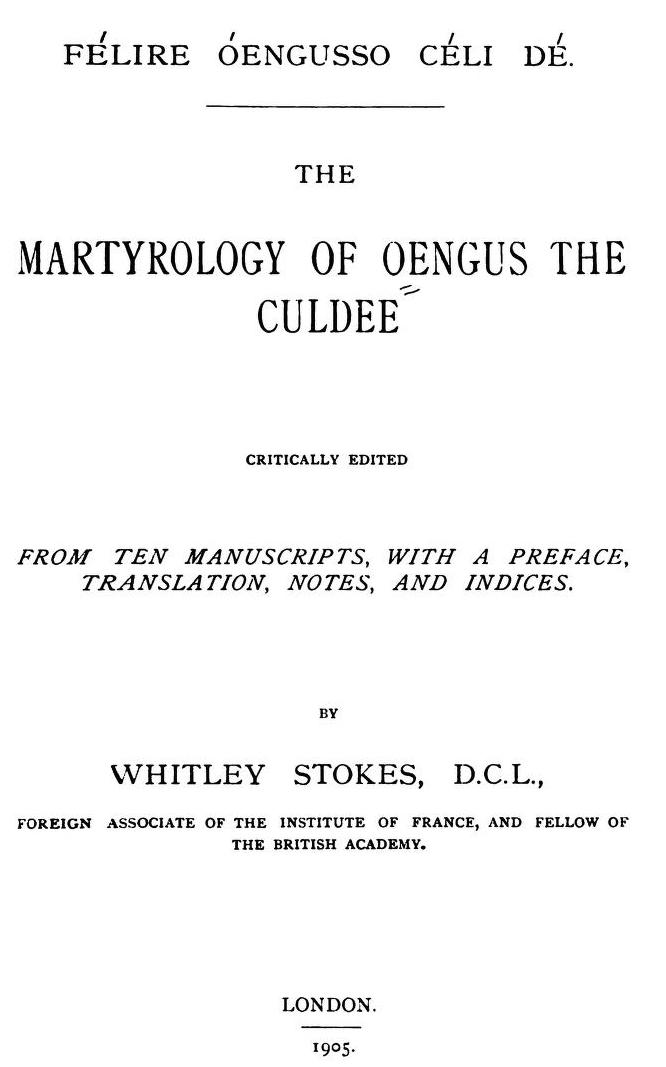
    IT is to be deplored, that so many literary memorials of the past have perished, and thus deprived us of information, it should now be so desirable to collect. Among these, seems to have been included the Life of this present holy man; for, we find it on record, that it had once existed. He flourished at an early period, since he is mentioned with eulogy, in the Metrical Calendar of St. Oengus the Culdee. The Acts of St. Becan were promised by Colgan for the 26th of May; but, he did not live to carry out such a purpose. The Bollandists notice Becanus of Cluain-aird, at this same date; however, they only give references to the Manuscript Martyrology of Tallagh, and to Colgan’s allusions, in the Acts of St. Abban. In the “Felire” of Oengus, and in O’Clery’s Irish Calendar, it is stated, that Beccan of Cluain-ard was otherwise called Mobecoc. Another form of his name was Dabhecog. We read of a Becan, son to Eoghan, son to Murchadh, of the race of Fiacha Muillethan, son to Eoghan Mor, son of Oilioll Olum. This genealogy agrees with Rev. Dr. Jeoffrey Keating’s account of St. Beacan’s stock; although we find, elsewhere, a different pedigree. The scholiast on St. Oengus tells us, that the present St. Becan was the son of Lugaid, son to Tuathan, son of Aed, son to Fergus, son of Eoghan, son of Niall of the Nine Hostages. Yet, a somewhat different genealogy is made out for him, at the 26th March, where he is called the brother of St. Corbmac. St. Becan, as we read, was the son of Eugene, son of Marchad, son of Muredach, son of Diermit, son of Eugene, son of Alild Flanbeg, son of Fiach Muillethain, son to Eugene the Great, who was son to Alild Olum.

    Notwithstanding, what has been thus related of his pedigree, the “Sanctilogium Genealogicum” states, that this saint was a son, not of Eugene, but of Marchad; and, it then gives his genealogy, in the order related, as deduced from a Life of St. Corbmac, one of St. Becan’s brothers. Our saint had four brothers, who were sons of the same father, and they are thus named—St. Culan, St. Enuines, or Euinus, St. Diermit, and St. Boedan, or Baitan. Two of these saints sought a happy retirement from worldly concerns, in the province of Connaught; one of them dwelt in Leinster; and the other in Ulster; while our saint, with his brother Culan, remained in their native province of Munster, where these became devoted to the practices of a religious life. This saint was brother of Cuimin a hermit, according to the title of an Epistle. He was a recluse in Hy, as we learn in the Table, postfixed to the Martyrology of Donegal. In the Life of St. Abban, it is stated, that on one occasion, he visited the northern part of that country, where the mountain called Crott was situated. It is now known too as Mount Grud, in the territory of Muscraighe, at present Anglicized Muskerry. A legendary story is told about Diarmaid, King of Ireland, who is said to have killed his son Breasal, in a fit of passion. The king afterwards lapsed into a settled melancholy; and, at last, he sought consolation from St. Columkille, who advised him to visit St. Beacan, then living in a poor cell, on the north side of Mount Grott. Kill-Beacain is also a name for the church of our saint, who is reverenced at this place. When King Diarmaid and St. Columkille arrived there, St. Beacan was engaged digging a ditch to surround the graveyard, and working in his wet clothes, for it was a rainy day. Perceiving that the King of Ireland approached, our saint cried out: “O murderer, down to the ground upon your knees.” Instantly, the king dismounted from his horse, and prostrated himself before the saint. Then St. Columkille informed Becan about the object of their visit, and that the king was almost distracted with grief, reflecting on the barbarous deed he had perpetrated. No solace was left him but prayers to heaven, that God would be pleased to pardon the offence and restore his son to life. Then, St. Columkille presumed, that so religious a person would not refuse to intercede for the king, since his life and happiness were immediately concerned. Moved with compassion, St. Becan prayed with great fervour to heaven three different times. As the legend relates, Breasal was restored to life, and presented to his father, who received him with inexpressible joy. Afterwards, the king held our saint in great esteem and veneration, on account of this miracle he had wrought.

    In the parish of Killardry, or Killaldriffe, Cluain-ard, meaning “the high lawn” or “meadow,” was the ancient name of that place, on which Kilpeacan’s old church now stands… About ten yards west of the church, are the pedestal and lower part of what appears to have been a stone cross. A few perches south-east of the church is Tobar Peacaion, or Peacawn’s well, having a circular ring of stone work surrounding it. Several scattered fragments of flags, evidently tombstones, are in the north-west corner of this church. A few yards from the south-east corner and towards the east, a few stones, fixed in the ground and having the western edge cut or hammered, are called by the people ” the Altar. It has an associated legend. Before the year 1830, pilgrims used to visit Peacawn’s church from places several miles distant. The patron day here was kept, on the 1st of August, as a strict holy day by the people, and devotions were performed, also, on Good Friday. From an entry, in one of our Irish Calendars, it would seem, that some doubt attaches to the exact habitation of our present saint. The ancient territory of Muscraighe Breoghain is comprised, however, in the present barony of Clanwilliam, in the south-west of Tipperary County. We learn, that St. Abban had consecrated the church, called Cill-Bhecain, in Muscraighe-Chuirc, on the north side of Siiabh gCrot, during the reign of Diarmada Mac Fearghusa Ceirbheoil. There, it is said, a great and most regular monastery was established, by St. Abban; and, it went by the name of Cluain-aird-Mobhegoc or Mobecoc, having been called after the present St. Becan, who was venerated, at that place, on the 26th of May. There St. Abban, also, as we are told, founded the monastery of Cluain Findglaise. However—according to another and probably a more reliable authority— Cluain-aird-Mobecoc was built by St. Becanus, and over it he ruled; while, it was called the monastery of Killbecain, after him. Even, the compiler of St. Abban’s Life seems to have had some idea of this statement; since it is allowed, that St. Becan resided there until death. The Life of St. Abban states, that Abban himself blessed a church at Cluain-aird Mobecoc, and that he left Becan in it, and that he left the office of the holy Church, in every church which he blessed.

    However this may be explained, at Cluain-aird-Mobecoc St. Becan was known as a most holy and religious recluse. We are told, that he lived contemporaneously with St. Columkille and with King Diarmit, son of Cervail. Consequently, we may infer, that he flourished in the sixth century. His whole lifetime was spent in a most penitential manner. He frequently fasted for three whole days. His nights were spent in watching, and his days in constant prayer. With tears, and on bended knees, St. Beccan bewailed his supposed manifold imperfections. He erected a stone cross, in the open air, and outside of his monastery. Whether cold or warm, stormy or serene, each day he sang the entire Psalter, beside that cross; on which account, it was afterwards held in great popular veneration. This place was also called, Ceall na nder, or “the cell of tears,” by many; on account of penitential tears shed by persons, seeking God’s mercies, through the intercession of St. Becan. It would appear, also, from O’Clery’s Irish Calendar, that this place had been situated, within the ancient territory of Muscraighe Breogain, which now forms part of Muskerry Barony, in Cork County. Among the landed denominations of the O’Donovan property, at Montpelier, which were furnished to the Irish Ordnance Survey Department, and all of which are in the East Division of West Carberry barony, and county of Cork, we see the names of Loughrott, Upper Loughrott, alias Crott, in the parish of Dromdalyege. The writer is unable to state, if these etymons formed any part of the Mountain Crott alluded to; nor, on the modern maps does it seem easy to identify that place, formerly called Cluain-aird-Mobhegoc, or Kilbeacan.

    The author of St. Abban’s Life appears to have visited the monastery of Becan; for, this writer says, he could confidently assert, he never heard of a more religious community than that of our saint, nor did he ever see a mere beautiful and regular monastery. In the Life of Abban published by Colgan, there is a glowing eulogy pronounced on this saint Becan, or Mobecoc. Twice do we find the entry of the death of Beccan of Cluain-Iraird or Ard, in the Annals of the Four Masters. The first entry, at A.D. 687, is evidently a mistake. The second entry, at 689, “Dabhecog, of Cluain-ard, died,” agrees with that, in the Annals of Ulster. In the “Feilire” of St. Oengus, at the 26th of May, it is remarked of St. Beccan, that he loved vigils, and Cluain Ard was his house. However, the scholiast in the “Leabhar Breac ” copy of this Metrical Martyrology states, that he was of Cluain Mobecoc in Muscraige Breogain in Munster, or at Tech hui Conaill in Hui-Briuin Chualann.

    At this date, the published Martyrology of Tallagh simply enters the name, Becan of Cluana aird; but, his name has been associated with another place, and in quite a different province. In the Martyrology of Donegal, we read, that on the 26th of May was venerated, Becan of Cluain-aird Mobecog, in Muscraighe Breoghain, or of Tigh Chonaill, in Ui Brinin Cualann. This territory was called, likewise, Feara Cualann, or Fercuolen, in the reigns of Queen Elizabeth and of King James I. Then, it was considered to be coextensive with the manor of Powerscourt, near Bray, in the county of Wicklow; but, anciently, it was more extensive. Its old church is sometimes called Temple Becan, after the present saint. It was also denominated Teghgumnill, or Tigh-Chonaill, and it is now known as Stagonnell, or Stagonil…

    In the Irish Martyrology of the Irish Ordnance Survey Office, now preserved in the Royal Irish Academy’s Library, there is a notice of this saint, at the 26th of May. At this date, likewise, the Kalendar of Drummond records the veneration entertained for our St. Beccan, even in Scotland. Each day of this saint’s life was marked by some miracle, which is found recorded in a very ancient Life, written, it has been supposed, by a contemporary. Most probably, this Life had been composed, at least some little time after his death. It may have abounded in legendary matter, like that found in the acts of many other native saints; but, as a learned French author observes, the traditions of Irish legends comprise within themselves an interest and a charm, which cannot entirely disappear, even when recorded by the least accomplished writer.

    Content Copyright © Omnium Sanctorum Hiberniae 2012-2015. All rights reserved.