Category: Saints of Tipperary

  • Saint Eoghan, March 15

    March 15 is the feast day of a Saint Eoghan, about whom no other information seems to be known. As the Bollandists note, this is a common name although the scholiast on the seventeenth-century Martyrology of Donegal tried to suggest that he may be Eoghan, the son of Saran, to whom the monastic rule of Saint Ailbhe was addressed, as Canon O’Hanlon reports below:

    St. Eugenius or Eoghan.

    The Martyrology of Tallagh enters a festival for S. Eugenius, simply, at the 15th of March. The Bollandists have merely the name, with an observation, that it is one often met with in the Irish Calendars. The Martyrology of Donegal this day records, Eoghan. “I think,” remarks the writer, “this is Eoghan, son of Saran, of Cluain Caolain, for whom Ailbhe, of Imleach lobhair, composed the very hard rule, which begins, ‘Say for me to the son of Saran,’ &c. For every other person of the same name, that is in the Martyrology, has some title, or church, which he possessed, except the Eoghan, who comes at this day.” In a subsequent page of the Martyrology of Donegal, Dr. Todd places Cluain  Coelain, in the county of Tipperary.
    Content Copyright © Omnium Sanctorum Hiberniae 2012-2015. All rights reserved.
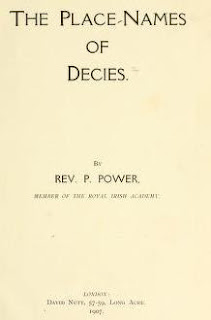
  • Saint Cúlán of Killcuilawn, February 18


    February 18 may be one of the feast days of a County Tipperary saint, Cúlán of Killcuilawn. Saint Cúlán is associated with a relic, the Barnane Cuilawn, about which I will make a separate post at a later date. It does not seem to be entirely clear how this Saint Cúlán is related to another of the same name commemorated on 12 March. Indeed overall, Canon O’Hanlon is unable to fully dispel the confusion surrounding this saint’s identity and feast day. Professor Ó Riain’s Dictionary of Irish Saints lists the saint at February 18 and gives literary sources for his cult. He confirms that Saint Cúlán’s feast is not recorded in any of our native calendars, but is found in a copy of the Martyrology of Usuard made in Cologne just before the year 1500:
    St. Dacualenus or Culanus, Bishop of Killcuilawn, County of Tipperary.
    [Possibly in the Seventh Century.]
    At this date, Colgan has a few notices, regarding St. Culanus or Dacualenus, a bishop. He thinks, however, that the name of this holy man should be written Cuculanus. In the anonymous list of Irish saints, published by O’Sullevan Beare, as also in the Catalogue of Henry Fitzsimon, at this day, we have a St. Cuculanus. On the authority of Florarius, the latter writer styles him bishop.The Bollandists have short Acts of this Saint Culan, in their great compilation. Yet, what Godefrid Henschenn adds there, to Colgan’s remarks, are not worthy of much consideration. Many foreign writers, amongst others Ferrarius,and Canisius, make mention of St. Culanus, as having been venerated in Ireland, on this day. By Florarius, he is called Cuculanus. But, Colgan tells us, he was unable to discover a saint, bearing either name, and whose festival had been kept on the 18th of February, according to our domestic Hagiographers. Yet, Usuard auctus, or the Carthusian Martyrology, and Hermann Greuan, have accounts of St. Culan, Bishop and Confessor, as having been venerated in Ireland, on this day. In one instance, Colgan has classed St. Culenus or Culan, Bishop, among the disciples of St. Patrick, following Tirechan’s list. We know, that in the Irish Calendars, there are many saints, having the name Colan or Coelon. However, Culanus, Cuilen, or Cualen, was the same as Culen or Dachualen, whose commemoration occurs, at the 12th of March, in the Martyrologies of Marianus O’Gorman and of Cathald Maguire. If he be the same person, his descent is traced, in the Genealogy of the Saints of Ireland, by Cormac, Bishop of Cashel, from the Hy-Niall family. The father of this saint was Guaire, son to Columba, son to Crimthann, son of Eochad Binnigh, son to Eugene, son to Niall of the Nine Hostages. Notwithstanding his assertion, Colgan omits any mention of a saint, bearing this name, at the 12th of March. According to the foregoing pedigree, this holy man should naturally belong to about the beginning of the seventh century. In the parish of Borrisoleigh, also called Illeagh, in the county of Tipperary, there was formerly a church dedicated to a St. Coulane—identical with the present saint—and here was long preserved a singularly ancient and curiously wrought bronze shrine or bell, called the “Barnane Cuilawn,” which was formerly in the possession of the Dwyer family, living at Ballinaruan, near Borrisoleigh, and afterwards it became the property of the late Thomas L. Cooke of Birr, who got it from the Dwyers. It passed from Mr. Cooke to a public institution, and it is said, that the “Barnaan Cuilawn” was found many years since, in the hollow of a tree, at a place named Killcuilawn, situate in the mountains, and about two miles distant from Borrisoleigh, in the parish of Glankeen and county of Tipperary. This curious relic, of a remote age, is likewise called in the Irish language “Obair na naoim;”—that is “the Saint’s work.” …
    .
    ..It is likely, St. Culan had his habitation, not far removed from Borrisoleigh, and Killcuilawn derived its name from a church he had there founded. His period is not well known, for, the accuracy of that information, furnished to the compilers of a modern topographical work,hardly falls within the range of probability. It is more likely he belonged to the seventh century. At Glankeen, it is said, an abbey had been founded, so early as the time of St. Patrick. In a Life of St. Cormach, it is stated, that he was descended from Oilum Olum. It relates, that he had five brothers, by the same father, and that Culanus was one of these. Again, it is asserted, that this St. Culan built a church in a valley of the region, known as Hi Luigdlicach, where he remained among his kindred and acquaintances. His pedigree is thus traced; he was the son of Eugene, son to Murchad, son of Muredac, son to Diermit, son of Eugene, son to Alild Flanbeg, son of Fianch Muillethain, son to Eugene the Great, son of Ailild Olum. His church was called Glean-chaoin, “the beautiful glen,” and it lies at the foot of Knockanura mountain, and at the bounds of Killaloe See. In reality, two buildings raised at different periods present themselves in the ruins of Glean-choin or Gleankeen Church. There was an old building formerly at Killcuilawn; but, towards the close of the last century, its stones were removed for the purpose of building a house. The Church of Culan was benefited by the piety and generosity of his relatives, and these considered themselves as more than recompensed by the saint’s prayers for their welfare. What particular reason there was for supposing, that Irish Apostolic men brought the relics of St. Culan to Germany, or even a veneration for him, Godefrid Henschenn has not explained. From what we have already seen, his relics appear always to have remained in Ireland; and probably, he belonged to that part of it, where the “Barnane Cuilawn” had been so long preserved.
    Content Copyright © Omnium Sanctorum Hiberniae 2012-2015. All rights reserved.
  • Saint Sínech of Crohane, October 5

    The Martyrology of Oengus commemorates a holy woman of County Tipperary, Sínech daughter of Fergnae, on October 5:

    E. iii. nonas Octobris.
    Blog dond liic lógmair
    la slóg martir namrae,
    Sínech ingen Fergnae
    Crúachan Maige Abnae.
    5. A fragment of the precious stone,
    with a host of marvellous martyrs,
    Sínech Fergnae’s daughter,
    of Cruachu Maige Abnae.
    Scholiast Notes

    5. A fragment of the precious stone, i.e. Sínech daughter of Fergnae, or good (ergna) is she herself, in Cruachan Maige Abna in Eoganacht of Cashel. Sínech, i.e. Fergna is her father’s name. Or she is ergna, i.e. good, from Cruachan Maige Abna, etc.

    Saint Sínech is also remembered in the later Martyrology of Donegal:
    5. E. TERTIO NONAS OCTOBRIS. 5.
    SINEACH, daughter of Fergna, of Cruachan Magh-Abhna, in Caenraighe. She was of the race of Eoghan Mor, son of Oilioll Olum, according to the Naomh-Senchas.
    According to this website Saint Sinech is the patroness of Crohane, County Tipperary and the writer helpfully provides information from Canon O’Hanlon:
    St Sinech is given as the Patroness of Crohane. The Mart. of Donegal commemorates her on Oct. 5th. says she was the daughter of Fergna of Cruachan Magh Abhna and of the race of Eoghan More, son of O. Olum according to the genealogical history of the Irish saints. The book is wrong in placing Magh Abhna in Co. Limerick.
    O’Hanlon says “she is mentioned also on Oct 5th by the Feilire of St Aengus, and as the daughter of Fergna of Cruachan Muige Abnae in Onacht Cashel”. Maurice Lenihan says “the virgin is likely the sister of St Senachus, Bishop, who was with St Ruadhan and St Columba of Terryglass among the pupils and disciples of St Finian of Clonard”. Crohane must be identified with the Cruachan of St Sinech he says, and the denomination of Magh Abhna has been reformed into Mowney a neighbouring parish in the barony of Slieveardagh. Her acts are not known to exist. Up to 1810 says O’Hanlon, her festival was remembered in Ballingarry on Oct 5th.
    Crohane-Cruachan Muighe Abhnae. Church ruins are in Drangan parish. In the Feilire Aenguis, Crohane is given as the round hill of Moy-Owney. This parish is bounded on the west by the parish of Killenaule, on the east by the parish of Mowney, on the north and north east by the parishes of Lickfinn and Ballingarry. The parish is in Slieveardagh Barony, and an amount of its land would be at present in Ballingany parish, though the old church ruin is in Drangan. This is the place called Cruachan Muighe Abhnae i.e. Croghane Mowney in the Festiology of Aengus, at Oct 5th for the glossographer places it in the territory of Eoghanacth Chaisil. This is rendered absolutely certain by the existence of the well of the Patron Saint and of other names of places in its vicinity, which the ancient authorities place in Eoghanacth Chaisil as Doire na bFlann etc. The name signifies the round hill in the plain of Abhna, which may be interpreted the plain of the river. Magh Abhnai, the name of the plain is still retained in that of the parish of Moy-Owney which bounds Crohane on the east.

    Content Copyright © Omnium Sanctorum Hiberniae 2012-2015. All rights reserved.