September 17 is one of the feast days of Saint Grellan, patron of the district of Hy-Maine. An account of his life forms the lead article for this day in Volume 9 of Canon O’Hanlon’s Lives of the Irish Saints. Most of the account is taken up with a long discourse on the legendary founder of the tribes of Hy-Many and of battles with the Firbolgs etc. I have omitted all of this and also the closing account of the O’Kelly family who claim Saint Grellan as a particular patron. If you would like to read this material however, you can view Canon O’Hanlon’s The Life of Saint Grellan, Patron of the O’Kellys and of the Tribes of Hy-Maine as a separate booklet here or the complete entry from The Lives of the Irish Saints in a nicely-formatted pdf version here. It seems that there is a degree of confusion around the time when Saint Grellan flourished, some of his hagiographers have sought to place him in the time of Saint Patrick, which would place him in the fifth century, the 17th-century hagiologist Father John Colgan, however, believed him to have been a disciple of Saint Finian of Clonard and a participant at the Columban Synod of Easdra which would place him a century later. When time permits I shall try to see what more recent scholarship has to say. The picture of Saint Grellan on the left was taken by Andreas F. Borchert at Saint Michael’s parish church at Ballinasloe, County Galway.
St. Grellan, Patron of Hy-Maine, Counties of Galway and Roscommon.
[Fifth or Sixth Centuries.]
Besides the universal reverence and love, with which Ireland regards the memory of her great Apostle, St. Patrick, most of our provincial districts and their families of distinction have patron saints, for whom a special veneration is entertained. Among the latter, St. Grellan’s name is connected with his favoured locality. The extensive territory of Hy-Many is fairly defined, by describing the northern line as running from Ballymoe, County of Galway, to Lanesborough, at the head of Lough Ree, on the River Shannon, and in the County of Roscommon. It extended nearly due east and west, taking in all the southern part of this last-named county. The eastern boundary ran along the River Shannon’s course, from Lanesborough to Scariff, in Clare County, and west of Lough Derg. Thence, the southern and western boundaries proceeded by Feacle, on Lough Graney, County of Clare, and passed some distance west of Loughrea to Athenry; thence, they continued through Killererin parish, near Tuam, and on to Ballymoe. All of these last-mentioned localities are situated within the County of Galway.
OF this holy man Lives have been written; while one of them is to be found in a Manuscript of the Royal Irish Academy, and another among the Irish Manuscripts, in the Royal Library of Bruxelles. Extracts containing biographical memoranda relating to him are given by Colgan, and in a much fuller form by Dr. John O’Donovan, as taken from the Book of Lecan. There is also a notice of him, in the “Dictionary of Christian Biography.” Colgan promised to present his Life in full, at the 10th of November; but he did not live to fulfil such promise.
It is to be regretted, that so few biographical particulars have been given in the only brief accounts we can find, regarding the Patron of Hy-Many. A very ancient copy of St. Grellan’s Life is quoted by Duald Mac Firbis in his Genealogical Book, as a proof of the existence of the Firbolgs in the province of Connaught, after the period of the introduction of Christianity; and, also, it is cited, by Gratianus Lucius, in his “Cambrensis Eversus,” as a proof of the fact, which he thinks it establishes, namely, that the ancient Irish paid tithes. No vellum copy of this Life is now in Dublin. There is an Irish Life of St. Grellan in paper, and transcribed by Brother Michael O’Clery. It is kept in a thick quarto volume, among the Manuscripts of the Burgundian Library, at Bruxelles. Besides this, there is a paper copy of his Life —probably containing similar matter — and preserved in the Royal Irish Academy, among its manuscripts. The Life of St. Grellan is in a quarto Miscellany of 352 written pages, copied by James Maguire, a good and faithful scribe, according to Eugene O’Curry. This transcript was finished in the year 1721, and in some place called Dubhbhaile (Black-Town). The pages are written in double columns, and chiefly Lives of Saints are to be found in it. The Life of St. Greallan is contained there, from page 235 to 240.
The usual name given to this holy man is Grellan, or Greallain, in Irish, and this has been Latinized into Grellanus. Dr. Lynch writes of him as Grillan, when alluding to the Patron of Hy-Many, in his celebrated work. According to the accounts we have of the saint, he was a contemporary with St. Patrick, and he must have flourished about the close of the fifth century. He is classed among the Irish Apostle’s disciples, and this too is stated, in the tenth chapter of his own Life. He also obtained the episcopal rank, being renowned for his sanctity and miracles.
His father’s name was Cuillin son of Cairbre Cluaisderg, of the Lagenians, while Eithne was the name of his mother. He was born in the time of St. Patrick, as the first chapter of his Irish Life states, and a legend is there introduced, as serving to illustrate the prognostications of his subsequent distinguished career, and especially accompanying the event of his birth.
In the time of Lugaidh Mac Laoighaire Mac Neill, a great thunderstorm was heard by all the men of Erinn, and they were astonished at its unusual loudness. They asked Patrick, the son of Alpin, what it portended. He answered, that Greallan was then born, and that he had been only six months in his mother’s womb, at the time. Hence, we should infer, that he came into the world towards the close of the fifth century. Wars and commotions are said to have prevailed in Ireland, at the advent of our saint’s birth. We are told, likewise, that Greallan had been fostered by one named Cairbre, probably a relation among his family connexions.
Among the many other cares of his mission, St. Patrick took charge of Greallan’s education, and made him a companion. He enrolled this young disciple amongst his brethren, taking him to Ath-Cliath, Dublinne when he went there. This must have been after the middle of the fifth century. Then is quoted a poem, in which St. Patrick said, that a noble person should be in the land of Leinster. This promise was an allusion to our saint, whose purity and virtues are there praised.
A kinsman to the celebrated Colla da Chrioch chieftain in Ulster possessed great influence in Hy-Many, a territory of the Firbolgs, in the time of St. Patrick, when he is said to have visited Echin, the son of Brian, son of Eachach, King of Connaught. Eachin refused to be converted, but all his brothers embraced the faith. Eoghan, who was son to Duach Gallach, one of Eachin’s brothers, was afterwards baptised by St. Grellan. On this occasion a great miracle was wrought, at a place called Achadh Fionnabhrach. When only a child, Eoghan had died, to the inexpressible grief of his parents. However, when St. Grellan beheld this afflicting state of affairs, he raised his staff, and then applied it to the body of their child. This touch caused him to be resuscitated, and it impressed a mark on their son, which was afterwards visible. As a consequence, he bore the name, by which he was best known, namely, Eoghan Scriabh, or “Owen the Striped.” The miraculous crozier was thenceforward held in great veneration. It is said, that Duach Gallach was a Christian, having been baptised by St. Patrick, while the wife of Echin, called Fortrui, was aunt to St. Benignus, a favourite disciple of the Irish Apostle. The latter proclaimed that he should be a king, and that from his race kings should proceed. In fine, Eachin was baptised at Kilbennin, near Tuam.
At Achadh Fionnabhrach, Duach Gallach bestowed a tract of land, and he gave possession of it to St. Grellan. The name was even changed — owing to this peculiarity of circumstance — from Achadh Fionnabhrach to that of Craobh Greallain, which signifies, the “Branch of Grellan.” This name is said in his Irish Life to have been owing to a branch, which Duach and St. Patrick gave our saint in token of possession. Here, east of Magh-Luirg, this saint is said to have built a Church, before the arrival of Maine-Mor in Connaught. When alluding to Craobh Ghreallain, Mr. O’Curry remarks, that he believed its precise situation was not known. As a token of the veneration for our saint, Duach required that every chieftain’s wife should give seven garments as a tribute to Grellan and, for payment of this ecclesiastical assessment, the guarantee of St. Patrick had been asked and obtained afterwards by the local Patron.
…Afterwards, St. Grellan selected at Kilcloony the site for a church. There he built on a rising ground, or Eiscir, a little distance to the north-west of Ballinasloe town. Some ruins are yet remaining there, but it would be altogether hazardous to assert the walls date back to the fifth century. The Irish were accustomed to impose voluntary assessments of the nature, already indicated by the record we have quoted, to mark their consideration and respect for those distinguished by their ministerial works. It is stated, in the Irish Life of St. Grellan, that he received the first offspring of any brood animal; such as hog, and lamb, and foal, in Hy-Many. These tributes were regularly paid to the successors of the holy man in the church honoured by his presence and labours during life.
Notwithstanding the statements in his own Irish Life, that St. Grellan flourished in the time of St. Patrick, it seems most likely he was not then born, and, moreover, it has been stated, his father’s name was Natfraich, that Grellan had been a disciple to St. Finian of Clonard, and that he assisted at the great Council at Easdra, held by St. Columkille before he returned to Scotland; wherefore, Colgan was justified in placing his career at A.D. 590. Whether or not he lived in the seventh century cannot be ascertained from any known record.
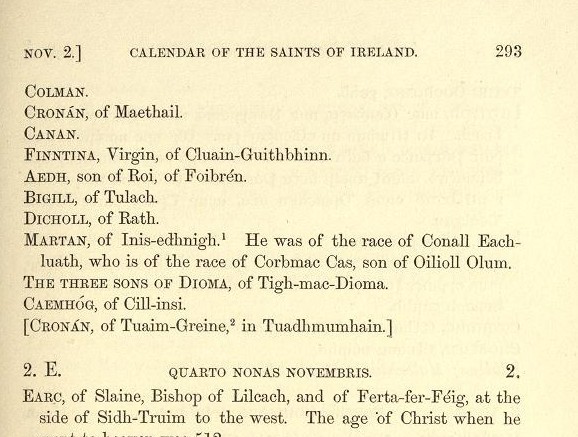
St. Grellan was honoured with particular devotion in the Church of Killcluian, diocese of Clonfert, on the 17th of September. On this day his feast occurs, according to Marianus O’Gorman, our traditions and Calendars, while he seems to have had a second festival, at the 10th of November. It seems strange, that at neither day he is mentioned in the Feilire of St. Aengus the Culdee, nor is the date for his death recorded in our Annals. However, we may fairly assume, that he lived on, until near the close of the sixth century.
St. Grellan is the principal patron of those portions of Galway and Roscommon counties, formerly known by the designation of Hy-Many; and, for many centuries, even to the present age, the crozier of St. Grellan had been preserved in the territory. Dr. Lynch declares also, that in his time this pastoral staff of St. Grellan was held in great veneration. A relic of this kind, when used as a standard, was usually called cathach, i.e., proeliator, such as the celebrated cathach of St. Columkille. This crozier of St. Grellan was preserved for ages, in the family of O’Cronghaile, or Cronelly, who were the ancient Comharbas of the saint. This term of Comharba had moreover an ecclesiastical meaning, and according to the usages which prevailed in early times, and in our country, generally it signified successor in a see, church, or monastery; but, in due course, it had a wider signification, and the Comhorba was regarded as the vicar — a legal representative of the Patron Saint, or founder of the Church. But, the word Comhorba is not exclusively ecclesiastical; for in the ancient laws of Erin, it meant the heir and conservator of the inheritance; and, in the latter sense, it is always used, in our ecclesiastical writings. The crozier of St. Grellan was in existence, so late as the year 1836, it being then in the possession of a poor man, named John Cronelly, the senior representative of the Comharbas of the saint, who lived near Ahascra, in the east of the county of Galway; but, it is not to be found at present, in that county. It was probably sold to some collector of antiquities, and it is not now known to be in the possession of any person; yet it seems incredible, that such an interesting relic could have been lost, as we have been enabled to ascertain the fact of its preservation to a comparatively recent period.
Content Copyright © Omnium Sanctorum Hiberniae 2012-2015. All rights reserved.