Category: Saints of Roscommon

  • Saint Cruimther Fionntain of Cill-Airthir, July 13

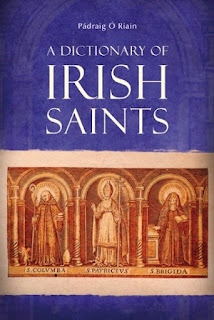
    Canon O’Hanlon brings details of an interesting saint at July 13: Cruimther Fionntain of Cill-airthir. The epithet Cruimther or cruimhthear indicates that our saint was a priest. In his account below, taken from Volume VII of the Lives of the Irish Saints, Canon O’Hanlon first tries to find a locality which fits   with Cill-airthir and then introduces the speculation of Father J.F. Shearman, author of the Loca Patriciana, a study of places associated with Saint Patrick, that our Cruimther Fintan is to be identified with a Crubther Fintain mentioned in the Life of the Welsh saint, Cybi, and based on the Island of Aran. When I turned to the authoritative A Dictionary of Irish Saints by Pádraig Ó Riain, a somewhat different picture of our Priest Fintan emerges. Ó Riain places him in Killerr, County Roscommon and does not comment on Father Shearman’s Aran/St Cybi theory. Instead he refers to the Life of Saint Mochta of Louth where Fiontan is portrayed as a disciple of Saint Patrick who is torn apart by the demons his master battles during Lent on Croagh Patrick. Saint Patrick restores Fiontan, who doesn’t even have a scar from his ordeal. He then went on to become abbot of Killair.  So, a most interesting saint, even if we can only rely on hagiographical rather than historical sources for details of his life and career. Canon O’Hanlon appears to be unaware of the sources Ó’Riain has used, but the account of St Cybi’s difficult dealings with the man of Aran, even if he isn’t our man, is such a good story that I will publish it on the commemoration of the Welsh saint on November 8:

    Cruimther Fionntain, of Cill-airthir. 

    Happy must be the condition of Christian communities, where we find the good priest united with a pious people, and a faithful flock bearing reverence towards their holy pastor. A festival to honour Cruimther Fionntain, of Cill-airthir, appears registered in the Martyrology of Donegal at this date. There is a Killartery townland in the parish of Mayne, barony of Ferrard, and county of Louth; there is also a Killartry townland in the parish of Aghavea, barony of Magherastephana, and county of Fermanagh. These seem the only Irish denominations likely to correspond with the ancient nomenclature of his place, which does not appear to be known. The Rev. John Francis Shearman has identified the present Cruimther Fintan with a Crubther Fintain, who lived in the Island of Aran, and who is said to have chased St. Cybi and his companions Maclog and Cyngar, not only from that place, but even away from Ireland. This, however, is manifestly a legendary story. The Bollandists were furnished by Father O’Sheerin, with a notice of Fintanus Sacerdos de Kill airthir, for the 13th of July.


    Content Copyright © Omnium Sanctorum Hiberniae 2012-2016. All rights reserved.
  • Saint Gallus of Loch Techet, April 4

    At April 4, Canon O’Hanlon brings details of a lake-dwelling saint, Gallus of Loch Techet:

    St. Gallus, of Loch Techet, now Lough Gara, Counties of Roscommon and Sligo.

    A distinguished statesman has observed, that there is no greater folly being circulated on the earth, than a disposition to undervalue the records of the past, and to break the links, which united human beings of the present day, with the generations that had been called to their account. The Martyrology of Tallagh, at the 4th April, inserts the notice, Gall, Locha Teiget. This lake, at present, is known as Lough Gara, or Lough O’Gara, near Boyle, and on the borders of the counties of Roscommon and Sligo. The river Boyle has its source from this lake. We are informed, that St. Patrick, while in Connaught, resolved to visit Moylurg, and that passing through Bearnas Hua Noililla, or the gaps of Collooney, he moved onward towards the River Buill—now the Boyle—which takes its rise in Loch Techet.’ According to the Martyrology of Donegal, on this day was venerated Gallus, of Loch Techet, and in the Bollandists’ work  he is likewise commemorated.

    Content Copyright © Omnium Sanctorum Hiberniae 2012-2015. All rights reserved.

  • Saint Finntina of Cluain Guithbhinn, November 1


    The Irish calendars record the name of yet another of our obscure female saints on November 1. Alas, the earliest of these, the Martyrology of Tallaght, has a hiatus in the surviving manuscripts and the entire month of November plus the first sixteen days of December are missing. The name of Saint Fintinna, Virgin, of Cluain Guithbhinn, is however recorded in the later calendars. The  Martyrology of Gorman,  compiled in the late twelfth century lists the saint and her day as does the seventeenth-  century Martyrology of Donegal.  The 1857 edition of The Martyrology of Tallaght produced by Father Matthew Kelly supplements the missing entries with those from the Martyrology of Donegal. It therefore lists: Nov. 1 Finntina Ogh o Cluain Guithbinn and the index identifies Cluain Guitbinn with Cloongefin, County Roscommon.  I can find out no further information on this holy lady but it pleases me to be able to record her name on the day when we celebrate the memories of all the saints. Saint Finntina, intercede for us!

    Content Copyright © Omnium Sanctorum Hiberniae 2012-2015. All rights reserved.