Category: Saints of Laois

  • Saint Mac Nissi of Clonmacnoise, June 13


    June 13 is the commemoration of Saint Mac Nissi, a sixth-century abbot of Clonmacnoise.  He shares his name with the episcopal patron of the northern diocese of Connor whose feast is celebrated on September 3. Today’s saint is noted in the Martyrology of Oengus in the following quatrain, translated by Whitley Stokes:
    With Bartholomew the active
    thou art weak if thou hear not
    from us to the Kings (of heaven)
    went Mac Nissi the chaste of Cluain.
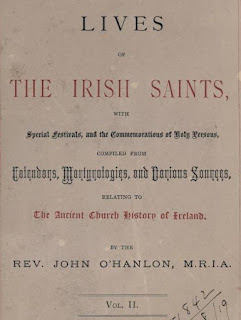
    Canon O’Hanlon brings this account of the saintly abbot of Clonmacnoise in volume VI of his Lives of the Irish Saints:
     
    St. Mac Nissi, Abbot of Clonmacnoise, King’s County [Sixth Century.]
    This holy man is mentioned, by St. Aengus the Culdee, as deserving of religious veneration from an early date. Among the Burgundian Library Manuscripts, at Bruxelles, there is a Latin Life of Moenissus. Whether he was the present saint, or the Mac Nissi, Bishop of Connor, venerated at the 3rd of September, the short account given by Mr. S. Bindon does not enable us to determine. In the Feilire of Aengus, Mac Nissi the chaste of Cluain is commemorated, on the 13th of June. We also find the name of Mac Nesi, Abbot of Cluana mic nois, occurring in the Martyrology of Tallagh, and in that of Marianus O’Gorman, as having had a festival, at the 13th of June. Nearly contemporaneously with the death of St. Ita, of Killeedy, the predecessor of Mac Nissi, and who is called the abbot Aeneas, departed this life. St. Macnessius immediately succeeded him, in the government of Clonmacnoise, at a time when this sanctuary of holiness; on the banks of the Shannon, was in the zenith of its splendour, as a house and home of retreat. He ruled from about A.D. 574, for a period of sixteen years, according to a gloss on Marianus O’Gorman. The account of his being abbot, during the lifetime of Eneas, must be taken to signify, either that he was elected at this abbot’s express wish, when on his death-bed, according to a custom of the time; or that the term abbot, said to have been applied to him by St. Ita, was rather an expression used by the author of her Life, and referable to Macnessius, at a future period. The O’Clerys place this saint’s death, at A.D. 590. The Martyrology of Donegal records him as Mac Nessi, Abbot of Cluain-mic-nois.
    Content Copyright © Omnium Sanctorum Hiberniae 2012-2015. All rights reserved.
  • Saint Comgan of Gleann Ussen, February 27

    On February 27 we commemorate an Abbot of Gleann Ussen, modern Killeshin, County Laois. There is some confusion around the identity and period in which Saint Comhghán (Comgan, Comhdan) flourished. Some of this has arisen due to conflicting accounts about his pedigree in the Irish genealogies, but also because of the attachment of the suffix ‘cend-inis’ to his name in some of the calendars. This is found in the entry in the Martyrology of Oengus for 27 February:

    With the suffering of Abundus,
    Great his gifts of poems ;
    The feast of Comgan, Cend Inis,
    The finding of the head of
    John [the Baptist].

    In the nineteenth century Margaret Stokes translated this epithet as meaning ‘without reproach’, but some of the earlier hagiographers appear to have believed that Cend Inis (Ceann Innis or Kean-Indse) was a place in Munster associated with the saint and assigned him to the period of the seventh century. Canon O’Hanlon, however, believes that he actually belongs to the ninth century and is more firmly associated with Gleann Ussen. As he explains:

    That St. Comgan was connected with Gleann-Ussen appears, from the authority of the Menelogium Genealogicum, the Martyrologies of Tallagh, of Cashel and of Marianus O’Gorman. This was the name of a remarkable glen, situated in the territory of Hi-Bairche, about two Irish miles to the west of Carlow. There exists a considerable portion of the ruins of an ancient church, called Cill Ussin, anglice Killeshin.

    At Killeshin, St. Diarmaid or Diermit is said to have built or presided over a church or monastery; and, this must have been as late as the ninth century, if we are to identify him with that Diarmaid, Abbot of Gleann-Uissean, whose death is recorded at A.D. 874. Now, Comgan is generally allowed to have succeeded him ; but, at what particular date is not clearly ascertainable, for we cannot find any well-known allusion to him in our Annals.

    We find him placed after St. Diarmaid, in the government of Killeshin Monastery, and he cannot have enjoyed this position, before the close of the ninth century. Probably this was about the time, when our St. Comgan was abbot over that establishment.

    At this day, he is commemorated in our Irish Calendars. We find the simple entry, Comgan, of Gliuni Usin, inserted in the Martyrology of Tallagh, at the 27th of February. St. Oengus the Culdee, likewise, has placed his festival in the Feilire. The Martyrology of Donegal reads:

    27. B. TERTIO KAL. MARTII. 27.
    COMMAN, Mac Ua Theimhne.

    COMDHAN, [i.e., Diarmaid,] of Glenn-Uissen, son of Diarmaid, son of Deghadh, of the race of Cormac Cas, son of Oilill Oluim ; and Ethne, daughter of Feidhlimidh, son of Tighernach, was his mother.

    The Kalendar of Cashel, the Martyrology of Marianus O’Gorman, and the Martyrology of Cathal Maguire, have entered his festival, at the 27th of February. This holy man appears to have been greatly venerated, in Ireland, where his Office, containing nine Lessons, was formerly recited.

    At the iii. of the March Kalends, or at the 27th of February, we learn from the Kalendar of Drummond, that in the Island of Hibernia, the Natalis of the holy Confessor Comgan, who went to Christ, was celebrated. No further biographical statements, in reference to him, have been preserved.

    In his authoritative 2011 Dictionary of Irish Saints, Pádraig Ó Riain upholds Saint Comhghán’s identification with Killeshin and that cen dinnis means without  reproach. He has been confused with another saint Diarmuid of Gleann Uisean, but they are two distinct individuals. Ó Riain suggests that the importance of Gleann Uisean is reflected in its early twelfth-century ‘chief teacher’ Duibhlitir Ua hUathghaile who wrote a version in Irish of the Sex Aetates Mundi, the Six Ages of the World. Saint Comhghán himself appears in a list of saints whose aid is sought for the men of Leinster in a poem attributed to Saint Moling. Saint Comhghán thus seems to be a good example of a saint who was once  ranked as an important saint of Leinster with a notable monastic foundation, but who is now shrouded in obscurity.

    Note: This post was first published in 2012 and revised in 2024.

    Content Copyright © Omnium Sanctorum Hiberniae 2012-2015. All rights reserved.

  • Saint Fintan of Clonenagh, February 17

    We commemorate one of the great Irish masters of the ascetic life, Saint Fintan of Clonenagh on the 17th of February.  The sources for his life and feast have been summarized by diocesan historian, Father Michael Comerford:

    On the 17th of February the Feilire of Aengus records, “The Feast of Finntan, the prayerful, of vast Cluain-Ednich;” and the Gloss in the Leabhar Breac, and the Martyrology of Donegal, on the same day, add:- Fiontain, son of Gaibhreine, son of Corcran, son of Eochaidh, son of Bresal, son of Den.- Here he and (St.) Brigid meet (in their pedigrees), Abbot of Cluain-eidhniach in Laoighis (Leix). Great was the abstinence of this holy Fiontain, as is evidenced from this verse (of Aengus)-

    Fiontain the generous
    Never ate during his time
    But bread of barley corn
    And water of earthy clay.

    A very ancient vellum book . . states that Fiontain of Cluain-eidhniach, chief of the monks of Erin, in his manners and life resembled Benedictus, head of the monks of Europe.

    Colgan styles him “Fintanus Stationarius de magno Cluaineadnach;” the epithet of stationarius being applied to him from his praying, like many others of our early saints, with his arms extended in the form of a cross.

    St. Fintan received his early education from a holy priest by whom he was baptized. Whilst yet a boy, he was visited by St. Columbkille, who, on that occasion, foretold St. Fintan’s future distinguished career. When he arrived at man’s estate, he entered the Monastery of Tir-da-glass (now Terryglass, Co. Tipperary), where St. Columba, son of Crimthain then presided over a famous school. Having passed a novitiate here, he and two, some say three, companions, being anxious to find a retired place where they might devote themselves to the service of God, consulted St. Columba, and, accompanied by him, they came to Clonenagh. Here, it is said, St. Fintan and his companions passed a year, but, finding their solitude greatly broken in upon, they determined to abandon the place, and directed their course to the Slieve Bloom mountains, again accompanied by St. Columba; this saint, looking back upon Clonenagh, saw a multitude of angels hovering over it. His disciples seeing him sorrowful, asked the cause; the saint replied: “Because I see the place we have left filled with the angels of God, and these angels unceasingly minister between it and heaven”. “One of us”, he added, “should return and abide there for the future”. Whereupon Fintan said: “Whomsoever, O Father, you direct to return, he will instantly obey”. Columba replied: “Go you in peace to that spot, O holy youth, and the Lord be with you. It has been divinely revealed that for you it shall be the place of your resurrection.” St. Fintan accordingly retraced his steps to Clonenagh and established himself there; this was about the year 548. Great numbers flocked to this place to serve God under the guidance of our saint, amongst whom was St. Comgall, afterwards the founder of the famous Monastery of Bangor, who passed some years under his direction. The discipline observed at Clonenagh was very rigorous; the fasting and abstinence were so severe that St. Canice of Aghaboe and other holy men remonstrated with St. Fintan on the subject. Yielding to their representations, he relaxed the rigour of his rule in favour of his community, but, himself, adhered to his former mode of life. Finding his end approaching, St. Fintan assembled his monks and named Fintan Maeldubh as his successor.

    Rev M Comerford” Collections relating to the Dioceses of Kildare and Leighlin” Vol.3, (1886).