October 12 is the feast day of Saint Fiacc of Sletty, County Laois, a saint around whom there is a rich hagiographical and folk tradition. Saint Fiacc is identified as one of the very earliest Irish saints, converted directly from paganism by Saint Patrick himself. An earlier post for Saint Fiacc can be found here but below is a reminder of the man and his locality from a late nineteenth-century paper by Father Michael Comerford. It includes many episodes from hagiography and ends with a useful summary of entries from the Irish Annals relating to Sletty and its saintly abbots:
SLETTY.
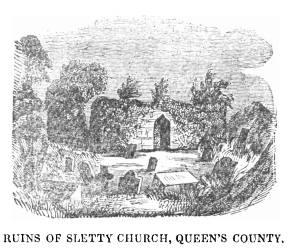
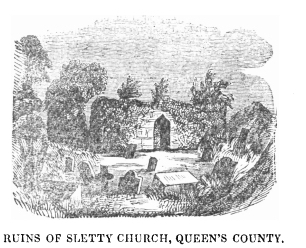
Sletty was at one time. a place of great importance, being the residence of the chief Bishop of Leinster. The name is translated mantesby Colgan, and Duald MacFirbis, speaking of St. Fiacc, the patron of the place, calls him Fiacc, of Cill Sleibhe, i.e., of the mountain of Drim Gabhla. The name must have been originally given to the church, from its contiguity to the mountain of Sliabh-Mairge (O9 Donovan Ord. Survey). No part of the original Patrician Church remains. The present old church measures on the inside 24 feet in breadth, and 42 feet in length. The old gable is totally destroyed, and its place is occupied by a modern wall about five feet high. The W. gable is in tolerable preservation, and so clothed in ivy that you cannot see its features (if any it has). The S. wall contains a rude window (near the S.E. corner), which is broad inside and narrow outside and a doorway near the S.W. corner, with a singular top in limestone, the sides being firestone. I take this to be a doorway of the thirteenth century. In the churchyard, nearly opposite the N.W. corner of the W. gable, stands a granite cross about 7 feet 10 inches high. It was never inscribed. I think that it is as old as St. Fiacc.
Sir Charles Coote mentions this cross, and another one like it, as standing in this churchyard. Inside the old church of Sletty, near the doorway, and to the left as you enter, there is. a large font of granite with a deep circular hollow, and pierced in, the centre, which appears to me to have belonged to the primitive church of St. Fiacc. There was also a holy well near this church called Tober-Feeg, but it is now stopped up.— (O’D.)
The following account of St. Fiacc is taken from the Tripartite Life of St. Patrick, Part 8 :- –
” Then Patrick placed over all Leinster, as supreme Bishop, Saint Fiacc, a man of most celebrated sanctity, whose first conversion and ordination happened in this manner. When St. Patrick proceeded from Tara to the territory of Southern Leinster, called Hy-Kenneselach, he met in the plain commonly called Mag-Craithar, where afterwards was built the Church of Domnach-Mor, that royal poet, Dubthach, the son of Lugaire, who, as well on account of his great piety towards God, and devotion to Patrick, as on account of his rare excellence in the metrical art, and his ancient and eloquent works, is of very celebrated memory and fame among the historians of Ireland. To this man, who had already embraced the Christian faith, the blessed Prelate was very much attached and devoted, as well on account of the singular probity of the man, as for the skill, on account of which he was the arch-poet, or prince of the poets of the age of the kingdom. The blessed man, then familiarly conversing with him asked of him where he should find, according to the precept of the Apostle, a man, the husband of one wife, sober, prudent, of good behaviour, hospitable, a teacher ; whom, having ordained him Bishop, he might place over that province. Dubthach answered that all these qualities were (to be) found in a certain disciple of his, Fiacc, the son of Ere, whose wife had lately departed, leaving an only son, by name Fiacra, and whom he had sent into Connaught to present certain poems of his to the princes of that land ; but while they were engaged in these discourses they beheld Fiacc returning; whom when he saw that the mind of Patrick was borne towards him, Dubthach resolved to induce him to consent to the wishes of the holy man, although otherwise he would not, without reluctance, forego his presence. And to this end St. Patrick and Dubthach devise this pious craft. For they pretended that Dubthach is immediately to receive clerical tonsure from the band of Patrick. Which, when Fiacc coming up, understood, he says to the holy prelate— Holy Father, whether would it not be better that I should receive clerical tonsure, who am of younger age and less necessary to the state than my master, who is advanced in years and very necessary for his children, and is (held) in great esteem by the chiefs of the kingdom. Patrick answered that the spontaneous offering was acceptable and grateful to him. Patrick, therefore, first baptised Fiacc, who before was only a catechumen, and afterwards gave him tonsure, and delivered to him an alphabet written with his own hand, and imparted his benediction, which he having obtained, learned the entire psalter in one day (or in fifteen days, as others say), and within a short space of time, assisted by the grace of the Holy Ghost, made such a progress in the studies of sanctity and letters, that he seemed to his master worthy, not only to be ordained bishop first, of all the Lagenians, but also to be placed over that entire province as supreme prelate. Patrick ordained with his own hand also his son, Fiaccra after he had become mature in years and learning. St. Fiacc first built a church in a place which, from his name, was afterwards called Domnach-Fiacc, i.e., the church of Fiacc, and he (St. Patrick) left him sacred utensils, ramely, a ministerial bell, the epistles of St. Paul, and a pastoral staff. He also left seven of his (disciples) companions of his labours, and imitators of his actions, namely, Muchatoc, of Inis-fail ; Augustin, of lnis-beg; Tecan, Diarmait, Nainnid, Paul, and Fedhelim.f But the most holy bishop and abbot, Fiacc, remained in the Church of Domnach-Fiacc until he had sent before him to heaven sixty saints of his disciples. But afterwards an angel of the Lord came to him, saying that the place of his resurrection would not be there, but beyond the river to the west ; and he bids him to erect a monastery there, in a place called Cuil-muige, assigning a proper and convenient place for each of the officials. For he directed him to build a refectory where (he should find) a boar and a church where he should find a doe. The holy man, a pattern of obedience, answered the angel that he would not dare to commence the building of a church unless his father and master, Patrick, would first measure and consecrate its site and dimensions. Patrick, therefore, being informed and requested, came to that place which is commonly called Slebhte, i.e., mountains, and there, according to the directions of the angel, he laid and consecrated the foundation of a church and monastery. But that place in which the church and monastery of Slebhte were built, was granted, not to Fiacc, but to Patrick, by Crimthaun, the son of Kenselah, King of Leinster, who a little before, was washed by St. Patrick in the saving laver (of Baptism), and was afterwards buried in the same place. For the noble family from which Fiacc sprang was then very much oppressed, and banished into different parts of Ireland by the aforesaid Crimthaun, King of Leinster. For from it monks in the territory Hy-Crimthaun derive their origin, and monks in Ulster, and the people of Kinell-Euna, in Munster. And amongst others were then banished four brothers of St. Fiacc — namely, Ailill, Aengus-mor, Conal, and Etherschel ; and their father was called Mac-Erc. Whence, although the place in which the Church of Slebhte was built, was in the patrimony of St. Fiacc ; still he would not have received it from the king, on account of the animosities and discords just mentioned, which existed between him and the family and brothers of St. Fiacc, had not St. Patrick interposed ; at whose intercession King Crimthaun granted to St. Fiacc not only a place for building, but also a portion adjoining it, or a fifth part of his paternal lands, with which he enriched that church, in which he placed an Episcopal See. But Aengus, the aforesaid brother of Fiacc, in revenge of the injuries of banishment inflicted on him and his family, at length slew King Crimthann, the chief enemy of himself and his family. Notwithstanding this, Grimthann was a king pious towards God and devoted to the servant of God, Patrick, and piously liberal and bountiful in erecting and endowing the churches of God. For he built and endowed with lands, first thirty churches, and afterwards forty, to God and Patrick, in the territory of Hy-Kennselach, and Eastern Leinster; among which were the church of Domnac-Criathar, of which above ; and of Inis-fail, in which he left Sts Mochonoc (Feast 12th Feb.), and Machadoc (Feast 24th Jan.), and another in Inis-beg, in which he left Erditus and Augustin. (Both Inisfail and Inis-beg are in the diocese of Ferns — O’D.) But after the Gentiles had taken possession of the Church of Slebhte these churches became desolate and deserted.
The sacred festivity of the Lord’s Day arriving, St. Patrick delayed in the plain of Maghdele-Biada (Morett, adjoining the Great Heath of Maryborough), and in a place which afterwards, from the church which was erected there, is called Domnach-mor, ie, the Great Church Having founded churches, and disposed of the affairs of the Catholic cause through Leinster, and having ordained Fiacc (Bishop) of Slebhte and supreme Bishop of the entire province undertaking his journey by Belach-Gaurain, Patrick betook himself to Origia or Ossory, &c.”
The title of Archbishop in the province of Leinster first belonged to the See of Sletty. By a decree of a synod, held at the request of Brandubh, King of Leinster, early in the seventh century, this dignity passed to the bishopric of Ferns (Ussher, p. 965), and was afterwards transferred to Kildare. It is certain, however, that these archbishops were not, strictly speaking, Metropolitans, nor were they invested with archiepiscopal power, or that jurisdiction provided bv the canon law. They enjoyed, by courtesy, and very often, through the favour of princes, a degree of honorary pre-eminence, and for this reason we find the title passing, in those days, from one see to another.— (Brenan, Eccl. Hist., vol. 1, p. 150).
St. Fiacc was born about the year 437. He was of the Hy-Bairrache race, descendants of King Gahir-Mor. His father was twice married, first to a daughter of Crimthamn, King of Hy-Kinnceslach, by whom he had four sons, whose names have already been given ; and secondly, to the mother of St. Fiacc, who is said to have been a sister of Dubhtach, the poet. Dubhtach adopted Fiacc as his pupil whilst yet a youth. He became a Christian convert, like his master, but it would appear not for a considerable time after him, as we find him still a catechumen on the occasion of St. Patrick’s consultation with Dubhtach, about the tnateries of a bishop, when Fiacc was recommended for that office. Fiacc was then a widower with one son, Fiacra. St. Patrick, having “put the grade of a bishop on him,” made Fiacc the presents referred to above, and left with him the seven saintly companions there named. The place where St. Fiacc founded his first monastery was called after him, Domnach-Fiacc, and was probably situated between Clonmore and Aghold, in the parish of Clonmore, near the bounds of the counties of Carlow and Wicklow. Some are disposed to hold that this first establishment of St. Fiacc was at the place now known as Bestfield, on the side of the Barrow, opposite to Sletty. Here he must have remained many years, as it is recorded that he did not leave it till he had sent sixty of his disciples to heaven. Then an angel appeared, and notified to him that the place of his resurrection (the place where he should be buried, and should arise from on the day of general resurrection) was to be on the west of the river Barrow. Fiacc objected to go until he had the approval of St. Patrick, and until that saint had actually marked out the site of his future monastery and church for him, St. Patrick obtained from King Crimthann the site, and also an extensive district adjoining, as an endowment. Through the action of Patrick the king granted him (Fiacc) land, the fifth part (of his father’s possession, and thereon it was that he built Sleibhte” — (Egerton Trip.) This took place probably between the years 469 and 480.
The territory about Sletty had (originally belonged to the family of St. Fiacc, but King Crimthann had forcibly taken possession of it, and driven all the family into exile. After the conversion of Crimthann by St. Patrick, and his baptism by that saint at Rathviliy, where he had his royal residence, at the solicitation of St. Patrick, he made the gift referred to in favour of St. Fiacc, and he also selected Sletty as the place of his future interment.” After this went Patrick to Fiacc, and measured his place for him, and consecrated it, and marked out his Forrach there ; and Crimthann granted the place to Patrick, for it was Patrick that gave Baptism to Crimthann, and it is in Sleibhte that Crimthann was buried.” — (Stokes’ Goidilica, p. 104). Crimthann was slain by his grandson, Aengus, in revenge for the injuries he had inflicted on his family. This took place in the year 483 (Annals of Ulster). The records of the life of St. Fiacc inform us that he was remarkable for his penitential austerities.” This Bishop Fiacc, with great patience, subdued his fleshy appetites and concupiscence, and finished a most holy course of life in his city of Sleibhti, near the river Barrow, in the White Field” (Ware’s Irish Writers, p. 6). And in the ” Vita Tripart,” written by St. Evin, it is stated that Fiacc went on Shrove Saturday to a cave on the hill of Dromm-Coblai, bringing with him five barley loaves, mingled with ashes. At the end of Lent he returned to Sletty to celebrate with his brethren the joyous festival of Easter. Father Shearman gives strong reason for concluding that the cave to which St. Fiacc used to retire for the penitential observance of Lent was that at Clopoke, which is distant about seven miles north-west of Sletty. He says that there lingers still in the locality a tradition that in ages past a saint used to retire to this cave to pray and fast, after which he returned to his distant church by a subterranean passage leading south, which is supposed to be still in existence (Loca Patr.) St. Fiacc being disabled from sickness, St. Patrick sent him from Armagh a chariot and horses at the suggestion of Lechnall (Vita Tripa.) ” The cause of giving this chariot to Fiacc was that chafers had gnawed his leg, so that death was near him.” The date of St. Fiacc’s death is not recorded; probably it did not take place till about the year 510. In the Liber Hymnorum, a MS. preserved in Trinity College, Dublin, and which Dr. Petrie reckoned to be about two hundred years old, is to be found a poem on the Life of St. Patrick, attributed to St. Fiacc. The best Celtic philologists, judging from its language alone, unhesitatingly refer it to the sixth century. The introduction to the poem states — ” Fiacc of Sletty it was that composed this eulogy of Patrick. . . . The place (where it was composed) was Duma Gobla, to the north-west of Sletty. The time was that of Lugdach MacLaegaire, who was King of Ireland then — the occasion was to eulogise Patrick, and it was after his (Patrick’s) death it was composed, as some authors say.” Some of the critics judge that the hymn in its present form was not, strictly speaking, the composition of St. Fiacc; that he was the writer of an historical poem on St. Patrick is admitted, though it is thought that the poem was fashioned into its present form by some other hand — perhaps, by St. Fiacc’ s successor in the See of Sletty, St. Aedh (Hugh), who died in 698. Besides this poem other compositions have been ascribed by ancient writers to St. Fiacc. A Latin poem in honour of St. Brigid (Book of Hymns, published by Dr. Todd for I.A.S , p. 57), though generally attributed to St. Ultan of Ardbraccan, is said in the old Irish Introduction to have been by some referred to St. Fiach of Slebhte. There is a short Irish prayer preserved in the MSS. of the Liber Hymnorum which may with more certainty be assigned to our saint. Whether composed by St. Fiacc himself, or by his disciple St. Nennidh, it will serve to show forth the sentiments of at least the school of St. Fiacc. For the poem we must refer the reader to the I. E. Record, vol. 4.
The prayer being short, the translation of it is here inserted.
” It was Ninan, the poet, that made this prayer, or it was Fiacc of Sletty.
” Let us put our trust in Patrick, chief apostle of Ireland. A bright flame, honourable, illustrious his name. He baptised Gentiles ; he battled with obdurate Druids. He overcame proud men by the aid of the King of bright heavens. He sanctified the fair plains of Erin. Great is the man to whom we pray. Let us pray to Patrick, chief apostle, to save us on the Judgment Day from eternal condemnation, and from the evil designs of wicked demons. May God be with me, with the prayer of Patrick, Chief Apostle.”
St. Fiacra succeeded his father as Bishop and Abbot of Sletty— the particulars of his life have not been preserved, further than that he was ordained by St. Patrick, and that he rests in the same grave with St. Fiacc. The memory of these saints was celebrated on the same day, on the 12th October, ” Fiac ocus Fiachra ejus filius cum eo I Sleibhte”— Mart. Tallaght, at that date. Domnach-Fiacc disputes with Sletty the distinction of being the burial-place of these saints. Without quoting the authorities pro. and con., we may say that the weight of evidence and the constant tradition are decidedly in favour of Sletty. These particulars of the life of St. Fiacc have been taken chiefly from Lanigan {Eccl. Hist., vol. i.), Father Shearman’s Loca Patriciana (part ix.) and from article on ” Poem of St. Fiacc” in I. E. Record, vol. iv., p. 269, et seq. .…
…”A.D. 698. Aedh, Anchorite of Sleibhte, died.”— (Four Masters)
This was the Aidus of Sleibhte mentioned in Tirechan’s Annotation on the Life of St. Patrick, preserved in the Book of Armagh. He is there stated (fol. 20, 6. 1.) to have dictated a Life of St. Patrick to Muirchu-Maccu-Mactheni ” Hsbc Panca De Sancti Patricii peritia et virtutibus, Muirchu-Maccu-Mactheni, Dictante Aidcceo Slebtiensis civitatis episcopo, conscripsit.” This brief notice of the life of our national Apostle is addressed to St. Aidus, Bishop of Sletty. In the Preface the writer states that he “undertook the task in obedience to the command and through reverence for the piety and authority of Aidus.” (See Dr. Moran’s Essays on the Early Irish Church, c. 3.) This St Aedh assisted at the famous ecclesiastical Convention, known as the Synod of Adamnan, presided over by Flann Fehhla, Abbot of Armagh, in 697. His death is entered at the year 699 in the Annals of Ulster—” Quies Aedo Anachoreto (De) Slibhtiu” His feast was celebrated on the 7th of January. At that day we find it entered in the Mart. Tall.—” Aidi Eps Sleibhte.”
“A.D. 819. The relics of St. Mochanoc (brother of St. Malach, and uncle to St. David, of Menevia), which had been enshrined at Innisfail, in Wexford Haven, since his death at the close of the fifth
century, were removed, together with the other treasures of that church, and transferred to Sletty for greater security. This saint was one of the companions who had been assigned to St. Fiacc by St Patrick, His feast was observed on the 11th February. (AA. SS.p. 811.)
In the Litany of Aengus Ceile De, Glunfal of Sletty is invoked.
” A.D. 862. Brocan, son of Comhsudh, Abbot of Sletty, died.”— Four Masters.
“A.D. 864 Struther (Shrule), Slebhte and Achadh Arglaisf were plundered by the Osraighi (Ossorymen).” — Four Masters.
” A.D. 1055. Maelbrighe O’Maelruain, Deacon of Sleibhte, died.”—(Id.)
An extensive college is traditionally alleged to have been connected with the church of Sletty, wherein many, both native and foreign, were educated. The college of St. Mary’s stands upon the Termon of Sletty. It was founded by the late Very Rev. Dr. Taylor while he was President of Carlow College. There can be no more appropriate site for an Irish college than the spot consecrated to learning and religion by the presence of St. Patrick, and by the labours of St. Fiacc….
Rev. M. Comerford, ‘Killeshin and Sletty’, in Transactions of the Ossory Archaeological Society, Vol. II (1880-1883), 128-148.
Content Copyright © Omnium Sanctorum Hiberniae 2012-2026. All rights reserved.