Category: Groups of saints

  • Saint Echlech, Cuimmein and Coemhan, August 14

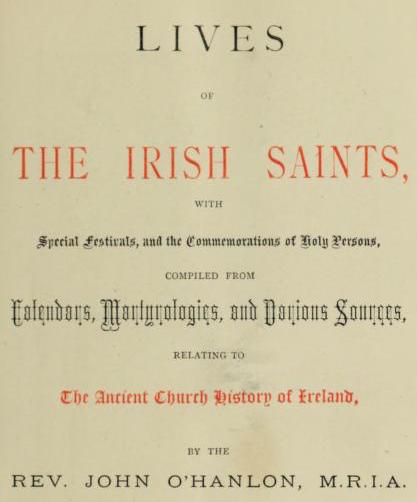
    August 14 is the feast of a trio of brothers, the three sons of Daighre – Echlech, Cuimmein and Coemhan. Canon O’Hanlon suggests that they should be located within the County Kerry parish of Kilcummin and in his account provides a glimpse into the traditional pious practices of the Irish countryside. His source here is the Ordnance Survey scholar, John O’Donovan, who was writing in 1841. The letters of O’Donovan and his colleagues are an important source of information on the Irish saints as they record the existence of sites, devotional practices and traditions regarding the saints in the various places they visited. Often the dates they noted for pattern days can give a clue to the commemoration of the feast days of the saints in the local areas. In this case, however, the people seemed to have gathered at the holy well not on August 14 but on the eve of May 1:

    Saints Echlech, Cuimmein and Coemhan, three Sons of Daighre.

    In the Martyrology of Tallagh, Cummine, Caeman and Aicclig, are the names set down in separate lines and in the preceding order, but without any further designation of their parentage. In that copy, contained in the Book of Leinster, they are placed in like order. In the Martyrology of Marianus O’Gorman, these saints are commemorated at this date… There is a parish dedicated to a saint having the name of Cummein, and which is called Kilcummin. It is situated in the barony of Magunihy, County of Kerry. The old church belonging to this parish is situated on a ridge of fertile land, within the glebe of Kilcummin. In 1841, it measured on the inside 56 feet in length, and 19 feet 6 inches in breadth. Its side walls were 3 feet 5 inches in thickness, and 10 feet in height; being built of green unequally sized stones, cemented with lime and sand mortar. The west gable was destroyed nearly down to the ground; only 3 feet of its height then remaining, but the other walls were nearly perfect. The internal portion of the east window was disfigured, but its external part was in a state of excellent preservation. The window, measuring 5 feet 2 inches in height, and 11 inches in width, was pointed and formed of cut lime stone; the sill was 4 feet 8 inches, from the outside ground level. At the distance of 8 feet from an east gable, there was a window in the south wall. This had been destroyed on both sides, with the exception of one stone left on either external side, These were chiselled lime-stones, and the distance between them was only 7 inches. A rude representation of the head and face of St. Cummin—as is believed—was carved on brown sand stone, which projected from the wall, near the northern extremity of the east gable and on the outside. There was also a large graveyard attached to this church. In the townland of Gortnagowan, in the east division of this parish, there stood a caher or circular stone fort, called Caher-Crovderg, i.e., the Fort of the Red-handed. On the eastern side of it, a holy well lay, at which stations were performed by the peasantry, on May eve. They also drove their cattle into the fort, and made them drink the water of this holy well, which was believed to possess the efficacy of preserving their animals from all contagious distempers, during the ensuing year. Colgan thinks St. Coeman, a deacon, and a disciple of St. Patrick, to be identical with one of these saints. He was set over the church of Ard-lice, commonly called Sean Domhnach. In the O’Clerys’ Calendar of Donegal, we find the three sons of Daighre, Echlech, Cuimmein and Caemhan, had veneration given them at the 14th of August.

    Content Copyright © Omnium Sanctorum Hiberniae 2012-2015. All rights reserved.
  • Feast of the Sons of Nadfraech, July 31

    We close the month of July with the collective feast of the Sons of Nadfraech. Inevitably, the  calendars do not agree with each other in their listing of the individuals who make up the grouping and it seems that some of the saints whose feasts happen to fall on this day may have been erroneously included as sons of Nadfraech. Canon O’Hanlon is cautious about the group but is able to bring accounts of all of them individually. We have already met one of them, Saint Colmán of Derrymore, on the blog and accounts of the others will follow:

    FESTIVAL FOR THE SONS OF NADFRAECH, VIZ., COLMAN, FOLLAMAN, PAPAN, IERNOC AND NATALIS.

    [FIFTH AND SIXTH CENTURIES.]

    MUCH uncertainty prevails, as we shall see, regarding the parentage and places, the sons—if they were not rather the grandsons—of Nadfraech, should have in our histories and calendars. We do not read of his conversion to Christianity, nor any very particular allusion to him, in the Acts of St. Patrick, although his son Aengus, King of Munster, became a distinguished convert, when the Gospel was preached in that part of Ireland.  However, it is likely, in this case, the father’s name has been set down for that of his son Aengus. According to the Martyrology of Donegal, the sons of Nadfaech had veneration paid them at this date. Their names are entered in detail, with marked distinction, and in the following order, according to the foregoing Calendar, viz. : Colman, Bishop; Fallamain, Bishop ; Iarnog, the sickly; and Natal of Cill-na-manach. It is not otherwise recorded, nor does it seem probable, except in a remote degree, that Natfraich had many children, who were saints. However, it is generally assumed, that Aengus was the father of a numerous and holy offspring. There are four of his sons numbered among our saints, and they are called Colman, Foilan, Lugad and Natalis. Nor does this account wholly agree with that of other authorities. At the 31st of July, Marianus O’Gorman seems to say, that the feast of Angus’ five sons, viz. : Colman, the son of Darenia, Follamonius, or Follomen, Papan, Iernoc and Natal is, had been celebrated on that day. These he calls the sons of Natfraich. But, by another designation, we are to understand, that they were only his grandsons, Aengus being their father.  In succeeding articles, we shall treat individually regarding each one of those saints, and as we find references to them in our records.

    Content Copyright © Omnium Sanctorum Hiberniae 2012-2015. All rights reserved.


  • The Seven Bishops of Tamhnach Buadha, July 21

    On July 21 the Irish calendars record another of those interesting groups of saints, in this case seven bishops. It often happens that we do not have the names of the individuals who make up these sorts of groupings but the seventeenth-century hagiologist, Father John Colgan, suggested that our septet were brothers and preserved Latinized names for them. Canon O’Hanlon starts off his account by explaining the sacred significance of the number seven before getting into the details preserved in the sources of The Seven Bishops of Tamhnach Buadha:

    The Seven Bishops of Tamhnach Buadha.

    The mystic number of seven in relation to our Irish saints and ecclesiastics has been as frequently recorded in our ancient books, as it has been found so often noted in the Sacred Scriptures. When Noe was commanded to enter the ark with his family, God said to him: “Of all clean beasts take seven and seven, the male and female.” Pharaoh, in his dream, saw “seven kine, very beautiful and fat, come up from the river” and ” other seven also came up out of the river, ill and lean fleshed.” Again, God ordered Josue to go with his army in procession around Jericho during seven days, and on the seventh, “the priests shall take the seven trumpets,” etc. Then with reference to sacrifice, we read that Balaam said to Balac, King of Moab: “Build me here seven altars, and prepare as many calves, and the same number of rams, and they laid together a calf and ram upon every altar.” Again, when Ezechias purified the temple of God, profaned by the wicked King Achaz, “they went into the house of the Lord, and they offered together seven bullocks, and seven rams, and seven lambs, and seven he-goats, for sin.” Examples of the same kind could easily be multiplied, but we have now to deal with an instance of seven Bishops in the Irish Calendars, and united on the same day for popular veneration. A festival, to honour Secht n Eps. Tamhnaighe, appears in the Martyrology of Tallagh. There were seven bishops, named respectively Saints Aidus, Diermit, Foebarchuo, Maclasrius, Manchinus, Tarchell, and Tinius, while these are said to have been seven brothers. They were sons of Muredac, son to Fochern, son of Dichull, son to Crimthann, son of Armedac, son to Senach, son of Aid Loga, son to Oscuon, son of Mienach, son to Lugad, son of Imchad, son to Fidchur, son of Eochod, son to Ennius Monchaoin, son of Ros, surnamed Rig-Foda, son of Fiacha Suighde, son of Feidhlemid Reachtmhar, founder of the Desies family. Colgan thinks those may be the seven bishops venerated at Tamnach-Buadha, on this day. Selbach enumerates twenty-three saints descending from Fiach Suighdhe, and venerated in our different Calendars. At this date, the Martyrology of Donegal records the Seven Bishops of Tamhnach Buadha [Bishop Tedda of Tamhnach.] We find seven bishops, the sons of one father, adds the Calendarist, while their names and history are among the race of Fiach Suighdhe, son to Feidhlimidh Reachtmhar, son of Tuathal Teachtmhar. There is an almost incredible number of Irish townlands, denominated Tamhnach—Anglice Tawny or Tawnagh either singly or in composition; yet, among these, it appears no easy matter to identify Tamhnach Buadha with any one of them. The ancient etymon probably has become obsolete among our modern local names. Under the head of Tamhnach Buadha, Duald Mac Firbis enters the seven bishops from Tamhnachbuadha, at July 21st.

    Content Copyright © Omnium Sanctorum Hiberniae 2012-2015. All rights reserved.