Category: Female Saints

  • Saint Masse, August 21

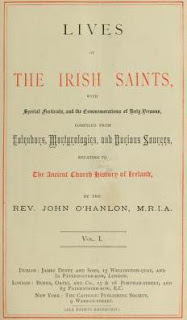
    One of the many obscure Irish female saints is commemorated on August 21, but as is so often the case all we know of Saint Masse is the recording of her name on our calendars. For some reason the Martyrology of Tallaght links her name to that of another saint with whom she shares her feast day, Celba of Kilbeg.  Canon O’Hanlon also reports that in the later Martyrology of Donegal the word species is appended to her name. In a footnote he adds that one of the original translators of this seventeenth-century calendar, the Anglican scholar Bishop William Reeves, gave this explanation: ‘Dr. Reeves interprets this word as the Latin equivalent for her name, Maisse, which in Irish signifies beauty. Speciosa occurs in the Martyrology of Molanus, at the 18th March’. So, here is O’Hanlon’s brief account of the beautiful Saint Masse, taken from Volume VIII of his Lives of the Irish Saints:

    St. Masse, or Maisse, Virgin.

    Sheltered from the baneful influence of a corrupt world, this holy Virgin grew each day in goodness, unconscious of evil, and in innocence like the angel who watched over her. The name of Masse occurs in the Martyrology of Tallagh at the 21st of August. Both in the published and unpublished copies, this name is united with that Celba, already noticed. Nothing, however, seems to be known, regarding her place or period. The name of Maisse, Virgin, appears in the Martyrology of Donegal, at the 21st of August. In the table, superadded to this latter work, after her name, we find the word species occurring.
    Content Copyright © Omnium Sanctorum Hiberniae 2012-2015. All rights reserved.
  • Saint Brigid of Fiesole, August 20

    Following on from yesterday’s feast of Saint Solon, we can now examine another of the feasts noted by the Scottish hagiologist Thomas Dempster. In his Menologium Scotorum at August 20 he notes:

    In montibus Faesulanis Brigidae virginis, quae ad fratrem suum Archidiaconum S. Andream e Scotia venit, & magna Christianae vitae continentia hic obiit.

    As I explained yesterday when dealing with another of Dempster’s calendar entries, the Irish were rather upset by this Scottish writer’s tendency to ignore the historical reality that in the early medieval period the Latin term Scotia was applied to Ireland and he claimed Irish saints and religious foundations on the continent for his own country. The virgin Brigid who came from Scotia with her brother the Archdeacon Andrew and was commemorated in the mountains of Fiesole on this day was an Irishwoman. I have been interested for some time now in the story of this Saint Brigid and her brother the Archdeacon Andrew who had come to Italy with fellow-Irishman Donatus, later appointed Bishop of Fiesole. As the story has come down to us, Andrew and his sister had been very close and she was heartbroken when he left Ireland to accompany Donatus on pilgrimage. Years later, as Andrew lay dying he wished for nothing more than to see his beloved sister again and she was miraculously transported from her home in Ireland to be with him. I have reproduced Margaret Stokes’ lovely version of the story here. After her brother’s death Brigid stayed on in the locality of Fiesole and lived the hermit life within a cave in the mountains.  It is a very beautiful and touching story, but I have always wondered if this Italian Brigid was not a separate individual living in the 9th century, as the hagiography portrays, but rather a manifestation of the cult of Saint Brigid of Kildare as brought to Italy and enthusiastically promoted by Bishop Donatus? One clue might be that although Dempster has recorded August 20 as the feastday of the Italian Brigid, he also records that she is commemorated on February 1, the feastday of the patroness of Ireland. Although Canon O’Hanlon seems content to accept that there were two separate Saints Brigid, he nevertheless finds their sharing of the same feastday a coincidence too far. The Italian writer on the Irish saints in Italy, Fra Anselmo Tommasini, puts forward some other reasons why he believes Brigid of Italy is really just the cultus of Brigid of Kildare and so I will return to this subject in a future post. For now, I will bring Canon O’Hanlon’s account of this feastday from the August volume of the Lives of the Irish Saints:

    Reputed Feast of St. Brigid, at Fesula, Italy.
    [Ninth Century.]

    The present St. Brigid is to be distinguished from the holy Patroness of Ireland, so named, and from another St. Brigid, venerated at the 14th of March. In Dempster’s “Menologium Scotorum,” at the 20th of August, there is a feast set down for St. Brigid, a noble Scottish virgin, who came to her brother St. Andrew, an Archdeacon, in a miraculous manner. He lived in the mountains at Fesula in Italy, with St. Donatus. We have already treated about the holy virgin St. Brigid, who lived in a hermitage near the source of the little river Sieci, where during her old age, she sought in a thick forest, among the higher Apennines, a place where she might lead a solitary life. There she desired to live, in penitence and prayer. She found a cave, at a lonely place called Opacum, near Lobaco, high among the mountains. There she passed a term of years, and died, during the latter half of the ninth century. The inhabitants of that country, venerating her as a saint, buried her remains, and built a church in her name, on the site of her hermitage. This was called S. Brigida. Her Natalis was celebrated there in after years with great solemnity. The Pieve or parochial district of Lobaco owns two filial parishes, St. Brigid at Lobaco, and St. Minatus at Pagnoli. Again, there is an ancient Church of San Martino, of Tours, beneath the shelter of the walls of Castel Lobaco; and here, also, the memory of our Irish St. Brigid was held in especial reverence. In his “Historia Ecclesiastica Gentis Scotorum,” Dempster asserts, that her festival was observed on the 1st of February, that she was renowned for sanctity in 802, that she was miraculously brought to Italy, that her writings have perished, and that he is unable to find when she died. It seems very probable, however, that our Irish St. Brigid’s festival abroad may have been confounded with that of the great St. Brigid, Patroness of Ireland; otherwise it is difficult to conceive how such a coincidence could have occurred, as to cause both their feasts to fall on the same day.

    Content Copyright © Omnium Sanctorum Hiberniae 2012-2015. All rights reserved.

  • Saint Attracta's Stags


    Below is a poem telling the story of the miracle of the hard-hearted King Keannfaelid and Saint Attracta, whose feast is celebrated on August 11:

    THE BALLAD OF SAINT ATHRACTA’S STAGS

    ATHRACTA was a maiden fair,
    A Prince’s daughter she;
    Down to her feet fell golden hair,
    A wondrous sight to see.

    And all amid this golden shower,
    The sweetest rosebud face
    Blossomed like a dew-fed flower
    Upon a stem of grace.

    Yet loved she not the court of kings,
    But in the wild would be,
    With but one maid her hair to braid
    And bear her company.

    So, near Lough Gara’s silver sheen,
    They built of turf and bark
    A hut wherein from springtide green
    They dwelt through winter’s dark.

    On seven cross-roads the hut was made,
    That they might offer rest
    To pilgrims by the night waylaid,
    And strangers hunger-pressed.

    To draw them water from the lake,
    To till their little soil,
    Two ancient horses did they take,
    Outworn for other toil.

    Once gallant chargers these had been,
    Keen-eyed and prancing gay,
    Who tourneys brave and wars had seen,
    All decked in bright array.

    But now their age in peace was spent
    By kind Athracta’s side ;
    No gallant wars, no tournament,
    And yet they served with pride.

    Their neighbors in the forest glades
    Were stately, antlered deer,
    Nor of the two most holy maids
    Had these, their brothers, fear.

    So dwelt the maidens there alone
    For many months and years,
    The doings of the world unknown,
    Its wars, its woes, its tears.

    But strife was stirring in the land,
    And kings must castles build,
    To guard them from the foeman’s hand
    With fire and weapon filled.

    And so the King’s most stern decree
    Went forth upon a day,
    “My serfs must build a fort for me,
    Each must his service pay”.

    “Each man and maiden must fulfill
    In this great work his share ;
    It is the King of Connaught’s will,
    Let tardy hands beware!”

    Athracta sent unto the King :
    “We be but maidens twain,
    My Liege, we cannot do this thing,
    I beg we may refrain.”

    But sternly sent he back the word,
    “Ye maids must do your part.”
    He was a hard and cruel lord,
    No pity touched his heart.

    So forth they fared into the wood,
    Athracta with her maid,
    To fell the timber as they could,
    Without of men for aid.

    Heavy the axe and full of pain
    Each weak and skill-less stroke,
    Yet strove the maids again, again,
    With walnut, beech, and oak.

    Until upon the wagon cast
    By which the horses stood,
    Their bleeding hands had piled at last
    The goodly logs of wood.

    But when Athracta saw the steeds
    Straining with feeble will
    To draw the heavy load, it needs
    Must make her eyes to fill.

    Athracta spoke all piteously,
    “Alack ! poor broken things,
    Must you, too, bear your painful share
    To save the pride of Kings?”

    “How can I ease your burden, how,
    My faithful servants still?
    My little hands are bleeding now
    With toil beyond their skill.”

    “O mistress dear,” then spoke her maid,
    “These be but feeble nags;
    How would the King’s pride be dismayed
    If you could harness Stags!”

    “Thou sayest well,” Athracta vowed.
    “Come hither, Stags!” she cried,
    And lo! the thud of hoofs grew loud
    Ere yet the echo died.

    “Come hither, Stags!” O’er green and glade
    The silver summons thrilled,
    And soon the space about the maid
    With antlered kings was filled.

    Through moss and fern and tangled trees
    Twelve panting creatures broke,
    And bending low their stately knees
    They knelt beneath the yoke.

    Now harnessed in the horses’ stead
    The great Stags strained their best,
    To please the Lady at their head
    And follow her behest.

    But lo! a vexing thing then happed;
    Scarce had they gained the road,
    The rusty chains of iron snapped
    Beneath the heavy load.

    Yet paused she not in weak despair,
    This noble-hearted maid,
    But loosed her heavy golden hair
    Out from its double braid.

    She loosed her locks so wonder-bright
    And shook them to the breeze;
    It seemed a beam of yellow light
    Had sifted through the trees.

    Then from amid this golden net
    She plucked some silken strands,
    And where the chains had first been set
    She bound them with her hands.

    She tied the ends against the strain,
    And knotted them with care,
    Then bade the Stags pull once again
    Upon the ropes of hair.

    And lo! the slender harness held,
    And lo! the antlered steeds
    Went forth to prove their generous love
    Lent to a maiden’s needs.

    Straight to the King her gift they bore
    To fill his heart with shame;
    And her true maiden went before
    To show him whence they came.

    Now when the King this wonder saw
    He turned all pale and red,
    “She hath a greater power than law,”
    He vowed, and bowed his head.

    “She hath a greater power than I,
    Whose slaves the wild stags be,
    And golden hair like this might snare
    E’en the wild heart of me.

    “No need to her of castles stout,
    No need of moat or tower,
    With antlered guardians about
    Her lonely wild-wood bower.

    ” No need to her of watch or ward,
    With friends like these at hand ;
    Bid her from me henceforth to be
    Queen of her little land.

    “Henceforth she is no serf of mine,
    Nor subject to my throne;
    Where’er her golden hair may shine
    That is her realm alone.”

    So where the seven cross-roads met
    Still dwelt the holy maid,
    Her hut a place of refuge set
    For all who shelter prayed.

    Her realm a holy place of peace,
    Where, with the ancient nags,
    Lived out their days in pleasant ways
    Athracta’s faithful Stags.

    Abbie Farwell Brown, The Book of Saints and Friendly Beasts (Boston and New York), 1900, 69-77.

    Content Copyright © Omnium Sanctorum Hiberniae 2012-2015. All rights reserved.