On March 8 this year I posted a Litany of Irish Women Saints which seeks the intercession of twenty-eight of our medieval holy women. Among them is Saint Scíre whose feast is recorded on the Irish calendars on March 24 and whose name is preserved in the district of County Meath where she once flourished. The parish of Kilskyre (Kilskeer) was one of those surveyed by the Ordnance Survey project in 1836 when leader John O’Donovan (1806-1861) reported:
Of the Parish of Kilskeer
This is the most western parish in the barony of Kells. It is called by the Irish Cill Scéire who remember that St. Sciar is the patroness. Her well lies about 5 perches south of the old grave yard in the townland of Kilskeer. Her festival, according to tradition, was celebrated on the 28th of September, but this does not agree with the calendar of Cashel and other festilogies which place her festival on the 24th of March.
In a note on the 7th chapter of the Life of St. Farannanus, Acta SS. p.337, Colgan says of this virgin and her parish:”The festival of this virgin is celebrated on the 24th of March in a church named from her and situated in a western region of Meath, according to St. Aengus, the Genealogy is thus given: “St. Schiria of Kell-Schire in Meath, the daughter of Eugenius, who was the son of Canamanys, who was the son of Alildus, who was the son of Fergusius who was the son of Eochodius Moimedonius” and the Genealogy of the saints and Festilogy of Aengus give her pedigree in a similar manner.
In the Irish Calendar she is mentioned under the 24th of March as “Scire, virgin of Cill Scire in Meath”.
There is another parish in Tyrone.. which has derived its name from her, viz Kilskeery, and if it were possible this name should be made to agree with it, but I fear that custom is too strongly opposed, as I find the Cill Scíre in Meath always called either Kilskyre or Kilskeer.
In the charter present in the Book of Kells I find the Erenach of Cill Scíre and the crozier of St. Scíre set down among the witnesses and vouchers. [1]
In his letter O’Donovan brings to light two anomalies. First, the fact that the local celebration of Saint Scíre’s feast day on September 28 differs from the date on which it is listed on the calendars. Secondly, that there is a parish in County Tyrone whose name seems remarkably similar to that of Kilskyre, County Meath. In the 1950s Father Bernard O’Daly attempted to sketch the history of Kilskeery, County Tyrone. He began by saying that ‘the parish appears to owe its name to a St.Scire, Virgin’ citing the genealogy and calendar entries for our saint but quickly admits ‘Whether or not she is to be identified with St. Scire of Kilskyre, Co. Meath we have no means of determining’. [2] Pádraig Ó Riain in his Dictionary of Irish Saints accepts the Tyrone location as a second church of the Meath saint, but can shed no further light on the differing feast days. [3]
In his reference to the Erenach of Cill Scíre and the crozier of Saint Scíre, O’Donovan also points to a Columban connection for our saint and her church. Noting that ‘the later Lives of male saints mention holy women who had lived at small churches and been buried there’, modern scholar Christina Harrington writes:
The Meath church of the virgin Scíre (Kilskeer) remains in the record, but now as part of the Columban federation; at some point, a late Life tells us, an important assembly
was held there. [4]
We find another mention of Saint Scíre’s church in the sixteenth-century Life of Colum Cille (Columba) by Manus O’Donnell when Columba’s disciple Baithín questions why his master is smiling and appears filled with joy:
Colum Cille answered saying ‘Fifty persons will be born tonight in one place in the west, and they will be loyal to God’. They were the youths of Cell Scíre (Kilskyre, Co. Meath)… [5]
A further Columban link is found in The Life of Saint Farannan which lists the name of Saint Scíre among the attendees at a meeting with Saint Columba at the ‘Synod of Easdara’, now modern Ballysadare, County Sligo:
We may form some idea of the crowds in Ballysadare, on this occasion, from the following extract of Colgan’s Life of St. Farannan : — “Before the Saint (Columba) returned to Britain he founded one church in the district of Carbury, and proceeded from thence to a place called Easdara, where all the prelates of the neighbouring regions, and vast numbers of holy men and women had come to meet him; and, to say nothing of the rest of the multitude, which was almost beyond counting, a great many distinguished saints of the race of Cumne are recorded to have been present.” [6]
Saint Scíre of Kilskyre was one of those saints from the race of Cumne whose attendance was recorded in The Life of Saint Farannan . The genealogies claim that Saint Scíre was one of two daughters of Cumne (Cuman), daughter of Dallbhrónach, thus linking her not only to Saint Columba but also to Saint Brigid. For Saint Brigid’s mother was also said to be a daughter of Dallbhrónach, thus making her a cousin of Saint Scíre.
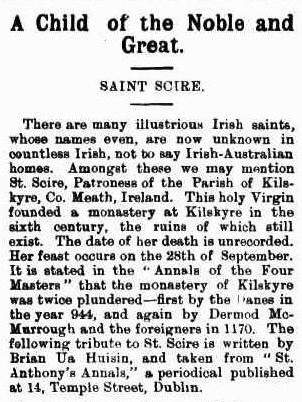
Whilst browsing the newspaper archives of the National Library of Australia I was surprised to find a 1904 article on Saint Scíre among the items of Irish interest published for the expatriate audience. It is accompanied by a poem in honour of Saint Scíre by the Irish nationalist writer and publisher Brian O’Higgins (Ó Huiginn), who was born in Kilskyre in 1882:
A Child of the Noble and Great.
SAINT SCIRE.
There are many illustrious Irish saints, whose names even, are now unknown in countless Irish, not to say Irish-Australian homes. Amongst these we may mention St. Scire, Patroness of the Parish of Kilskyre, Co. Meath, Ireland. This holy Virgin founded a monastery at Kilskyre in the sixth century, the ruins of which still exist. The date of her death is unrecorded. Her feast occurs on the 28th of September. It is stated in the “Annals of the Four Masters” that the monastery of Kilskyre was twice plundered—first by the Danes in the year 944, and again by Dermod McMurrough and the foreigners in 1170. The following tribute to St. Scire is written by Brian Ua Huigin, and taken from “St. Anthony’s Annals”, a periodical published at 14, Temple Street, Dublin.
Far back in the long vanished ages,
a child of the noble and great
Fled from the halls of rejoicing,
and far from her queenly estate;
And she came where a Meathian lowland,
in a mantle of silence was dressed.
She gazed on the beauties around her,
then said, “In your midst will I rest.”And soon was upraised from the valley
a cloister, a school, and a shrine;
And pilgrims came there o’er the ocean,
from the lands of the Seine and the Rhine;
And Scire the good gave them blessings
and welcomes a thousand times o’er,
For they sought in the language of Erin,
a share of her faith and her love.‘Twas fair! till the Danish invader
swept down with his fire and his sword,
To loot and to burn was his glory,
and greed was the God he adored;
Laid low were the walls of Kilskyre,
the weak ones were slain by the strong,
But their loved one, their guardian, their mother,
was spared to remember the wrong.Once more did the school and the cloister
uprise from the ashes of years,
Once more came a ruthless despoiler,
unmindful of prayers and of tears.
And the woundings of grim desolation
were laid on that fair valley’s face;
But out from it all flashed triumphant,
the faith which no hand could erase.Oh Scire! our patron, our mother,
remember thy children, and pray
That the faith which no torture could weaken,
may never bend low to decay;
That its lustre may cheer us and guide us,
that our toil in the future may be
For the.honour of down-trodden Erin,
for the glory of God and for thee.North Sydney, J.B. [7]
Saint Scíre is one of many female saints who, despite being recorded in the sources and present in the Irish landscape, remains a shadowy figure about whom we can only wish we knew more.
Notes and References
[1] Transcribed from a letter dated July 15, 1836, in the online edition of the Ordnance Survey of Ireland Letters, pp.44-47 here:
[2] Rev. B. O’Daly, ‘Material for a History of the Parish of Kilskeery’, Clogher Record, Vol. 1, No 1 (1953), pp. 4-17.
[3] P. Ó Riain, A Dictionary of Irish Saints (Dublin, 2011), 551.
[4] C. Harrington, Women in a Celtic Church: Ireland 450-1150 (OUP, 2002), 225 and fn 18.
[5] Brian Lacey, ed., The Life of Colum Cille by Manus O’Donnell, (Dublin, 1998), 59.
[6] Rev. T O’Rorke, History, antiquities, and present state of the parishes of Ballysadare and Kilvarnet, in the county of Sligo (Dublin, 1878), 2-3.
[7] Southern Cross, Friday 8 July 1904, p.3
Content Copyright © Omnium Sanctorum Hiberniae 2012-2026. All rights reserved.