Category: Female Saints

  • Saint Brigid of Kildare, February 1

    February 1 is the feast of the patroness of Ireland, Saint Brigid of Kildare. Most of the materials relating to Saint Brigid published on my previous blog, Under the Oak, have now been archived here. Below is a new post taken from the collection of Irish saints’ lives by Father Albert Barry. The writer relies heavily on the hagiographical record and thus presents a wonderful account of all of the most famous miracles and incidents from the life of Saint Brigid:

    SAINT BRIGID was born at Foughart (near Dundalk) in the year 449. Her father was Dubthach, and her mother was Broetsech. She was very holy, and worked miracles even in her youth. The young maiden was sent one day to a neighbouring house for meadh for her sick nurse, but got none. She filled her pitcher with water from a well on her way home, and this water became sweet meadh; and when her nurse drank it she became well.

    Her parents wished her to wed one of the many noble youths who sought to marry her; but she longed to give herself to God in the religious state, and answered like Saint Agnes: “I am betrothed to Him who has angels for his servants.” Her brothers met her one day as she was going to help a poor family. The eldest said roughly to her: ” Why do you wander about in this way instead of staying at home? You are unwilling to do the bidding of your father, and cling stubbornly to your own will: you lead a life of virginity to the dishonour and loss of your kindred; but we will overcome your wilfulness, and get you a husband, and thus get friends for our family.” The others, however, moved by her gentle bearing, said: “It is not right to persecute our sister in this way: she has chosen the better part: let her serve God as she likes: and let us not bring guilt on our souls.” The holy dove thus got free from the clutches of her headstrong brother.

    Brigid got the religious veil in the year 467 from Bishop MacCaille, in Uisneach Midhe (W. Meath). “She henceforth”, as an ancient writer says, “led a very holy life, helping the needy in all their wants. She was very modest and humble, never looking on the face of a man, given to fasting, prayer, and good works, spotless and patient, and gladly doing the will of God at all times. She was a consecrated shrine to receive the Body and Blood of Jesus Christ, a temple of God; her heart and mind were the throne of the Holy Ghost, and she shone brightly by her miracles. As a dove amongst the birds, as a vine amongst the trees, as the sun amongst the stars, so was she amongst other women; she helped all who were in distress and danger, healed sickness and kept the angry fury of the sea within bounds. She is the Mary of Ireland.”

    “She looked not on the face of man:
    Nor husband had; nor brother:
    But where she passed the children ran,
    And hailed that Maid their mother.

    O Saint, the favourite of the poor,
    The afflicted, weak, and weary:
    Like Mary’s was that face she bore,
    Men called her Erin’s Mary.”

    A. DE VERE.

    Seven maidens, who had consecrated themselves to Jesus Christ, came and lived with her, and walked blameless before God under her skilful guidance. The holy Bishop MacCaille one day made a feast for them. As soon as they had sat down Brigid said: “Father, first feed our souls with spiritual food.” He then spoke on the eight Beatitudes. When he had ended, she said: “My beloved sisters, we are eight in number, and eight virtues are set before us, let each of us choose one of them.” She herself chose Mercy. She henceforth began her meals with the Word of God.

    Saint Brigid met Saint Patrick soon afterwards, and heard him preaching. Whilst he was preaching she seemed to be asleep. Saint Patrick, after his sermon, said to her: “Tell aloud what you saw in sleep.” She answered: “I had this vision: I saw a herd of white oxen amid ripe corn: and then mottled oxen: then black ones: then sheep and swine: and lastly, wolves and dogs fighting.” Saint Patrick said: “That vision foreshadows the future state of this land.”

    Brigid worked many miracles during her lifetime. Jesus Christ had said: these wonders shall follow after those who have faith: they shall cast out devils in My Name: they shall speak with new tongues: they shall take up serpents: and if they drink any deadly thing it shall not hurt them: they shall lay their hands on the sick, and they shall get better. This promise was fulfilled in this holy Virgin, who was full of faith, whose conversation was in heaven, and who was destined by God to be the Patroness of Ireland.

    Brigid went to Anghaile, County Longford, where the O’Fearghails dwelt, and stayed in a convent of holy virgins. As soon as she went into it the Nuns washed her dust-stained feet, and then poured the water on the limbs of a Nun who was a cripple, and she at once became well. A woman came one day to the convent, bringing a basket of ripe apples from her orchard as a gift for Brigid. A leper was lying on the ground near the door. Brigid said to the woman: “Give some of these apples to that poor leper.” The woman answered: “I brought them for you and your Nuns, and not for lepers.” Brigid said to her: “Your trees shall not bear fruit again.” The woman, on her return home, found her trees withered, and they never bore fruit again.

    Brigid then went home with her Nuns. As they were driving along the road they saw a man with his wife and child working hard in a field under the scorching summer sun. Brigid looked with pity at them as they went about bent beneath their heavy loads in the sweltering heat, and bade the driver of her chariot unyoke the horses and give them to the man to help him at his work. She and her Nuns meanwhile sat down on the roadside. She said to a Nun: “Dig a little in the earth, and a stream of water shall flow; some men are coming, and they shall need to drink.” When the Nun had dug a little in the earth a clear stream of water bubbled up and began to flow along the dusty road. A throng of men, on foot and on horseback, followed by a Chieftain in his chariot, soon afterwards came in sight. They ran at once to the well to slake their thirst. When the Chieftain had learned what Brigid had done he made her a gift of his horses, and then went on his way thanking God and his holy spouses.

    She worked another miracle at this time. Two British wayfarers, knowing her great holiness, said to her: “We are sick and suffer much; we beg you to heal us.” She answered: “Go into the house, and you shall there get food and drink; and I meanwhile will pray to God in the Church for you.” But they said roughly to her: “You heal your own countrymen when they are sick, and you will not do anything for us who are strangers.” She said nothing; but, going into the church, got holy water, and then coming out sprinkled them with it, and they were at once healed. Some pagans, who were standing near, when they saw this miracle, were converted.

    Brigid built a monastery in the year 484 in a meadow amid wide-spreading oak trees, and many maidens flocked to that holy house and strove to walk in her footprints. It was called Cill-dara.

    “In woods of Oriel-Leinster’s vales,
    Her convent home she planted,
    And Erin’s cloistered nightingales,
    Their matins darkling chanted.”

    A. DE VERE.

    Her religious family was spoken of with respect far and wide; and the church of Cill-dara became a place of pilgrimage for all the Irish. Saint Broegan writes: “She was a ladder to heaven for very many souls, and was called by all the chaste Head of the Nuns of Erin.”

    “Saint Brigid is the mother, all men know,
    Of Erin’s Nuns that have been or shall be,
    From great Saint Patrick’s time to that last day
    When Christ returns to judge the world with fire!
    Her life was full of miracles.”

    A. DE VERE.

    Cuinnen of Conneire writes: “Brigid of the blessings loved ceaseless penance beyond womanhood, watching, and early rising, and hospitality to holy men.” She was wont to go forth from the convent on winter nights with another Nun, and to stand, with scanty clothing, for hours, in bitterly cold water, praying and reciting the Psalms.

    Brigid had many visions at this time. She one day saw men clothed in white garments hard at work ploughing the fields throughout the whole island, whilst other men sowed good seed in the furrows. She then saw men clad in black garments, ploughing and uprooting the growing seed. An angel said to her: “The workmen in white garments are Saint Patrick and his holy disciples; the men in black garments are teachers who shall come towards the end of time: they shall uproot the Gospel seed.”

    The Chieftains were ever fighting, like angry dogs, against one another. There was peace, however, wherever Brigid dwelt. Although, as an old writer says, “the whole island was a trembling sod” on account of the endless wars waged by the clans, no blood was ever shed in the neighbourhood of Cilldara during the lifetime of the holy Virgin. Many Chieftains fled to her for shelter, and the monastic church of Cilldara was looked on by all as a safe sanctuary and city of refuge. An ancient writer says: “The veiled Virgin, who drives over the Curreach, is a shield against sharp weapons. No one was found equal to her but Mary: let us put our trust in our Brigid.”

    A Chieftain, dwelling near the convent, came one day to see the holy Virgin, and, when he was leaving, got her blessing. He went home full of gladness. Whilst he was sleeping in his rath that night, a man, who bore him a deadly hate, broke into his dwelling, and, stealing on tip-toe into his bedroom, stabbed him with his own sword, which was hanging at the head of the bed. He drove it deeply into his body, and then fled, thinking he had killed him. The Chieftain screamed, and the inmates of the house rushed in and found him covered with blood. It turned out, however, that he was only slightly wounded. The Chieftain thereupon said to the bystanders: “Do not bewail what has happened, for the blessing which I got to-day from Brigid has saved my life.” He went early the next morning to thank her, and also gave her many gifts for herself and her Nuns. Brigid coaxed him to forgive the man who had striven to kill him, and, after some time, the two men became friends through her entreaties.

    Brigid was very hospitable and kind to strangers and travellers, and always gave whatever she had to the needy. She was an eye to the blind, and a foot to the lame, and a mother to the poor. Her Nuns one day said to her: “Mother, you give away everything that God gives to us through the hands of charitable Christians; you leave nothing to us, but give all to the poor.” She answered: “Give earthly things to God, and He will give you in return both earthly and heavenly gifts.” A young man one day putting on the clothes of a beggarman came to the convent, and bent down, leaning on a stick, and heaving deep sighs, begged Brigid to give him a sheep as an alms. The holy woman gave a sheep to him. He came back next day and begged her to give him another. She gave it. He came back day after day, until he had got at last the whole flock. He then gave them back. When the holy Bishop Broon had come with some of his Priests to the convent, she took off their sandals, washed their feet, and gave them food and drink as long as they stayed there. She also gave them a rich gift when they were leaving, as she was wont to do whenever a guest was going away. God would not allow Himself to be outdone in generosity, and gave her power to multiply food and drink. Corn and meadh, when blessed by her, often wonderfully increased, like the oil in the house of the widow of Sarepta when blessed by the prophet Elias.

    [Saint Brigid wrote this Hymn,]
    “I would like the viands of faith and true piety: I would like the flails of penance to be in my house,
    “I would like the men of Heaven to be at my house.
    “I would like kieves of peace to be at their disposal:
    “I would like vessels of charity for distribution: I would like caves of mercy for their company.
    “I would like cheerfulness to be in their drinking: I would like Jesus also to be amongst them,
    “I would like the three Marys of illustrious renown: I would like the people of Heaven to be there from all parts.
    ” I would like to be a rent-payer to the Lord, that should I suffer distress, He would bestow a good blessing upon me.”

    Some holy virgins said one day to Brigid: “Mother, why do not water-cresses, on which holy men live, grow in this stream?” She answered: “They shall grow there in future.” She prayed all through the following night to God to work this miracle, and the banks of the stream were thickly covered with water-cresses the next morning.

    Bishop Mel came at this time to see Brigid, and stayed some days at Cilldara. He begged her to go with him to Tailten (Co. Meath) where Saint Patrick was then holding a synod. Whilst she was there she often spoke to Saint Patrick, and got great help from his teaching. He gave Priesthood to Natfraich, and gave him to her to be her chaplain. She then went back to Cill-dara. As Natfraich was one day driving her chariot, she asked him to give a spiritual discourse to herself and to the Nun who was seated by her side. He threw down the reins, and, turning round, spoke of spiritual things to them. The horses, suddenly taking fright, ran down a steep road overhanging a precipice; but they met with no hurt, having been protected by God.

    Nectan Mor, a Pictish King, having being driven from his kingdom by his brother Drust, came to see the holy Virgin, and begged her to pray for him, Brigid foretold to him that he would get back his kingdom, and that God would have mercy on him. It happened as she had foretold; and when he became King once more, he gave Abernethy to God and to her in the presence of her disciple, Saint Darlughdach, who sang Alleluia over the gift.

    The holy Bishop Ercc of Slaine (Co. Meath)  came to see her, and begged her to go with him to Desmumha (S.Munster). As they were going along the road Brigid said to him: “Show me with your hand, where your birthplace is.” He showed it to her, and, seeing that she had a sorrowful look, he said: “Why are you so sad?” She answered: “Because there is warfare now between your family and a neighbouring tribe.” The Bishop said: “I readily believe it, for they are very unfriendly to each other.” Brigid soon afterwards said to him: “Your friends have been beaten in battle and are flying from the field.” He afterwards learned that she had spoken the truth. They went through Hy-Failge and Eoganacht, and came to the rich plain of Feimin. Brigid worked many miracles there. Bishop Ultan wrote them in a book in the year 650. They arrived at length at the home of Bishop Ercc, near Dun Gurbhan, on the seashore. She then saw the southern ocean for the first time.

    She beheld the great sea slowly break on the shore,
    And her heart quickly beat as she list to its roar,
    For a vision it seemed of God on His throne,
    And deep awe filled her soul as she stood there alone.

    Brigid then turned her footsteps towards Aradha Cliach (Co. Limerick). She and her companions got food and shelter on their journey sometimes at the strongholds of Chieftains and sometimes at “houses of hospitality” built alongside the great roads at short distances from each other. They reached Aradha Cliach in a few days.

    Brigid stayed for some time in the golden plain of Aine (near Kilmallock). Whilst she was there she learned that a man was kept as a slave by the King of that country: She went into his rath, but did not find him at home. His foster-father and his children, however, were there. Brigid seeing harps hanging on the wall said to them: “Play for us on your harps.” The young men said to her; “The harpers are, not here, they have gone out on the highway.” A man who was with Brigid then said to them in fun: “Play yourselves on the harps for us, and Brigid will bless your hands so that you may be able to play: do whatever she bids you to do.” They answered: “We will play: let her bless us.” They then took hold of the harps in their hands and began to play. The King heard the music as he drew nigh to the house and asked: “Who is playing?” He learned what happened, and, going in, begged Brigid to bless him also. When she had blessed him she said: “Do you now in turn give freedom to the man who is in chains.” He gave the man his freedom at her request. Brigid then went back to Cill-dara, and soon afterwards heard of the death of Bishop MacCaille, at Cruach-an-Bri Eile (Croghan) in the year 489.

    Saint Conladh, a hermit living in Magh-Liflfe, came to Cill-dara in the year 490, and soon afterwards became Bishop there. He once gave some rich vestments as a gift to Brigid, “but she” as Saint Broegan writes, “gave to the poor even these rich vestments which Bishop Conladh had used when offering the Sacrifice on the festivals of the Lord.” Saint Conladh died in the year 519.

    Brigid and a blind Nun sat side by side, speaking of God and of heaven, one evening as the sun was sinking in the west. The night wore on whilst they were speaking, and daybreak came. The bright morning sun stood on the hilltops, and turned earth and sky to gold. When Brigid saw the fields and trees glittering in the sunshine and sparkling with dew, she felt sad at heart at the thought that her beloved friend could not behold “the beauty of heaven with its glorious show,” and she prayed to the God who had made the sun to give light to her eyes. She then laid her fingers gently on the sightless eyeballs, and the Nun at once was able to see. She feasted her eyes for a long time on the blue sky, the bright flowers, and the green meadows, gleaming with sunlight, and thanked God with her whole heart. Withdrawing her eyes from the lovely scene, and looking at Brigid, she said: “Mother, shut my eyes again, for I fear lest the better I am able to see earthly things the less I shall be able to see heavenly things” Brigid yielded to her wish, and she became blind for evermore.

    Brigid was now always living in thought in heaven. Saint Broegan writes: “Brigid never loved the world, and her thoughts were ever in heaven. She overflowed with faith. She never spoke ill of anyone. She was kind-hearted and charitable, and had no care but for God alone, and God worked more wonders through her than through anyone else. She showed the same love to all, to the servants as well as to her spiritual daughters, to
    beggars, and to the sick.”

    “Bridget never turned away her mind from the Lord, even for one hour, but was ever thinking of Him in her heart and mind. She spent her time diligently serving the Lord, doing wonders and miracles, healing every sickness, until she gave up her soul to heaven.” (Annals of Ireland.)

    When Brigid, soon after she had become a Nun, was one day driving, she saw a giddy youth running wildly along the road. She sent one of the Nuns to fetch him. He would not come to her at first, but the Nun at length coaxed him to go to her. Brigid said to him, as he stood abashed before her: “Whither were you running?” The giddy boy began to laugh, and answered: “I was running towards the kingdom of Heaven.” Brigid said to him: “Would that I were worthy to run with you to-day towards the kingdom of God: pray for me that I may go to that blissful land.” The boy answered: “Saint, pray to God that I may go straight to heaven; and I will pray in turn that you may have everlasting happiness, along with many others” Brigid said to him: “I shall get the Body and Blood of my Lord Jesus Christ from your hand when I am dying.” The boy answered: “Would that you might live long enough to get Communion from me.” He then went away. But Brigid prayed much for him, and he thenceforth led a very holy life, and carefully kept that hand stainless which was to give the last sacraments to the holy Virgin. He was therefore called Ninnidhlamh-glan, Ninnidh of the stainless hand. He became a Priest, and, sailing to Britain, did much good there during many years. He was now once more with Brigid at
    Cill-dara, for her holy life was drawing to an end.

    The snow-white rose whom Christ had made His bride in His blood was about to be planted in the heavenly garden of her Spouse: the busy bee that had been gathering honey during her whole lifetime, was going to where it was stored in the city of God: the wise and faithful Virgin was going forth to meet the divine Bridegroom with the lamp of grace burning brightly in her soul: she was going to drink for ever of the water of life, and to eat for ever of the tree of life. Brigid, the Queen of the South, the Mary of the Irish was dying surrounded by angels, and by her Nuns. She died a holy and happy death, February 1st, in the year 523.

    Her body was buried in the Church, and the Nuns, as Bishop Edmund O’Dwyer writes, kept a fire burning day and night before it: “The hearth burns with Brigid’s unceasing fire, and the ashes do not increase: it is the emblem of her loving soul.” The bodies of Saint Conladh and of Saint Brigid were afterwards placed, one on the right and the other on the left of the altar, in shrines adorned with gold, silver, and precious stones: and golden crowns were hung overhead.

    The relics of the holy Virgin were taken away when the Danes made an inroad into Hy-Failge, in the year 835. Bishop de Burgo writes: “I saw the head of St. Brigid, the Patroness of Ireland, in the year 1770 in the chapel dedicated to her in the Church of Saint John Baptist, at Lumiar, near Lisbon. Her Office and Mass are celebrated February 1st, and the members of the Sodality founded in her honour assist at them. Sheep and cows are brought there to be blessed.” — Hibernia Dominicana.

    Saint Brigid was honoured for many ages in the Irish Church as the special Patroness of ecclesiastical students.

    Rev. Albert Barry, Lives of Irish Saints (Dublin, n.d.), 1-18.


    Content Copyright © Omnium Sanctorum Hiberniae 2012-2015. All rights reserved.

  • Saint Cera of Kilkeary, January 5

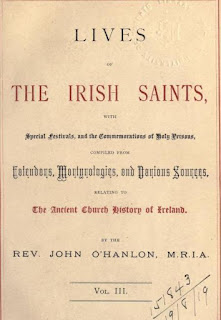
    January 5 is one of the feast days of Saint Ceara, patroness of Kilkeary, County Tipperary. The account below has been taken from Volume I of Canon O’Hanlon’s Lives of the Irish Saints:


    ST. CEARA, CIAR, CYRA, CIOR, OR CERA, VIRGIN, PATRONESS OF KILKEARY PARISH, COUNTY OF TIPPERARY.

    [SEVENTH CENTURY.]

    We find the name of this holy virgin variously written Ceara, Ciar, Cior, Cyra, and Cera in the Irish Menologies. Our national hagiographist, Colgan, has endeavoured to compile acts of this saint for the 5th of January; but it is probable he fell into mistakes during the process. According to his computation, she must have been born sometime about the middle of the sixth century. It seems more likely, however, that her birth took place about or after the commencement of the century succeeding. The father of this holy virgin was named Duibhre. Her origin is derived from the royal race of Conor, King of Ireland. Both in this island and in Scotland many royal and saintly descendants from this monarch flourished. As founders of families and religious houses many of those personages are distinguished.

    St. Cera is said to have been a native of Muscraidhe Thire but in what particular part of the present baronies of Upper and Lower Ormond, in Tipperary county, she was born has not transpired. As she grew, however, the fame of her sanctity and miracles became widely known. A miracle having reference to her is introduced by Colgan, in which it is stated, that at the request of St. Brendan, patron of Clonfert, this holy virgin, St. Cera, by her prayers extinguished a pestiferous fire which had broken out in the region of Muscraidhe Thire.” Her reputation for piety soon drew many virtuous persons to imitate her example. She was then induced to erect a nunnery, which took the name of Cill Ceire from her. It is now known as Kilkeary, near Nenagh, in the barony of Upper Ormond, county Tipperary. Here she governed a community of nuns, but not so early as the sixth century.

    There appears to be no sufficient reason for supposing she lived contemporaneously with St. Brendan of Clonfert; and the story to which allusion has been already made may rest only on popular rumour, or have reference to some other St. Cera. Perhaps, indeed, as we shall see hereafter, she may have lived in the time of a St. Brendan, who was quite a different person; and in the case of homonymous saints, it may often be doubted, if legends prevailing and attributed to one of them may not rather be ascribed to some other, and to a totally distinct person.

    Having ruled over her religious establishment in Muscraighe Thire for some time with great prudence and sanctity, Cera found the number of her postulants daily on the increase. She then resolved on seeking another location where she might erect a second house. Accordingly, the holy woman left Kilkeary, in company with some of her religious. She directed her course, it is said, towards Heli, or Ely O’Carroll country – but it would appear she went beyond its bounds to the northern part of the King’s County. From St. Fintan Munnu she is said to have obtained the site for a nunnery, and at a place called Tech Telle. It is now known as Tehelly. There St. Fintan Munnu lived; but to St. Cera and to the five nuns who accompanied her he resigned that site. Here she is thought to have remained for some time – afterwards she returned to Kilkeary.

    A learned writer supposes St. Cera’s establishment was not formed at Kilkeary until after she had left Tech Telle; but for this opinion he assigns no valid reason. At all events, in Kilkeary she spent many years, which were devoted to the exercises of penance and of a holy life. To reconcile his conjecture that St. Cera lived before the death of St. Brendan the Navigator, Colgan maintains that she must have attained the extraordinary age of 120 or 130 years. This holy virgin resigned her pure soul to the Creator on the 5th day of January, A.D. 679,- but another festival to her memory is held on the 16th of October. The following stanza, from the Leabhar Breac copy of the Feilire of St. Oengus, in Irish, at the Nones of January, with its English translation, was obligingly furnished by Mr. O’Longan : —

    ” The call of Semeoin, the sage,
    To Christ of purest form ;
    A new transitory gentle sun was
    Ciar, the daughter of Duibrea. ”

    According to this translation, the probable inference to be drawn from the foregoing would be that Ciar lived for a short time only, and yet her virtues shone brightly; while it is right to observe the commentator on this passage seemed to think she lived only a short time before St. Oengus wrote, for in a gloss he thus states:

    “not long since, or short since, she was, i.e., in Cill Chen, in Muscraidhe Thire, and she is of the race of Conaire.”

    The Semeoin alluded to in the text was St. Simeon Stylites, venerated at the 5th of January. The “Martyrology of Tallagh,” the “Calendar of Cashel,” Marianus O’Gorman, and the “Martyrology of Donegal,” commemorate a Ceara on both these days. This latter feast, however, may have reference to a different saint of the name, for we find her called Ceara, of Maghascadh. Yet it is expressly stated by Marianus O’Gorman and Charles Maguire that the present St. Cera’s body was buried in the Church of Magh-ascadh. It seems doubtful enough if this can be identical with the Church of Kill-chere, where the “Calendar of Cashel” and other authorities state that her remains repose. Some confusion seems to have arisen, for there are different saints of this name represented as having been assigned to various days in our Menologies. It is conjectured by Colgan that the 5th of January must have been her natalis, or the date for St. Cera’s death – while the 16th of October must refer to some other commemoration or solemnity, probably to a translation of her relics.

    Content Copyright © Omnium Sanctorum Hiberniae 2012-2015. All rights reserved.


  • Saint Fanchea of Ross Oirthir, January 1

    We begin the month of January with a female saint, Fanchea of Ross Oirthir, sister to Enda (Endeus) of Aran. Canon O’Hanlon’s account of her below illustrates one of the strengths of his Lives of the Irish Saints, for he has relied on the account of the great 17th-century Irish hagiologist, Father John Colgan, a work I would have found it difficult to otherwise access. It seems that Colgan himself lamented that no Life of Saint Fanchea had survived and he was thus forced to use the Life of her more famous brother as a primary source. The Life of Saint Enda appears to credit Fanchea with having played a crucial role in both the conversion of her brother and in his decision to pursue the monastic life. She is portrayed as having acted as a counsellor in spiritual matters and he as having heeded her advice. There is a particularly interesting account of both having been pilgrims in Rome and of some Latin visitors coming to Ireland.

    I have taken some liberties with O’Hanlon’s text, omitting a few sections, but the original is available through the Internet Archive if you wish to read it in its complete form. There are some disturbing hagiographical devices to be found in the account of Saint Fanchea, one at the beginning concerning the brutal way in which Fanchea brings Enda to his senses over the body of his dead fiancee, and another at the end concerning the unholy rivalry between the peoples of Leinster and Meath over Saint Fanchea’s remains. Both are stock in trade as far as medieval hagiography is concerned, but seem somewhat grotesque to the reader of today. Canon O’Hanlon, however, ends his account, as he often does, with one of his charmingly pious homiletics.

    ST. FANCHEA, VIRGIN, ABBESS OF ROSS OIRTHER, OR ROSSORY, COUNTY OF FERMANAGH, AND OF KILLANY, COUNTY OF LOUTH.

    …This saint’s name is found variedly written Fanchea, Fuinchea, Fainc, Fuinche, and Funchea. Four other holy virgins bearing this name are inscribed on our Irish Calendars. To the present St. Fanchea’s name, the denomination Garbh, is also found affixed. She was daughter to Conall Dearg, prince of Oriel territory, in the Ulster province; while her mother was Briga, or Aibfinn, daughter to Anmiry, of the Dalaradian race. St. Fanchea was born at a place called Rathmore, in the vicinity of Clogher. She was sister to the celebrated St. Endeus, Abbot of Aran, as also to Saints Lochina, Carecha, and Darenia. When our saint grew up, she was distinguished for extraordinary beauty; but remarkable virtues rendered her still more admirable.

    Aengus, son of Natfraich, King of Munster, is said to have desired Fanchea’s hand in marriage. Notwithstanding all his pressing entreaties, however, and rejecting those earthly dignities to which she might be advanced by yielding to his suit, the holy virgin’s mind was intent on a life of celibacy, and on those rewards promised by Christ to his spouses. Even she was obliged to resist parental importunities in refusing this offer of a matrimonial alliance. In order to divert Angus from his solicitations, she had sufficient address, while declining his advances towards herself, to direct his attentions towards her sister Darenia. To her he was afterwards united in marriage. Darenia was the mother, or, according to another account, the aunt and nurse of St. Colman, who was Abbot and Bishop at Daremore or Derrymore Monastery.

    In the list of holy virgins, who received the veil from St. Patrick, St Fanchea is numbered by Colgan; this statement, however, seems to rest on no good authority. Her reputation for piety was so great that several ladies of royal birth were numbered among her disciples, and placed under her rule. Having entirely consecrated herself to God, Fainche, in her own person, furnished a bright example of self-denial and sanctity. Many others of her sex, desiring to walk in the way she had marked out, renounced the pleasures of this world, for happy enjoyments in the next. She built a nunnery, at a place called Ross Oirthir, on the borders of Lough Erne, and within the present county of Fermanagh. It appears to have been within the patrimonial territory of Oriel.

    …This holy virgin exercised a great and holy influence over her brother, St. Endeus. Some discredit has been thrown on his Acts, which are regarded as abounding in fables. Yet those acts are the chief authority we can discover to furnish us with particulars regarding St. Fanchea. From Endeus’ life we learn how in a great measure she contributed to effect his conversion, and move him to a change of life. On the death of his father, Conall, St. Endeus succeeded in the chieftainship over his principality, and with the unanimous acclaim of his own people. The young prince preserved himself free from all corrupting influences of rank and station; but, on a certain occasion, being urged by some clansmen to march against his enemies, Endeus gave a sort of unwilling assent to their intreaties. However, the young chief did not allow his mind to be filled with malice or revenge against his adversaries. One hostile to Endeus having been killed by his soldiers, these returned towards their own country. As they approached St. Fanchea’s house the band sang a triumphant song in praise of their recent victory. Hearing the approaching sounds, St. Fanchea said to her community, “Know you, my sisters, this dreadful vociferation is not pleasing to Christ?” Then recognising the vocal tones of their chieftain, Endeus, among his followers, by some Divine intimation, Fanchea cried out, “He is a son of Heaven’s kingdom, whose voice is so particularly distinguished.” She knew her brother’s heart, with all its defects, to be chivalrous and pure. Wherefore, standing at the gate of her nunnery, Fanchea said to the chief, “Do not approach near us, for thou art contaminated with the blood of a man who is slain.” Endeus replied,”I am innocent of this murdered man’s blood; and, as yet, I am free not only from homicide but even from carnal sins.” The virgin then said, “O wretched man, why do you provoke the Lord to anger? And why do you plunge your soul into the depths of sin by your various crimes?” Endeus answered, “I hold the inheritance of my father, and therefore I am justified in fighting against my enemies.” His sister replied, that their father, whose sins were his own, was then enduring punishment for them in another world.

    Endeus afterwards requested his sister to give him a certain noble maiden placed under her care for his wife. He promised in the future to follow those religious admonitions he had thus received. The holy virgin said she should soon give a response to his petition. Immediately going to the place where the aforesaid maiden lived, Fanchea said to her, “A choice is now given: dost thou desire to love the Spouse whom I love, or a carnal one?” The girl replied,”I will love Him whom you love.” Fanchea said to her, “Come with me into this chamber that here you may rest a while.” The maiden complied, and placing herself upon a bed she soon expired. Her pure soul fled to the guardianship of her chosen and heavenly Spouse. Having put a veil over the face of this deceased young lady, St. Fanchea returned to Endeus. She then conducted her brother to the chamber of the dead. Uncovering the departed maiden’s features, Fanchea exclaimed, “Look now upon the face of her whom thou hast desired.” Endeus, struck with horror, cried out, “It is at present sadly pale and ghastly.” “And so shall your features hereafter be,” replied the virgin. Then Fanchea spoke to him regarding the pains of Hell, and dwelt also on the joys of Heaven, until the young man burst into tears. Having heard these discourses of his holy sister, despising the vanities of this world, Endeus took the habit of a monk and received the tonsure. Thus he embraced the clerical profession, and became eventually one of the most distinguished among the saints of Ireland.

    The companions of Endeus, hearing about his conversion, endeavoured with some manifestations of violence to excite his feelings, and to withdraw their chieftain from a fulfilment of his purpose. It is said that St. Fanchea offered up her prayers, and she made the sign of the cross against this unjust attempt. The clansmen’s feet then became fastened to the ground. On that spot they remained like so many immovable statues. A fine moral lesson is then envolved by the legend-writer. It seemed those men, who were so much attached to earthly pursuits should even in this manner, although unwillingly, adhere to earth. As misfortune often produces a better frame of mind, entering upon a consideration of their state, the culprits promised to do penance when released from bondage. Thus, what the Lord said to the Apostles when he sent them to preach,”Whatsoever you shall bind upon earth, shall be bound also in heaven, and whatsoever you shall loose upon earth, shall be loosed also in heaven,” seemed to have been fulfilled in the person of this apostolic virgin. Hereupon the newly-converted chief began to fulfil by works what he had conceived in mind.

    With his own hands Endeus commenced digging earth around the nunnery. This habitation he fenced in with deep trenches. He rooted up thistles and other noxious weeds likewise, and with all the care of an experienced husbandman. Having bestowed the necessary amount of labour on this nunnery, the servant of Christ went to a place afterwards called Killaine, now known as Killany, in the county of Louth. There he intended to found a house for a religious congregation of men. Here also he became oeconomus, or steward, over artificers who were engaged upon his buildings, and he furnished the workmen with all necessary supplies. From the context of his acts it would seem that a nunnery for Fanchea, or a branch establishment for her religious, was established here; and it appears even probable that the holy sister of Endeus resided at Kill-aine for some considerable time previous to her death.

    We are told, while he lived at Kill-aine, certain robbers, enemies to Endeus and his country-people, from a district called Crimthann, passed with their booty near the monastery. Pursuing these robbers, the clansmen of Endeus had there overtaken them. When about to attack the spoilers at this place, feeling an irresistible desire to succour his friends, their former chieftain seized one of those wooden poles which were used in building his monastery. That Endeus intended to employ as a weapon. But St. Fanchea then said to her brother,”O Endeus, place your hand upon your head, and recollect you have taken the crown of Christ.” On obeying this command Endeus immediately felt he had assumed the clerical tonsure. Withdrawing his hand the holy monk remained in his cell, and at peace with all mankind. He who once puts his hand to the plough and afterwards looks behind is not fit for God’s kingdom.

    The virgin Fanchea afterwards counselled her brother to leave his native country and kindred, lest perchance he might again be tempted by any worldly considerations to forsake that path in which he trod. She wished him to visit Britain, and to enter Rosnat Monastery, that he might become an humble disciple of Mansenus, who presided over that house. Having listened attentively to her advice, Endeus asked how long he should remain there, when Fanchea told him to continue until she should have received a good report regarding the manner in which his time had been spent. Wishing to fulfil his sister’s desire, St. Endeus passed over the sea, and came to the aforesaid monastery. There he remained under the discipline of its abbot, Mansenus. When he had made sufficient progress in learning and in the science of a religious life, he took another sea-voyage on his way to Rome. Here Endeus disposed himself for the reception of Holy Orders. After a diligent study of examples left by the saints, it pleased Almighty God to invest him with the priestly dignity. Carefully considering the duties of his new profession, he deemed it incumbent to show others the way towards heaven. Therefore, having collected some disciples, he erected a monastery. This was called Latinum; but the place where it was situated appears to baffle further enquiry.

    After some time had elapsed, certain pilgrims came from Rome to Ireland, where they visited St. Fanchea’s cell. The virgin held some conference with them. Among other religious acquaintances those strangers mentioned the name of Endeus, who was a native of Ireland, and whose reputation for sanctity had been much extolled by all who knew him. They told her where the monastery over which he presided stood. On hearing this account St. Fanchea knew St. Endeus was her brother. She then resolved to pay him a visit, in company with three other virgins. The abbess ordered these to take none of their effects along with them; but one of her companions disobeyed this mandate and brought a brazen vessel, which she conceived would be of use in washing their hands during this journey. A strange and incredible legend is then related to account for the detection and reproof of such disobedience. A prosperous voyage is said to have conducted those adventurous females to the wished for port in Britain. Further they journeyed, perhaps, but our accounts fail us in reference to this matter.

    The Almighty, who reveals wonderful secrets to his friends, was pleased to enlighten Endeus regarding the approaching visit of those religious females from Ireland. His brethren were directed to prepare all things necessary for their expected arrival. While the monks were thus engaged, the holy virgins appeared at their monastery gate. St. Fanchea preferred a request to see her brother; but she was told she might have her choice of two alternatives—either to receive his greetings without seeing him, or to see him without receiving his salutations. The virgin said she preferred the choice of conversation without the permission of seeing him, thus conceiving she should derive more advantage from her visit. Endeus then had a tent erected in the grounds of his monastery. Being veiled from her sight, the abbot entered into conversation with his sister. Fanchea advised that as God had gifted him with talents, he ought to exercise these among the people of his native land, and thus enhance doubly their value. Hereupon Endeus replied, “When a year shall have elapsed after your return to Ireland, I hope the Almighty may permit me to follow you.” Fanchea then said to her brother, “When you come to Ireland do not enter the land of your nativity at first, but rather seek out a certain island called Aran,” which is situated off the Irish western coast. The interesting group of Aran islands lies at the entrance to Galway Bay, and out in the Atlantic Ocean.

    Having thus advised her brother, she received his benediction, and afterwards she appears to have passed over into Ireland with her virgins. Under the guidance of angels, they escaped all sea dangers, and landed safely in their native country. It would appear, however, St. Fanchea did not long survive her arrival in Ireland. As a further favour, she obtained from heaven that her soul might be permitted to escape from the prison of the body. She wished it to ascend with the celestial attendants of her voyage to that kingdom, where virgins “follow the lamb whithersoever he goeth.” From the obscurity of that narrative, contained in St. Endeus’ Life, it is not possible to discover whether our saint lived to reach her native shore, or whether she died during her last sea voyage. Her religious sisters greatly lamented her decease.

    A contention arose between people belonging to the provinces of Meath and Leinster for possession of this holy virgin’s body. What claim the Leinster people had to her remains does not appear, unless her death took place among them. This quarrel was appeased in a miraculous manner. Fanchea’s remains seemed to rest on a vehicle borne by two oxen. These animals are said to have preceded the people of Leinster, bearing the supposed body of this holy virgin towards a cell, which was called Barrigh, in Magh-Lifife. There the Leinster people deposited what they had conceived to be St. Fanchea’s body but the people of Meath in like manner saw oxen preceding them and bearing the real body of St. Fanchea, while the companions of her voyage were present at this funeral procession. Having arrived at the nunnery, commonly called Kill-aine, the remains of our holy virgin were there deposited to await the day of final resurrection. This most pure virgin, the spouse of her Heavenly Bridegroom, is thought to have departed to her long-desired and beatific rest on the feast of our Lord’s Circumcision. This day her natalis is kept, according to our Irish Martyrologies. It seems probable, however, that her feast had been more solemnly observed on a different day. Some held this opinion for various reasons. St. Fanchea lived in the fifth and died, it is thought, about the commencement of the sixth century. Long ago has this noble virgin, drawing life from the fountain of Divine love while on earth, passed away from its unrealities to perennial enjoyment with the blessed in heaven.

    Content Copyright © Omnium Sanctorum Hiberniae 2012-2015. All rights reserved.