Category: Female Saints

  • Saint Brigid of Moin-Miolain, March 9

    On March 9 the Irish calendars commemorate Saint Brigid of Moin-Miolain and also another Brigid whose locality is not specified. The entry in the Martyrology of Donegal reads:
    9. E. SEPTIMO IDUS MARTII.

    BRIGHIT, of Moin-Miolain.
    BRIGHIT.

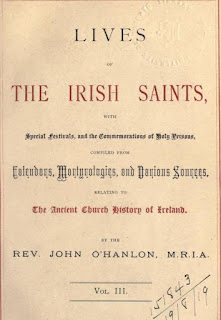
    As Canon O’Hanlon explains, not much is known of either: A saint, named Brigit, Mona Milain, occurs in the Martyrology of Tallagh, as distinguished from another St. Brigid, whose festival is set down, at the same day, the 9th of March. We are informed, likewise, that the Martyrologies of Donegal and of Marianus O’Gorman make a like distinction, at this same day. They record, that our present saint was venerated, at a place called Moin Miolain. There seems to be little consistency, in Colgan’s statements; when, in one place, he notes her, as the daughter of Neman, and at another, as mentioned by Keating, the Brigid, daughter to Aidus, son of Eochad, son to Colle, son to Caelbad, King of Ireland. Colgan says, Moin-Miolain is to be found, in Dalaradia, where the posterity of Caelbadius, a supposed progenitor to this saint, had extensive sway. The Bollandists have notices of Brigidade Moimiolain, at the 9th of March. It has been conjectured, that the present saint may have been that holy virgin, called Brigh, and mother of the handmaids of Christ, mentioned in the Acts of her great namesake, St. Brigid of Kildare. However, her history is involved, in great obscurity. He adds in a footnote:
    Speaking of the many saints, bearing the name of Brigid, in Ireland, we find the following enumeration in Dermod O’Conor’s translation of Keating’s ‘History of Ireland’: “The religious women that were known by the name of Bridget in that kingdom were fourteen, and were those that follow: Bridget, the daughter of Dioma; Bridget, the daughter of Mianaig; Bridget, the daughter of Momhain; Bridget, the daughter of Eana; Bridget, the daughter of Colla ; Bridget, the daughter of Eathtair Ard; Bridget, of Inis Bride; Bridget, the daughter of Diamair; Bridget, the daughter of Seannbotha; Bridget, the daughter of Fiadnait; Bridget, the daughter of Hugh; Bridget, the daughter of Luinge; Bridget, the daughter of Fischmaine; Bridget, the daughter of Flainge,” book ii., p. 389.
    Content Copyright © Omnium Sanctorum Hiberniae 2012-2015. All rights reserved.
  • Saint Aldetrude of Malbod, February 25

    At February 25 Canon O’Hanlon brings an account of a Belgian abbess, Altedrude of Malbod, whom the seventeenth-century hagiologist, Father John Colgan, claimed was of Irish descent:

    St. Aldetrude, or Aldetrudis, Virgin and Abbess of Malbod, or Maubeuge, Belgium.

    This holy virgin is claimed as belonging to the Saints of Ireland, by Father John Colgan, who inserts her Acts at the 25th of February, because on the father’s side, her ancestral blood was Irish, even although she was born in Belgium, and lived there. The Bollandists, after a Scholiast introduction, produce a brief Latin Life of the saint, adding some few notes, by way of elucidation. These Acts are made up from a Manuscript Codex of St. Aldetrude’s Life, found in the Monastery of Rubra Vallis, near Bruxelles, and inserted in the first part of the Brabantine Hagiology; and again, from Lessons of the Breviary, for the collegiate church of Mons, founded by St. Waldetrude. The father of St. Aldetrude was Maelceadar or Maldegarius, also called Vincent, the latter name having been received on account of numerous victories he obtained, and for this reason, too, he was created Count of Hainault, in the Low Countries, by Dagobert, the renowned King of the Franks. This latter monarch to increase those honours gave his relative St. Waldetrude, or Waldetrudis, in marriage. Their alliance was the happy occasion, for giving at a future time four holy children to the Church, viz. : St. Landric, Bishop of Meaux; St. Dentelinus, Patron of Rosensis, in Cleves; St. Aldetrude and St. Madelberta.

    The sister of St. Waldetrude, called St. Aldegunde, had founded a religious establishment at Maubeuge, a town in French Flanders, and near the southern border line of Belgium. From her earliest infancy, St. Aldetrude, with her sister, St. Maldeberta, was distinguished for her pious dispositions; and both were placed under the charge of their holy aunt Aldegunde, to receive a secular and a religious training. The influence and precepts of this holy woman soon brought her nieces to despise the vanities of this world, and to resolve on dedicating their virgin souls to Christ. Our saint especially loved to hear the Gospel sentences, relating to the wise and foolish virgins, she engaged in fervent and constant prayer, in continual vigils, in abundant alms-givings. One interesting anecdote is related. Being resolved, that the wax used in the altar candles should not go to waste, Aldetrude gathered the scrapings, drippings, and fragments of tapers to put them again into the pot. When placed on the fire, however, and when the wax melted, it caught fire. Thinking there was danger from the blaze, and not wishing to lose the wax, Aldetrude boldly seized the pot, and lifted it in her hands from the fire, to the stone floor. Although some of the melted wax ran over her hands and arms, she miraculously escaped without any burn or hurt, as a consequence of this brave adventure. This gave great edification to all the servants of the convent, who were present.

    Several sisters in her nunnery had remarkable visions, confirming the sanctity of Aldetrude. One of these visions showed a star descending and ascending, as if inviting the nuns to the marriage feast of their heavenly bridegroom. When her holy aunt, Aldegunde, was summoned from earth to heaven, our saint was appointed to succeed her, in the administration of conventual affairs, at Maubeuge. Over this community she presided most religiously, for a term of twelve years. During this period, St. Aldetrude ruled her nuns with great care and charity. One of her spiritual daughters, when the offices for the day had ended, and when all had retired to rest, enjoyed a vision of the Apostle St. Peter and of St. Aldetrude. They seemed to stand, at the corner of the altar, and engaged in conversation. With a benignant smile, the Apostle was heard to exclaim: “Have courage, amiable virgin, for I shall have thee and thy servants under my constant guardianship, and I shall bring to naught the efforts of the old enemy.” Again looking, the nun saw a honey-comb on the lips of her Abbess, and a ladder was near, by which she endeavoured to ascend towards heaven. The relation of this vision gave great comfort to Aldetrude’s religious community.

    Another nun heard one Sunday night the sound. of men’s voices speaking to the Abbess, whose hand she held in the courtyard of the nunnery. Yet could she see no person. But venturing to ask her superioress, what she had learned, the latter said, “I heard them say : because thou art a queen, thou shalt be wedded to an eternal king.” Aldetrude then fell upon her knees, and in joy struck her breast devoutly, saying, “Lord, how can this be, since I am an unworthy sinner?” Another time, eagles were seen flying towards heaven and bearing thither, as it were, St. Aldetrude and her prayers. Yet, she had some doubts regarding their efficacy, and respecting her own merits ; but, she was re-assured in a nocturnal vision, when she saw a large and a bright crystal globe fly before her and towards the East. A few days, afterwards, a holy priest told her, that on the night of the Epiphany, he beheld a venerable long-haired man, coming as an Eastern King, with three wands, bearing flowers, in his hand. These he presented to Aldetrude, saying, “Thou shalt rule them with a wand, and they shall grow in her hand to the clouds.” The holy Abbess fell on her knees, and prayed with tears to God. Again, being in the open space, before the doors of her church, and alone, looking towards the south, she was dazzled with the most vivid flashes of lightning, while a tremendous roar of thunder was heard. This terrified her so much, that she cried out, “Lord Jesus, into thy hands, I commend my spirit.” Suddenly, our Lord Jesus Christ himself, in the shape of a most comely young man, passed by, and said, “Be not afraid, I will guard you.” This gave her great confidence and courage.

    One of St. Aldetrude’s religious sisters related to St. Dado or Audoen, the bishop, a full account regarding the Life of her Abbess, not doubting but they should have an account of it for Maubeuge Nunnery, as the Abbot Sobnias, or Sobinus, had written a Life of her aunt, St. Aldegunde, for the Monastery of Nivelles.

    St. Aldetrude departed to bliss, on the 25th of February; and, the year of her death is said to have been A.D. 676, although the Bollandists seem to think, that she survived St. Audeon. But this is by no means certain.


    Content Copyright © Omnium Sanctorum Hiberniae 2012-2015. All rights reserved.

  • Saint Gobnait of Ballyvourney, February 11

    Saint Gobnait (Gobnata, Gobnet, Gobnat) is one of those saints whose memory is kept alive in popular tradition, but whose written Life has been lost. The seventeenth-century hagiologist, Father John Colgan, reported that in his time her Acts were extant in the south Munster area but had not been published. Her feast appears on the Irish calendars on February 11:

    The Martyrology of Oengus records:

    11. My Gobnat from Muscraige Mitaine, i.e. a sharp-beaked nun, Ernaide is the name of the place in which she is. Or Gobnat of Bairnech in Moin Mor in the south of Ireland, and of the race of Conaire is she : a virgin of Conaire’s race.

    The later Martyrology of Donegal entry reads:

    11. G. TERTIO IDUS FEBRUARII. 11.

    GOBNAT, Virgin. At Moin-mor, in the south of Erinn, is her church, [and at Baile Mhuirne.] She was of the race of Conaire, son of Modh-Lamha, monarch of Erinn ; she is of the race of Heremon.

    Canon O’Hanlon summarizes the mentions of Saint Gobnait on other calendars:
    ‘The designation, Gobnat Ernaidhe, i Muscraidhe Mitine, occurs, in the Martyrology of Tallagh, at the 11th of February, The Calendar of Cashel enters, at the same date, St. Gobnata, the nun, of the village of Boirne, or Bairnigh, in Munster, and she belonged to the race of Conaire. Charles Maguire says likewise, at this day, Gobnata, of Ernuidhe—I know not where it is—or Gobnata, of Burneach of Moinmhor, in the southern part of Ireland, and she is of the race of Conaire. Marianus O’Gorman, also, states, St. Gobnata, virgin of Moinmor; her church lies in the southern part of Ireland. In Scotland, too, her memory was revered. The holy virgin Gobnat departed to Christ, on the iii. Ides—corresponding with the 11th—of February, according to the Kalendar of Drummond.’

    Thus the calendar references establish her as being both a nun and of aristocratic lineage. They also concur that she flourished in the Ballyvourney, County Cork area, which is borne out by the survival of ruins of a church and other monuments bearing her name in that location. However, for other information, the only source we have is popular devotion and local folklore. The webpage of the Diocese of Kerry has collected some of this:

    ‘The main centres of devotion to Gobnait are Inis Oírr (Aran Islands), Dún Chaoin in West Kerry and Baile Bhúirne near the Cork/Kerry border. There are a number of other places which carry her name – often as Kilgobnet or Cill Ghobnait – near Dungarvan and Milltown in Co. Kerry for example. All of these sites carry a link to the story of Gobnait and the journey undertaken by her to seek “the place of her resurrection”.

    Tradition records that Gobnait left her native Clare to escape some enemy and went to Inis Oírr where an early medieval oratory dedicated to her is extant on the north side of the island near the shore (cf. Archaeological Inventory of County Galway (West Galway), BÁC, 1993, p.96 No. 552, it is known locally as Cill Ghobnait). While on Inis Oírr an angel appeared to her and told her that the “place of her resurrection” was not to be there but in the place where she would find nine white deer grazing. Gobnait then left Inis Oírr and travelled through the southern, coastal counties – Kerry, Cork and Waterford. The foundations associated with her mark her various stops in her search for the nine deer. These places include Dún Chaoin as mentioned, Kilgobnet near Dungarvan and Kilgobnet (between the MacGillicuddy Reeks and the Laune, accessible from the Killorglin/Beaufort Road on the southern side of the Laune; it is interesting to note that this Kilgobnet is also said to have been the original site of the Lughnasa festival now held in Killorglin – Puck Fair! cf. Máire Mac Neill, The Festival of Lughnasa, Oxford, 1962, 299). At various stages of her journey Gobnait met white deer – three at Clondrohid and six at Baile Mhic Íre – but it was only when she crossed the Sullane river that she found the nine as foretold at Baile Bhúirne. This place, on a rise overlooking the Sullane and looking towards the Derrynasaggart hills was where she settled, died and was buried “to await her resurrection”. She is regarded as the great protector of Baile Bhúirne and is much associated with healing. One story tells of how she cured one of her nuns who was sick and how she kept the plague away from Baile Bhúirne by drawing a line along the eastern borders of the parish with her stick beyond which the plague never came. Many accounts exist of how Gobnait prevented invaders (said to have been O’Donoghues of the Glens) from carrying off the cattle – on their approach she let loose the bees from her hives and they attacked the invaders, forcing them to flee. One version of the tale has the beehive turning into a bronze helmet and the bees themselves turning into soldiers. It is said that it was the O’Herlihys who sought her help and that they handed down the bronze helmet from one generation to the next as a great source of protection. M.T. Kelly, writing in the JCHAS , Vol.III No. 25. (1897), p.102 , suggests that Windele had come across accounts of this helmet but that it had been lost somewhere in Kerry. Another version has the beehive turning into a bell which then became Gobnait’s bell.’

    Another story is told of how, during her lifetime, foreigners came intent on building a castle in Baile Bhúirne, but that the locals opposed this (reminiscent of more recent times and rows over development!). Every night after the builders had left the saint knocked down their building by throwing her bell at the castle. Eventually they gave up, the site, ‘Carraig an Chaisleáin’ is still pointed out as proof of the power of Gobnait. Another version of this tale has Gobnait casting a stone ball at the castle each night. This ball is now said to be the one in the wall of the medieval church and can be seen on the rounds.

    Saint Gobnait is an example of how a saint’s memory and cult was kept alive by the oral tradition, in the absence of written accounts. Today this popular devotion centres around the holy well dedicated to her and there is also an old statue which is exhibited for veneration on her feastday in Ballyvourney. This has a specific ritual attached to it:

    ‘A medieval wooden image of Gobnait, kept traditionally in a drawer in the church during the year, is venerated in the parish church on this day. The devotion is known as the tomhas Gobnatan. People bring a ribbon with them and ‘measure’ the statue from top to bottom and around its circumference. This ribbon is then brought home and is used when people get sick or for some special blessing. The statue is thought to belong to the 13th c.’

    The photograph below shows someone taking ‘Gobnait’s measure’ on her feastday:


    Content Copyright © Omnium Sanctorum Hiberniae 2012-2015. All rights reserved.