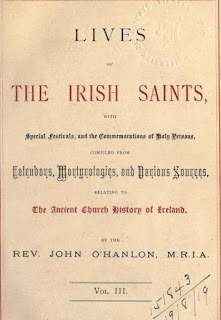
March 14 is the feast of a Saint Brigid, around whose precise identity much confusion reigns. Canon O’Hanlon’s source is Bishop Forbes’ Scottish Kalendars and so we can turn directly to this account:
BRIGIDA II. V, March 14.—
A Scotch S. Brigida’s relics were preserved in Abernethy. It is probable that there were two saints of this name. —(See Ussher, Works, edition Elrington, vol. vi 256, 257, 451.) A Brigida is said, in the Irish Life of S. Cuthbert, to have been brought from Ireland, and educated by S. Columba with S. Cuthbert at Dunkeld.—(Libellus de Nativitate S. Cuthberti, c. xxi.) The Brigida of Abernethy is associated with the nine Maidens. See Mazota. [1]
O’Hanlon reproduces this information but ends by saying that ‘Most likely, the present St. Brigida, or Brigid, was an Irish saint.’ He does not, however, have any supporting evidence to offer nor does he address the Scottish links in the sources.
Miss Agnes Dunbar in her work on women saints also mentions the Scottish Brigid of Abernethy:
The Aberdeen Breviary, in the story of St. Mazotta, says that St. Brigid of Abernethy was cousin of Graverdus, king of the Picts, who during his wars with the Britons was admonished by supernatural means to send to Ireland for Brigid, and follow her advice. She came with St. Mazota and eight holy virgins, and settled at Abernethy, and there built a church, where the king was baptized. [2]
and the Dunkeld Brigid:
St. Brigid March 14. An Irish virgin, brought up at Dunkeld with St. Cuthbert, by St. Columba. Bishop Forbes, Scot. Cal [3]
There may be a third possiblity, that Brigid of Abernethy is a manifestation of the cult of Saint Brigid of Kildare in Scotland. It is interesting that the Aberdeen Breviary mentions that the Pictish King ‘sent to Ireland for Brigid’ and Abernethy seems to have enlisted not only Ireland’s patroness but also our patron in its foundation story:
Special notice has here been taken of St Bridget’s connection with the church of Abernethy, in as much as the Aberdeen Breviary links the story of St Mazota with that of the Abbess of Kildare, thereby removing Mazota to a date earlier than her own. The narrative in the Breviary is thus given by Bishop Forbes: “Graverdus, son of Domath, the distinguished king of the Picts, and cousin of S. Brigida, while fighting against the Britons, is supernaturally warned to send for her to Hibernia and to obey her precepts. S. Brigida obeyed the summons, and with nine holy virgins came from Hibernia to Scotia, and settled at Abirnethy close to the Taye on the south, in which places he erected a basilica in honour of Almighty God and the Virgin Mary, in which the king with all his family was baptized. Mazota was the most remarkable of these virgins, and she followed in all things the steps of Brigida. The king of the Picts promised that the church should be dedicated by S. Patrick, at that time dwelling in Scotia, and there Mazota with the other virgins continued to serve God, till they all died and were buried. No tongue can tell the miracles that God in Heaven caused to take place by her agency.” We may remark in passing that an interesting reminiscence of St Bride’s Nine Maidens was to be met with till recent times in Sanquhar parish, Dumfriesshire, where “it was customary to resort on May-day to St Bride’s Well, where each maiden presented nine smooth white stones as an offering to the Saint, which correspond in number with St Bride’s nine virgin attendants.” [4]
Interesting too in this regard is the fact that Saint Darlugdacha, the immediate successor to Saint Brigid at Kildare, is also part of the foundation legend of Abernethy:
Thomas Innes says, “The death of Brigid was soon after followed by that of Darlugtach Virgin, her disciple : the same who came over to Britain in the time of Nectan, the third king of the Picts, and conversed with him on the first foundation of the ancient church of Abernethy. Her feast is celebrated February the first.”—(Innes, Civ. and Eccl. Hist, of Scotland, p. 128: Spalding Club. See Irish Nennius, p. 163) [5]
So, in summary we can say that there is a record of the commemoration of a Saint Brigid in Scottish sources on March 14 with two possible identities proposed (1) Brigid of Abernethy and (2) Brigid of Dunkeld. I doubt though that we will ever be able to say with any confidence who exactly the Saint Brigid commemorated on March 14 actually was.
[1] Alexander Penrose Forbes, D.C.L. Bishop of Brechin, Kalendars of Scottish Saints, (1872), 291-2.
[2] A dictionary of saintly women (Volume 1) (London, 1904), 135-6.
[3] ibid.
[4] J.M.Mackinley, ‘Traces of the Cultus of the Nine Maidens in Scotland’ in Proceedings of the Society of Antiquaries of Scotland, Volume 40 (1906), 259.
[5] Forbes, op.cit., 321.
Content Copyright © Omnium Sanctorum Hiberniae 2012-2015. All rights reserved.

 OMNIUM SANCTORUM HIBERNIAE