Category: Hymns, Prayers and Poems

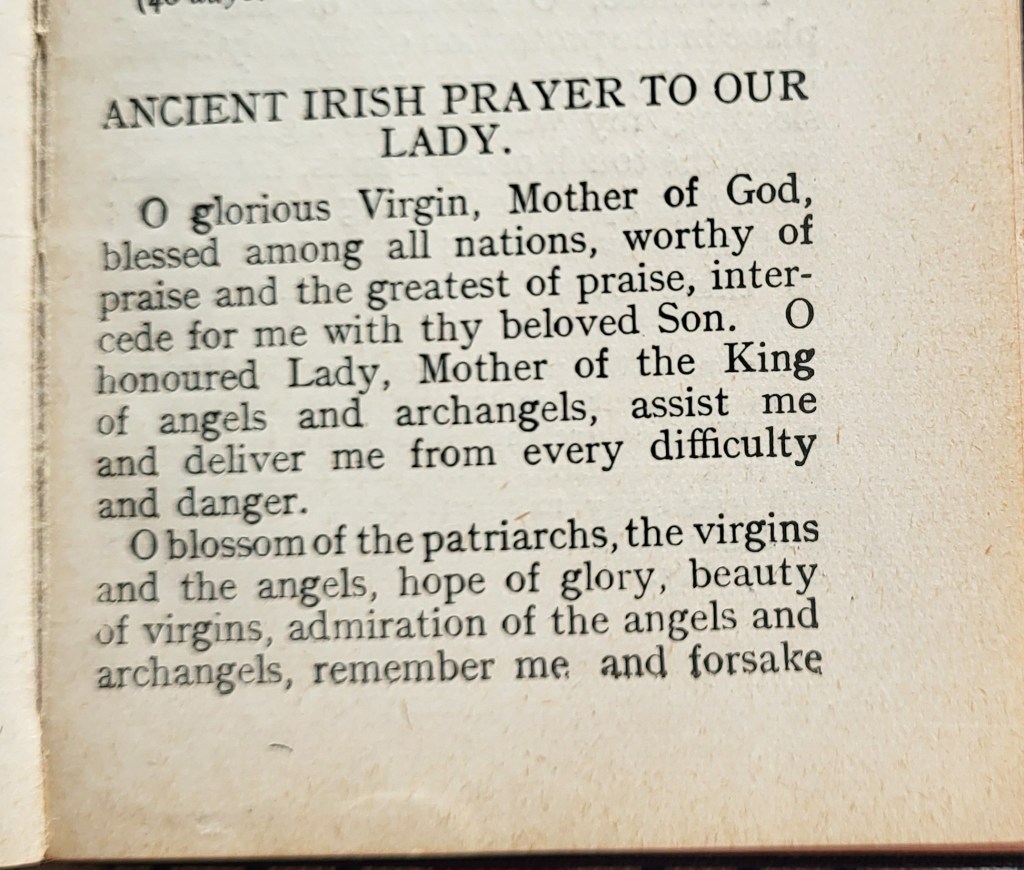
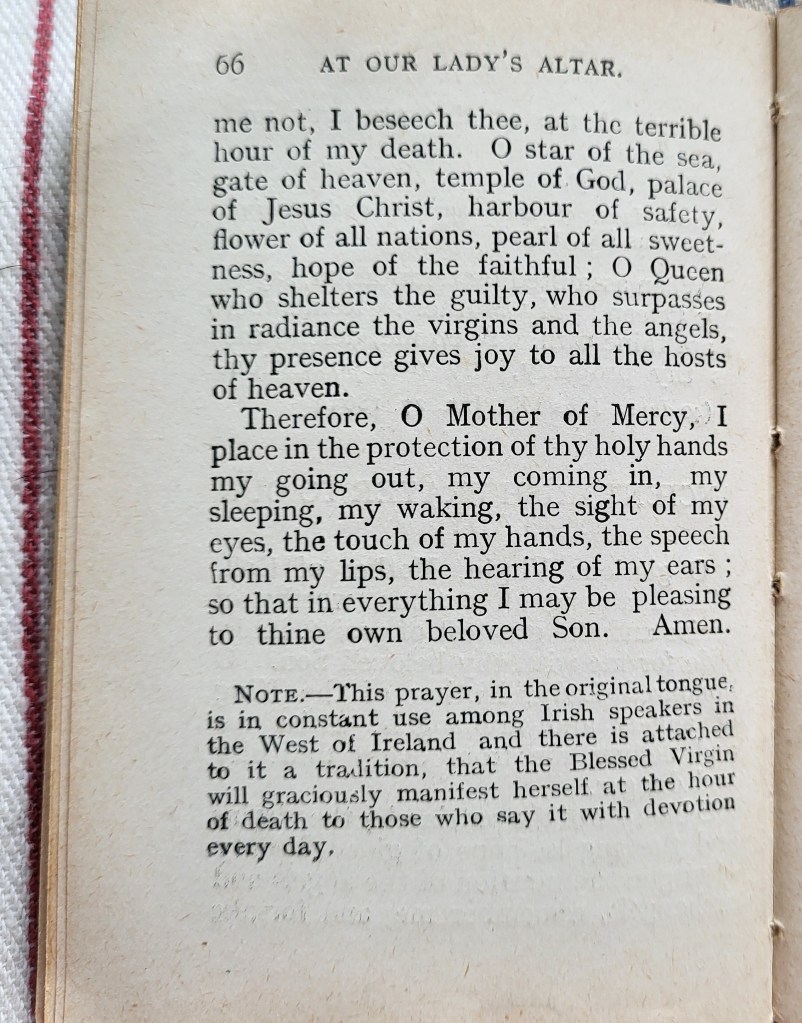
  • An Ancient Irish Prayer to Our Lady?

    The month of May in Catholic tradition is dedicated to Our Lady and over past weeks I have been praying what the old prayer book, At Our Lady’s Altar, describes as an ‘Ancient Irish Prayer to Our Lady’. But I found myself wondering just how ‘ancient’ this prayer actually was since to me it felt more representative of later medieval or early modern praises of the Blessed Virgin. As you will see from the scans from the prayer book, we are told that it is in use among the Irish-speaking communities of Connacht. I wondered, therefore, if it might have been one of those gathered by Ireland’s first President, Douglas Hyde (1860-1949), in his 1906 collection The Religious Songs of Connacht, and so it proved to be. Dr Hyde recorded that he got this prayer from two separate sources, first from a friend of his who took it down from an old man called Hegarty from Claremorris, County Mayo, but he goes on to say:

    I got it a great deal better in a beautiful manuscript book that Seóirse Giolla an-Chloig, or Bell, had in Claremorris, and which Dr. Maguire has since very kindly given to me. This book was written by one Edmond O’ Conor in the year 1740. I put down hero the prayer exactly as he wrote it, and since I am changing nothing in the orthography, not even a dot, the reader will see how excellent and exact the book is.

    A PRAYER TO THE VIRGIN MARY.

    O glorious Virgin, Mother of God, Woman above all rank, praiseworthy in all praising no matter how great, make intercession on my behalf to thine own beloved Only-Son. O honourable Woman, thou art the mother of the King of the Angels and of the Archangels relieve me and save me from every hardship and evil.

    O blossom of the patriarchs, of the Virgins and of the angels; O Hope of Glory, O Beauty of the Virgins, O Higher Thought of the angels and of the archangels, remember me, and I pray thee not to forsake me in the fearsome time of my death. O star of the sea, O door of Paradise, O temple of God, O Palace of Jesus Christ, O Harbour of health, O blossom of all nations, O pearl of all sweetness. O Queen sheltering the guilty, O Hope of the Faithful, O upper Brightness of the Virgins and of the Angels; verily it is thy conversation with the angels and with the archangels that is for them a delight.

    Therefore, O Mother of Mercy, I place in the protection of thy own blessed hands my going out and my coming in, my lying-down and my rising-up, the sight of my eyes, the touch of my hands, the speech of my mouth, the hearing of my ears, so that they may be pleasing to thine own beloved Son. Amen.

    Douglas Hyde , Abhrain diadha chúige Connacht -The Religious Songs of Connacht, a collection of poems, stories, prayers, satires, ranns, charms, etc., Volume II (London, 1906), 291-295.

    So it seems that this prayer was known from at least the middle of the eighteenth century. I would suspect there is an even older Latin original behind it. This type of litany-style prayer seems to have translated very readily into Gaelic tradition, there is another at the blog here which was similarly labelled ‘ancient’, but which is later medieval. One which may fairly be described as ‘ancient’, the Hymn of the eighth-century monk Cú Chuimne of Iona, is also available at the blog here.

    Content Copyright © Omnium Sanctorum Hiberniae 2012-2025. All rights reserved.
  • A Litany of Irish Female Saints

    Marking International Women’s Day with The Litany of the Virgins, a lorica-type prayer which invokes the protection of twenty-eight Irish women medieval saints. Among them are the four female saints with written Lives – Brigid, Íte, Moninne and Samthann. I note that Our Lady, the Holy Virgin of Virgins, heads the list followed by her Irish equivalent, Saint Brigid, the Mary of the Gael. This Litany is number eleven in the collection Irish Litanies published by the Rev. Charles Plummer a century ago. The original was preserved in the twelfth-century Book of Leinster. Below is the Irish text followed by Plummer’s translation.

    Litany of the Virgins

    [1] [No]m churim ar commairge
    Maire ogi ingini,
    Brigti báne bruthmaire,
    Cua[che] mor-glaine,
    Moninni is Midnatan,
    Scire, Sinchi, Samchaine,
    Caite, Cuacae, Coemilli,
    [C]raine, Coppe, Cocnatan,
    Nessi ane Ernaigthi,
    Derbfhalen is Becnatan,
    Ceire is Chrone, is Chailainne
    Lasrae, Lochae, is Luathrinni,
    Ruind, Ronnait, [R]ignaige,
    Sarnat, Segnat, Sodeilbe,
    Is na nóg i noen-baile,
    Tuaid, tess, tair, tiar.

    [2} Nom churim ar commairgi
    Na Trinoite togaide,
    Na fádi, na fir-apstal,
    Na mmanach, na mmartirech,
    Na fedb is na foismidech,
    Na nog is na nirisech,
    Na noem is na noem-aingel,
    Ar cach nolc dom anacul,
    Ar demnaib, ar droch-doenib,
    Ar dornom, ar droch-aimsir,
    Ar galar, ar gu-belaib,
    Ar uacht is ar accorus,
    Ar anaeb, ar escuni,
    Ar dígail, ar dairmitin,
    Ar dinsem, ar dercháine,
    Ar mi-rath, ar merugud,
    Ar theidm bratha borrfadaig,
    Ar olc iffirn il-phiastaig
    Co nilur a phian.

    Translation

    I place myself under the protection
    Of Mary the Pure Virgin
    Of Brigit, bright and glowing,
    Of Cúach of great purity,
    Of Mo-ninne and Midnat,
    Of Scíre, Sinche and Samthann,
    Of Caite, Cúach and Coímell,
    Of Craine, Cop and Cocnat,
    Of Ness the glorious of Ernaide,
    Of Derfáilind and Becnat,
    Of Ciar and Cróine and Coílfhind,
    Of Lasair, Lóch and Luaithrinn,
    Of Ronn, Rónnat, and Rígnach,
    Of Sarnat, Segnat, and Soidelb,
    And of the Virgins all together
    North, South, East, West.

    I place myself under the protection
    Of the excellent Trinity,
    Of the prophets, of the true apostles,
    Of the monks, of the martyrs,
    Of the widows, and the confessors,
    Of the virgins, of the faithful,
    Of the saints and the holy angels;
    To protect me against every ill,
    Against demons and evil men,
    Against thunder (?)and bad weather,
    Against sickness and false lips,
    Against cold and hunger,
    Against distress and dishonour,
    Against contempt and despair,
    Against misfortune and wandering,
    Against the plague of the tempestuous doom,
    Against the evil of hell with its many monsters.
    And its multitude of torments.

    Rev. C. Plummer, ed. and trans., Irish Litanies: text and translation. Edited from the manuscripts. (Henry Bradshaw Society, London, 1925)92-3; 121-3.

    Content Copyright © Omnium Sanctorum Hiberniae 2012-2026. All rights reserved.

  • An Invocation to Christ of Saint Oengus the Martyrologist

    In his 1861 collection, the Lectures on the Manuscript Materials of Ancient Irish History, Eugene O’Curry (1797-1862) gave a translation of the opening invocation from the Prologue to the Martyrology of Oengus. His translation, made from the copy of the text preserved in the Leabhar Breac, is distinct from that of Whitley Stokes, who published a translation of the Martyrology based on ten manuscripts in 1905. O’Curry’s version is much better suited to personal prayer and I reproduce it below, complete with his introduction to the work of Saint Oengus:

    “This composition consists, properly, of three parts. The first is a poem of five quatrains, invoking the grace and sanctification of Christ for the poet and his undertaking.

    The second is a poem, by way of preface, consisting of 220 quatrains, of which 80 are prefixed, and 140 postfixed to the main poem.

    The third is the Festology itself, consisting of 365 quatrains.

    The Invocation is written in the ancient Conachlann, or what modern Gaedhlic scholars call in English “chain-verse”; that is, an arrangement of metre by which the first words of every succeeding quatrain are identical with the last words of the preceding one. The following literal translation may not be out of place here [see original in Appendix, No. CXIIL]:

    Sanctify, O Christ! my words: —
    O Lord of the seven heavens!
    Grant me the gift of wisdom,
    O Sovereign of the bright sun!

    O bright sun, who dost illuminate
    The heavens with all thy holiness!
    O King who governest the angels!
    O Lord of all the people!

    O Lord of the people!
    O King all-righteous and good!
    May I receive the full benefit
    Of praising Thy royal hosts.

    Thy royal hosts I praise,
    Because Thou art my Sovereign;
    I have disposed my mind,
    To be constantly beseeching Thee.

    I beseech a favour from Thee,
    That I be purified from my sins
    Through the peaceful bright-shining flock,
    The royal host whom I celebrate.”

    Eugene O’Curry, Lectures on the Manuscript Materials of Ancient Irish History, (Dublin, 1861), 365-6.

    Content Copyright © Omnium Sanctorum Hiberniae 2012-2025.