Author: Michele Ainley

  • Saint Maeldobharchon of Kildare, February 19


    February 19 sees the commemoration in the Irish calendars of Saint Maeldobharchon, a bishop of Kildare. Canon O’Hanlon summarizes what is known of him:

    St. Maeldobharchon, or Maeldobhorchon, Bishop of Kildare, County of Kildare. [Seventh and Eighth Centuries]

    The Bollandists have a brief entry of this holy bishop, at the 19th of February. The Martyrologies of Tallagh and of Marianus O’Gorman, and of Donegal, on this day, record Maeldobharchon or Maoldobhorchon, Bishop of Cilldara, now Kildare, in the county of the same denomination. It seems likely enough, the Abbot of Kildare, Lochen, surnamed Meann, or the Silent, also called Lochen, “the Wise,” who died on the 12th of January, or 12th of June, A.D. 694, as also St. Farannan, Abbot of Kildare, who died on the 15th of January, A.D. 691, may have exercised episcopal functions over this see. If so, it is probable, the present holy man succeeded this latter. According to Colgan, he died A.D. 704 but, the Annals of the Four Masters state, that this prelate died, A.D. 707. According to the Annals of Ulster, he departed this life in the year 708.

    The entries from the Annals are also quoted in the essay on the Bishops of Kildare by the Rev. Michael Comerford:

    “A.D. 707. MAELDOBORCON, Bishop of Kildare, died on the 19th of February.”(Four Masters.) “A.D. 708. Maeldoborcon, Episcopus Cille-daro, pausavit.” (Annal Ult.) The death of this Prelate is stated by some to have taken place in the year 704 (Ware). Keating (Book, 2, p. 46,) relates that King Congall Kennmagar persecuted the Church at this time, and burned the secular and regular clergy of Kildare; but Lanigan discredits this statement, judging to the contrary from the peaceable and prosperous reign ascribed to this monarch by old writers. A great conflagration, it is true, laid Kildare waste in 709. (Four Masters), during this King’s reign ; and, as we may suppose that some clerics lost their lives in this fire, this circumstance may have given occasion to the story.

    Rev. M. Comerford ‘Collections Relating to the Dioceses of Kildare and Leighlin’ (Dublin, 1883), 5.


    Content Copyright © Omnium Sanctorum Hiberniae 2012-2015. All rights reserved.

  • Saint Cúlán of Killcuilawn, February 18


    February 18 may be one of the feast days of a County Tipperary saint, Cúlán of Killcuilawn. Saint Cúlán is associated with a relic, the Barnane Cuilawn, about which I will make a separate post at a later date. It does not seem to be entirely clear how this Saint Cúlán is related to another of the same name commemorated on 12 March. Indeed overall, Canon O’Hanlon is unable to fully dispel the confusion surrounding this saint’s identity and feast day. Professor Ó Riain’s Dictionary of Irish Saints lists the saint at February 18 and gives literary sources for his cult. He confirms that Saint Cúlán’s feast is not recorded in any of our native calendars, but is found in a copy of the Martyrology of Usuard made in Cologne just before the year 1500:
    St. Dacualenus or Culanus, Bishop of Killcuilawn, County of Tipperary.
    [Possibly in the Seventh Century.]
    At this date, Colgan has a few notices, regarding St. Culanus or Dacualenus, a bishop. He thinks, however, that the name of this holy man should be written Cuculanus. In the anonymous list of Irish saints, published by O’Sullevan Beare, as also in the Catalogue of Henry Fitzsimon, at this day, we have a St. Cuculanus. On the authority of Florarius, the latter writer styles him bishop.The Bollandists have short Acts of this Saint Culan, in their great compilation. Yet, what Godefrid Henschenn adds there, to Colgan’s remarks, are not worthy of much consideration. Many foreign writers, amongst others Ferrarius,and Canisius, make mention of St. Culanus, as having been venerated in Ireland, on this day. By Florarius, he is called Cuculanus. But, Colgan tells us, he was unable to discover a saint, bearing either name, and whose festival had been kept on the 18th of February, according to our domestic Hagiographers. Yet, Usuard auctus, or the Carthusian Martyrology, and Hermann Greuan, have accounts of St. Culan, Bishop and Confessor, as having been venerated in Ireland, on this day. In one instance, Colgan has classed St. Culenus or Culan, Bishop, among the disciples of St. Patrick, following Tirechan’s list. We know, that in the Irish Calendars, there are many saints, having the name Colan or Coelon. However, Culanus, Cuilen, or Cualen, was the same as Culen or Dachualen, whose commemoration occurs, at the 12th of March, in the Martyrologies of Marianus O’Gorman and of Cathald Maguire. If he be the same person, his descent is traced, in the Genealogy of the Saints of Ireland, by Cormac, Bishop of Cashel, from the Hy-Niall family. The father of this saint was Guaire, son to Columba, son to Crimthann, son of Eochad Binnigh, son to Eugene, son to Niall of the Nine Hostages. Notwithstanding his assertion, Colgan omits any mention of a saint, bearing this name, at the 12th of March. According to the foregoing pedigree, this holy man should naturally belong to about the beginning of the seventh century. In the parish of Borrisoleigh, also called Illeagh, in the county of Tipperary, there was formerly a church dedicated to a St. Coulane—identical with the present saint—and here was long preserved a singularly ancient and curiously wrought bronze shrine or bell, called the “Barnane Cuilawn,” which was formerly in the possession of the Dwyer family, living at Ballinaruan, near Borrisoleigh, and afterwards it became the property of the late Thomas L. Cooke of Birr, who got it from the Dwyers. It passed from Mr. Cooke to a public institution, and it is said, that the “Barnaan Cuilawn” was found many years since, in the hollow of a tree, at a place named Killcuilawn, situate in the mountains, and about two miles distant from Borrisoleigh, in the parish of Glankeen and county of Tipperary. This curious relic, of a remote age, is likewise called in the Irish language “Obair na naoim;”—that is “the Saint’s work.” …
    .
    ..It is likely, St. Culan had his habitation, not far removed from Borrisoleigh, and Killcuilawn derived its name from a church he had there founded. His period is not well known, for, the accuracy of that information, furnished to the compilers of a modern topographical work,hardly falls within the range of probability. It is more likely he belonged to the seventh century. At Glankeen, it is said, an abbey had been founded, so early as the time of St. Patrick. In a Life of St. Cormach, it is stated, that he was descended from Oilum Olum. It relates, that he had five brothers, by the same father, and that Culanus was one of these. Again, it is asserted, that this St. Culan built a church in a valley of the region, known as Hi Luigdlicach, where he remained among his kindred and acquaintances. His pedigree is thus traced; he was the son of Eugene, son to Murchad, son of Muredac, son to Diermit, son of Eugene, son to Alild Flanbeg, son of Fianch Muillethain, son to Eugene the Great, son of Ailild Olum. His church was called Glean-chaoin, “the beautiful glen,” and it lies at the foot of Knockanura mountain, and at the bounds of Killaloe See. In reality, two buildings raised at different periods present themselves in the ruins of Glean-choin or Gleankeen Church. There was an old building formerly at Killcuilawn; but, towards the close of the last century, its stones were removed for the purpose of building a house. The Church of Culan was benefited by the piety and generosity of his relatives, and these considered themselves as more than recompensed by the saint’s prayers for their welfare. What particular reason there was for supposing, that Irish Apostolic men brought the relics of St. Culan to Germany, or even a veneration for him, Godefrid Henschenn has not explained. From what we have already seen, his relics appear always to have remained in Ireland; and probably, he belonged to that part of it, where the “Barnane Cuilawn” had been so long preserved.
    Content Copyright © Omnium Sanctorum Hiberniae 2012-2015. All rights reserved.
  • Saint Silvin of Alciac, February 17

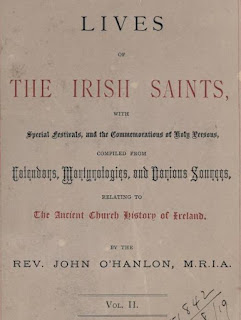
    On February 17 Canon O’Hanlon presents an account of an eighth-century saint who flourished in Belgium and whom some accounts described as a ‘Scotus’ or Irishman. Admittedly this is not a strong basis for Saint Silvin’s inclusion in the Lives of the Irish Saints, but in his ascetical practices this saint is very much in the Irish tradition.

    St. Silvin, reputed to be an Irish Bishop, at Alciac, or Auchy, in Belgium.
    [Seventh and Eighth Centuries]

    By many writers, it has been remarked, that in past ages no less than in later times, Ireland seems to have been indifferent to the fame of her illustrious children, who have served and blessed other countries, by their presence and labours. Desirous to remove some part of this reproach, we should not be willing to omit any record, that might tend to recover even a possible appropiation of fading renown. Thus, St. Silvin, Bishop of Alciac, or Auchy, in Belgium, is said, in an unpublished life, to have been a Scotus, by which term we may consider him an Irishman. His feast occurs on this day, in several Calendars. In the city of Rheims, in France, Federicus Flouetus had seen a Manuscript Life of St. Silvinus, in which it was asserted, that the present holy man was a Scot by birth. Nor have we any very strong reason to doubt, that such was the case; for, not only are the names of Sillan or Silvans purely Celtic, but, in the time of this saint, many Irishmen were accustomed to emigrate and to settle in different parts of France. Yet, we have a different account, regarding the place of his birth, in a Life of St. Silvin, at first said to have been written by a bishop, called Antenor, and afterwards considerably amended, and apparently altered, by some anonymous writer. He was engaged on this task, by request of an abbess, named Leutwith or Lseutevit. This amended biography makes Silvin to descend from a noble family, and to be born in the territory of Thoulouse. He is said to have lived in the time of King Charles I. and of Childeric, or Chilperic. When a young man, he espoused a maiden, according to the rite then prevailing; but, the grace of God wholly taking possession of him, he reflected deeply on these words of our Divine Redeemer, “every one that hath left house, or brethren, or sisters, or father, or mother, or wife, or children, or lands, for my name’s sake, shall receive a hundred-fold, and shall possess life everlasting.” Doubtless, with the free consent of his affianced spouse, they resolved on a mutual separation, and Silvin decided on embracing a religious life. He seems to have remained in the world, until after the Vinciac War, waged by Charles against Raghenfrid, or Ragemfrid. The latter was totally defeated, with great slaughter, while his troops were dispersed.

    When Silvin began his missionary career, the fame of his sanctity and eloquence went abroad, while many souls were converted to God. He went to the Teruanensian region, where the people were yet uncultured in the maxims and practices of religious feeling. In a short time, by word and example, Silvin effected a wonderful change. His self-denying life was a subject for admiration among his converts. His humility was unfeigned, and yet recognised, by them, and for this very reason, he was loved as a father, while he was revered, as if he were a great lord and master. Doing good to all men, but especially to those, who belonged to the household of the faith; he was prudent in teaching, devout in feeling, incessant in missionary work, full of integrity, correcting first what he found to be deserving of reprehension in himself, and thus was he justly prepared to reprove the faults of others. Meantime, while remarkable for his comeliness of mien and cheerful look, he was clothed in a poor habit, but rich in God’s graces, his constant study was to gain over souls, and in uniting them to the fold of Christ, he hoped to increase the more his individual merits. In his humble habitation, guests and strangers were received, as if he beheld Christ in their persons. He washed their feet, while he gave them food and clothing; for he desired on the last day to be among the number of those to whom should be said, ” I was hungry and you gave me to eat: I was thirsty and you gave me to drink: I was a stranger and you took me in: naked, and you covered me: sick, and you visited me: I was in prison, and you came to me.” Mindful, too, of the Royal Prophet’s words, “I will take heed to my ways, that I may not sin with my tongue, his vocal organs were usually employed either in preaching God’s word, or in hymning the Divine praises. More solicitous to adorn his soul with graces, than his person with fine dress, he imitated the Saviour of the world in a contempt for its riches; his prudence and judgment were shown, by regarding secular affairs as transitory, and by desiring only the love of God and of his neighbour, that this might tend to his eternal gain.

    Through no desire of change, or to gratify human curiosity, but rather to satisfy his devotion, Silvin visited the shrines of many saints, and he travelled much for his own spiritual comfort.” He prayed for the intercession of God’s holy servants, to aid him on the way to glory; and he knew, that as no person can be saved through his own efforts, so was it necessary to ask Divine assistance. He even travelled as far as the Holy Land, visiting among other places Calvary, where our Lord was crucified, and the Jordan, where he was baptized. Having thus satisfied his devotion, he left that distant country, and returned. He cultivated most kindly relations with the secular clergy and religious. He was renowned as a holy confessor, while multitudes flocked to receive his salutary admonitions in the tribunal of penance. For the four Cardinal Virtues of Prudence, Justice, Fortitude and Temperance, St. Silvin was distinguished; and taking them as a shield and a coat of mail, he was able to repel all temptations of the most wicked one. He preached most eloquently, and daily, both to the clergy and to the people, in his church, where he fervently prayed. This holy bishop was ever under the guardianship of his protecting angel, who led him safely to the end of his life. The father of orphans, the defender of widows, the protector of virgins, the glory of monks, St. Silvin was a promoter of peace, cautious in preaching and holy in work. He took care to observe the Apostolic admonition, lest preaching to others he should become himself a cast-away, strengthening himself in the grace of God, and becoming all things to all men, that he might gain souls to Christ. He referred all things to God, and gave whatever he possessed to the Lord. Thus on property, belonging to himself, St. Silvin erected two churches. One of these was in a place called Mundini Cisterna, and the other lay in Remicensi Campana. Here he was accustomed very frequently to celebrate the Almighty praises. St. Silvin, besides redeeming several captives, converted many of them to the Christian Faith. It was his custom, when infirm persons flocked to him, first to procure their conversion, and afterwards, when their souls were refreshed by sacramental graces, to send them away healed from their bodily infirmities. So great was his abstinence, that it is said, for forty years together, he did not taste even bread; he being content with the herbs and fruits of the earth. His clothing was of a very humble description, except when wearing the vestments for religious ceremonials. He practised various austerities, sleeping on the bare earth, wearing an iron chain next his skin, desiring to lead a hermit’s poor life, only for his episcopal engagements, and even sighing for the martyr’s crown. He made a pilgrimage to Rome, and visited the shrine of St. Peter.

    Silvin wrought many miracles; he relieved possessed persons, he cured lepers, he healed paralytics, the lame, the blind, and the infirm. But the time for his release at last approached, and he fell into a fever. During this illness, he caused the holy Sacrifice of the Mass to be celebrated in his presence, and the psalms to be sung, while he was frequently refreshed with the Sacrament of the Body and Blood of Christ. Giving holy admonitions to those surrounding his death-bed, he left all present a great example of perseverence to the end. In the supreme moment of his exit from this world, he had an angelic vision. He recovered strength to exclaim in a clear voice: “Behold, the Angels of the Lord come to me; Behold, the Angels of the Lord come to me!” His departure took place on a Sabbath evening, and as generally supposed at Auchy, in the district of Artois, on the 15th of February, about A.D. 718, or 720. He was buried however, on the 17th of this month, and it is the date generally assigned for his feast. As the angels rejoiced in heaven, at the coming of such a saint, the faithful on earth lamented his departure; his funeral solemnities were celebrated in a becoming manner, and while the dirge was sung, priests, clerics, nuns and people were in tears. His remains were deposited in the monastery at Auchy, or Auxy-les-Moines, several monks, from the adjoining religious house of St. Richarius, or Riquier, at Centule, affectionately and piously assisting at his obsequies. A nobly-descended nun, called Siccherdis, caused his tomb or shrine to be magnificently adorned with gold and precious stones. The Bollandist Acts contain details of many great miracles wrought at the shrine of St. Silvin, long after his happy departure. To preserve his remains from the Northmen impieties, they were brought, at first to Dijon, and afterwards to the monastery of Besua, for preservation. It is probable, the chief part of those sacred lipsanae were again taken back to Auchy. In 951, his relics were removed to St. Bertin’s monastery, at St. Omers, and there the greater part of them were preserved, towards the close of the last century. At the time of the French Revolution, this magnificent establishment was left the melancholy, but still noble, ruins it exhibits, at the present time, and St. Silvin’s relics, with others, must have been dispersed. The jaw-bone and arm of this holy man were preserved at Auchy, in the seventeenth century; and, it is probable, they have not been destroyed or lost.

    Content Copyright © Omnium Sanctorum Hiberniae 2012-2015. All rights reserved.