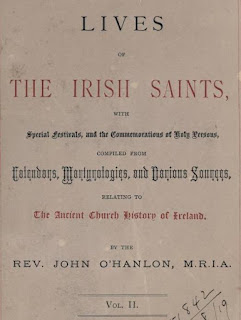
There are no less than three abbots of Iona commemorated on March 2. Last year’s post looked at Saint Feargna Britt, now Canon O’Hanlon records the remaining pair, beginning with Saint Slebhene:
St. Slebhene, or Slebhine, Abbot of Iona [Eighth Century]
At this date, likewise, the Irish Church seems to have venerated another abbot of Iona. When or where he was born does not appear to have transpired; yet, we have sufficient proof, that he was of a well-known Irish race. The Martyrology of Donegal this day registers, Slebhene, son of Conghal. His father was Dubhduin, son to Slebhine, son of Seghine, son to Ronan or Cronan, son of Loam, who was the son of Fergus Cennfada or Duach, and of his wife, Erca, the daughter of Loam Mor. Thus was he in a right line descended from the race of Conall Gulban, son to Niall the Great. The holy man Slebhine seems to have lived under the discipline of Cilline Droicteach, who died abbot of Iona, on the 3rd of July, A.D. 752.
The virtues and merits of Slebhine, no doubt, singled him out, among his brother monks, as worthy of succession. He was the fifteenth abbot of Ia, and soon after his accession, the death of Cillen, son of Congaile—probably his own brother—took place in Hy. During the period of Slebhine’s incumbency, the Columbian influence in Ireland seems to have been at its height, as may be concluded from the mention of the Lex Columcille having been enforced by Domhnall, King of Ireland, in A.D. 753, and also by Sleibene himself, A.D. 757. In the year 754, the Abbot of Iona visited Ireland; and, in the year 758, he returned thither. After the death of Fedhlimidh or Failbe, who discharged the duties of assistant abbot of Hy, Sleibne passed to the rewards of the just, A.D. 754, according to the Annals of Inisfallen. Those of the Four Masters, however, place his demise, at A.D. 762; while the Annals of Ulster have the year 766, and again, the Rev. William Reeves states, that he died, on the 2nd of March, A.D. 767, after an incumbency of fifteen years, over the celebrated monastery of Iona.
St. Suibhne, Abbot of Iona. [Eighth Century]
The pedigree of this holy man is not recorded; but, probably, he was born in Ireland, and of the Tirconnellian race. He seems to have discharged the duties of assistant abbot at Iona, during the lifetime of Slebhine, and in that capacity he visited Ireland, A.D. 765, or 766. On his death, the succeeding year, Suibhne succeeded to the full rule of the monastery, which only engaged his care for four years exactly, for he died, on the 2nd day of March, A.D. 772.
Content Copyright © Omnium Sanctorum Hiberniae 2012-2015. All rights reserved.