
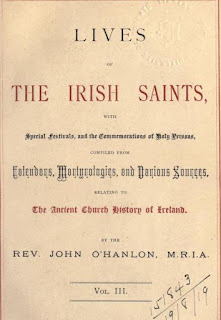
We have a most interesting saint commemorated on March 5, whom tradition says was literally a martyr to the monastic rule of Saint Patrick. For Colman the Thirsty sacrificed his life rather than transgress the letter of the law. This extraordinary episode provides Canon O’Hanlon with an opportunity to sound very Victorian on the dangers of ‘habits of intoxication’ and ‘the frequent use of spirituous liquors’ and reminds us of the strong moral component of the Irish national revival:
St. Colman, surnamed the Thirsty.
[Supposed to be of the Fifth Century.]
Obedience is better than sacrifice has often been advanced, as a maxim, by spiritual writers; but, in the present instance, we may discover both virtues, distinctly placed, and yet combined. Colgan assigns the festival of a particular St. Colman, to this day; although, he confesses himself unable to determine such a position, with a full degree of certainty. This saint is thought assignable, to the early period of our Christian history. Still, our national hagiologist seems to err in his conjecture, that the present saint may have been a St. Colman, son of Enan, and a brother to three other saints. Elsewhere, he is of opinion, that the present holy man was one of St. Patrick’s disciples. The Bollandists have some brief notices of him. According to Colgan’s inferences, this Colman was a monk under the rule of St. Patrick. So exact was he, in complying with all things required, that he became a martyr to monastic discipline. Whilst employed with other monks in collecting the harvest, at a place denominated Trian Conchobhuir, one of these called Colman felt extremely thirsty. Although a tub of cold water had been placed in the field, to be used by the labourers; yet, an injunction was issued, that no one should drink from it, until the hour for saying Vespers had passed. Colman’s strength began to fail, however, on account of the intolerable thirst experienced; still, the patient monk did not wish to infringe an established rule. At length, unable to bear this privation, to which he had voluntarily subjected himself, the holy servant yielded up his spirit to the Maker of all things, having sunk on the ground exhausted and lifeless. He was buried at the cross, which had been erected before the newly-built Cathedral Church of Armagh; and, on being consigned to the tomb, in this consecrated spot of ground, much as he no doubt lamented the circumstances attending this death, the Irish Apostle felt gratified, that the body of a saint should repose in his graveyard, as the first fruits of deposition. He is even said to have prophesied, that the church, which was consecrated by such a happy sepulture, should afterwards be prosperous, and should abound in riches and honours. St. Patrick, also, saw the soul of his departed brother ascend to heaven, where it found rest, in company with the martyrs.
The 5th of March was the Natal day of a St. Colman—probably the present—according to our Irish Martyrologies. At this dale, the Martyrology of Tallagh records a festival in honour of Colman, designated Isirni. Marianus O’Gorman and Charles Maguire record him; but, they neither add time, place, or other circumstances, to identify him. The name of a Saint Colman has been omitted from the published Martyrology of Donegal, at this day; but, the simple name, Colman, has been inserted by the compiler of a table subjoined, with the remark appended, that he had not been noticed in the body of this work. About the year 445 must have been the period for his death, were we to credit Ussher’s statement, that at this date, the foundations of Armagh church were laid. The O’Clerys, however, refer this event, to the year 457. As many bodies, no doubt, were early interred within the cemetery of Armagh, and as Saint Colman’s remains were the first therein deposited, we may probably refer his death and burial, to that very year, in which the church foundations had been laid.
His cognomen of the Thirsty was obtained, not from his being often obliged to satisfy such a distressing want of nature; but, owing to that heroic yet misconceived resolution, whereby he overcome natural requirements, even at the sacrifice of his own life. What an example of abstemiousness ought not this be for many unhappy drunkards, who end their days prematurely, when indulging in habits of intoxication, and in the frequent use of spirituous liquors. That wholesome beverage, pure water, is abundant, especially in “Erinn of the streams,” and it, at least, can be obtained free from charge or hindrance. It usually promotes health, and it can hardly be used to excess by any of our people, while it never can deprive them of reason or sense.
Notwithstanding his exemption from rule, for grave moral and physical reasons, yet, it is to be lamented, that a conscientious and good man, in the present instance, mistook the nature of his engagements, when by a moderate draught of this pure element, he might have saved a valuable and an exemplary life.
Content Copyright © Omnium Sanctorum Hiberniae 2012-2015. All rights reserved.

 OMNIUM SANCTORUM HIBERNIAE