February 1 is the feast day of Saint Brigid of Kildare, secondary patron of Ireland and the most well-known and well-loved of all our female saints. She shares her day, however, with a number of other lesser-known holy ladies, one of whom is Saint Cinnia (Cinne, Cionna), a 1928 account of whom I came across whilst browsing the Australian newspaper archives. Newspapers there syndicated articles likely to be of interest to the Irish expatriate community and I have been struck by how many relatively obscure saints they included. Cinnia was part of a feature on ‘Irish Saints in Miniature’ along with the sisters Eithne and Fidelma and like them is claimed to be one of Saint Patrick’s early converts. It is clear that the writer of this account has drawn on the hagiography of Saint Patrick and in his 2011 Dictionary of Irish Saints Pádraig Ó Riain acknowledges the Tripartite Life as the source of the stories about Saint Cinnia, her father and her monastic teacher, Cathuberis (Ceachtamair) . He confirms too her association with Druim Dubháin, County Monaghan. The saint is also documented on the Irish calendars of the saints. At February 1 the name of Saint Cinnia is found on the Martyrology of Tallaght, and on the Martyrology of Gorman where she is described as Cinne chaemhfind,’ dear-white Cinne’, as well as on the Martyrology of Donegal. The newspaper account reads:
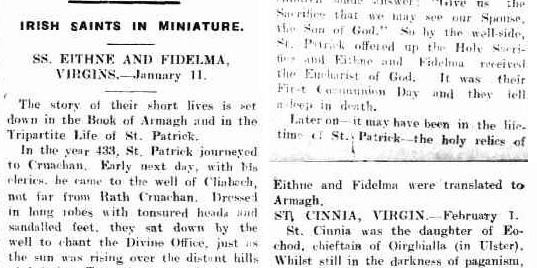
ST. CINNIA, VIRGIN. — February 1. St. Cinnia was the daughter of Eochod, chieftain of Oirgliialla (in Ulster). “Whilst still in the darkness of paganism, her father wished her to espouse Cormac, a descendant of the great Neill, King of Ireland; but some holy instinct urged her to refuse her consent. She was destined for a nobler spouse. When St. Patrick first arrived in her father’s territory (near Clogher), he came upon Cinnia in the forest. He spoke to her, instructed her in the faith and exhorted her to deserve the reward of virginity. Like SS. Eithne and Fidelma, she is. said to have’ been baptised by St. Patrick and to have received at his. hands the veil of virginity.
The Apostle then commended Cinnia. to the care of the holy virgin Cathuberis, who first of all women had received the veil from his hands. She was then ruling over a large community of nuns in the convent at Druimdubh (near Clogher). Here Cinnia prayed unceasingly for the conversion of her father; but he died without receiving the light of Faith. St. Patrick raised him to life, instructed him and gave him holy Baptism. Then to Eochod ha gave a choice:
. . .Yet awful more than beauteous.
“Rule o’er earth,
Rule without end, were naught to that great hymn
Heard hut a single moment. I would die,”
Then Patrick, on him gazing, answered : “Die!”
And died the king once more.
— Aubrey de Vere.
In 482, St. Cinnia died. With St. Brigid of Fiesole and St. Darlua of Kildare, the favourite disciple of St. Brigid, St. Cinnia’s Feast day falls on that of the greatest of the Virgin Saints of Ireland— St. Brigid of Kildare.— “The Golden Hour.”
IRISH SAINTS IN MINIATURE. The Age (Brisbane, (1928, February 18). p. 20.
 OMNIUM SANCTORUM HIBERNIAE
Leave a comment