January 11 is the traditional date when we commemorate two female saints known from Patrician hagiography: Saints Eithne and Fidelma. As I explained in a previous post here, the origins of this feast day can be traced to the seventeenth-century hagiologist, Father John Colgan, who speculated that the otherwise unidentified Saint Fidelma (Feidhealm) whose name is found in the Martyrology of Tallaght on January 11, was Feidhealm Ruadh, sister of Eithne and daughter of King Laoghaire. Father Colgan further assigned February 26, when an otherwise obscure Eithne’s name occurs on the Martyrology of Tallaght as the feast day of Fidelma’s sister. Both sisters share their names with a number of other Irish women saints. But despite the uncertainties surrounding their feast days, there is no denying the beauty of their story as recorded by Saint Patrick’s biographer Tírechan and summarized below in a 1928 newspaper article. I was hoping that ‘Irish Saints in Miniature’ might have been a regular series but this was the only article I could trace. It did however, include another female saint, Cinnia, who shares her feast day with Saint Brigid of Kildare and so I will hold over that account until February 1:
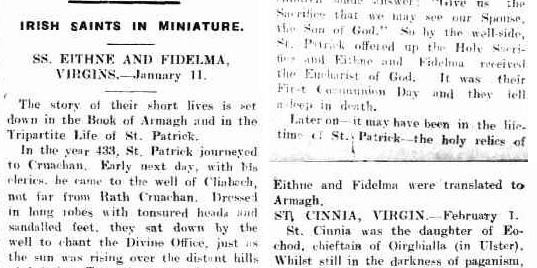
IRISH SAINTS IN MINIATURE.
SS. EITHNE AND FIDELMA, VlRGlNS. — .January 11.
The story of their short lives is set down in the Book of Armagh and in the Tripartite Life of St. Patrick.
In the year 433, St.. Patrick journeyed to Cruachan. Early next day, with his clerics, he came to the well of Clebach, not far from Rath Cruachan. Dressed in long robes with tonsured heads and sandalled feet, they sat down by the well to chant the Divine Office, just as the sun was rising over the distant hills of Leitiim. Through the meadows came two young maidens remarkable for their extraordinary beauty. The elder of the two was of fair complexion and had golden hair: the other was of ruddier features crowned with auburn hair. They were Eithne “the Fair’ and Fidelma “the Red Rose” — the daughters of Laoghaire, High King of Erin. They came attended by their maids and by the Druids, Caplait and Mael. the fosterers of the Princesses. Seeing the clerics, dressed in strange garments and speaking strange words, they were lost in wonder. They knew not who these might be — fairy men or gods, of the earth, perhaps? Eithne the Fair spoke to St. Patrick: “Who is your God? Where is He? Is He beautiful? Is He ever-loving? Is He to be found? How is He to he loved? Shall we find Him in youth or in old age? Tell us this knowledge of God.”
Whereupon Patrick instructed them and they believed and he baptised them. He blessed a white veil — not the veil of the rite of baptism but the white veil of their virginity which they had consecrated to God — and placed it upon their heads. Then they asked to see the face of Christ. But the Saint said: “You cannot see the face of Christ except you taste of death and receive the Sacrifice before death. You must first with the mouth of your heart and of your body devoutly receive the Flesh and Blood of your Spouse. Thus being quickened with the Living Food and having tasted of death, you may pass into the starry bride-chamber.” The children made answer: “Give us the Sacrifice that we. may see our Spouse, the Son of God.” .So by the well-side St. Patrick offered up the Holy Sacrifice and Eithne and Fidelma received the Eucharist of God. It was their First Communion Day and they fell asleep in death.
Later on— it may have been in the lifetime of St. Patrick — the holy relics of Eithne and Fidelma were translated to Armagh.
IRISH SAINTS IN MINIATURE. (1928, February 18).The Age (Brisbane, Qld. : 1892 – 1929), p. 20. Retrieved from http://nla.gov.au/nla.news-article291811672
 OMNIUM SANCTORUM HIBERNIAE
Leave a comment