Tag: Vitae

  • How to Honour a Saint – a Medieval Hagiographer's View

    Recently, I came across a rather interesting description by a medieval hagiographer of the various ways in which a saint may be honoured:

    The author of a vita of St. Nicholas, composed sometime in the thirteenth or fourteenth century, tells us how he views the various ways of honouring a saint. If someone celebrated the memory of the saint with all his heart and soul, says this anonymous author, he will not go away disappointed. If someone builds a chapel in the saint’s name, he will confound the devil as well as all his enemies, and God will increase his possessions as he did for Job. If someone writes down the life and miracles of the saint, he will be granted release from sins on the Day of Judgment. And if someone expounds the saint’s life and miracles before other men, he will earn his reward in heaven and eternal life. In short, to honour the saint on his feast day is fine; to build something in his name is better; to write down his life is better still – but to declaim it before others is the best of all.

    Nancy Patterson Ševčenko, The Vita Icon and the Painter as Hagiographer, Dumbarton Oaks Papers Vol. 53 (1999), pp. 149-165 at page 149.

    Content Copyright © Omnium Sanctorum Hiberniae 2012-2016. All rights reserved.

  • Some Miracles from the Life of Saint Berach

    February 15 is the feast of Saint Berach, a post on whose life can be found here. Below are some of the miracles attributed to the saint by his hagiographers and a final eulogy in his honour:

    How Saint Berach got his name:

    (16) Now St. Berach was born in the house of his mother’s brother, Fraech the Presbyter, son of Carthach, in Gort na Luachra (the Close of the Rushes), near Cluain Conmaicne. And in that place there is (now) a mother-church and a cross, and the stone on which St. Berach was born. And Presbyter Fraech subsequently offered this estate to Berach. Presbyter Fraech too it was who baptized St. Berach, and fostered him till he was old enough to study. Now Berach’s baptismal name was Fintan, as the learned man said in the verse :

    Fintan a man pre-eminent, acute,
    Though he were proud at Cluain Coirpthe
    (Yet) he suffered, &c.

    Berach (pointed, acute) however was the name he acquired by reason of his acuteness and the sharpness of his mighty works and miracles.

    Saint Berach arrives at Glendalough:

    xi.(29) After this Berach proceeded into Leinster to Glendalough, and went into the guest-house ; and his feet were washed there. At this time Coemgen’s cook had died. Coemgen was troubled thereat, for he did not know who would be fit to superintend the monks’ refection. And the angel said to him that he should entrust the task of preparing it night by night to the guests, till God should grant him some one suitable for it. And thus it was done by Coemgen ; and that night the duty was entrusted to Berach. And Berach divided the refection in two, and prepared one-half that night; and the monks were much better served that night than any night in the year.(30) The next night the refection of the monks was entrusted to Berach to prepare. Then said Berach to the attendant : Here is the half of last night’s refection ready for the monks ; take it with thee. And he did so. And though (the refection) was good the first night, it was better far the last night. (31) So on the morrow St. Berach was taken to Coemgen. Coemgen gave him welcome, and asked him whether he were willing to superintend the monks’ refection. And Berach said that he would do anything which Coemgen enjoined him. And he undertook to superintend the monks’ refection. And Coemgen gave great thanks to the Lord for the good success which he gave to the monks refection through the grace of Berach. So that it was of this that Coemgen said:

    Better than any refection is moderation,
    When one comes to eat ;
    Better is pain than the abundance
    Which obtains eternal destruction.

    Saint Berach expels demons from the monastery:

    xii. (32) At this time there were many legions of demons in Glendalough, fighting against Coemgen and his monks, and they caused trembling and terror to weak men, and hurt them, and caused plagues and many sicknesses in the glen; and they could not be cast out till Berach came. Then Berach went round the city (monastery), and rang his bell, and sang maledictory psalms against the demons, and cast them out of the glen. And it was of this the poet sang:

    The little bell of Berach, lasting the treasure,
    Does battle against a perverse hundred ;
    It was heard as far as Ferns of the hundreds ;
    It chased demons from its sacred path.

    And hence it is that the bell of Berach is carried daily round Glendalough; and no power of demons, nor plague, nor punishment shall be there so long as Berach’s bell shall be therein. And the name of God and of Berach was magnified through this mighty work.

    Saint Berach prevents infanticide:

    xxvi. (78) Once upon a time great scarcity came to Erin. At that time Laegachan was in his island on Loch Laegachan, and had no provisions. He went then with his kernes to seek for food, and left his wife, who was pregnant, on the island with a single woman in her company; and he told her, if she should bear a child after his departure, to kill it, as they had no means of rearing it. And the woman bore a male child afterwards, and the woman who was with her asked her what was to be done with the boy. And she said : Kill it. The other woman said : It is better to take it to the clerk of the church here to the west, to be baptized, and let his service be offered to him in return for his maintenance. (79) This plan was agreed upon by them, and the child was taken to Berach, and he baptized it, and the name given to it was Ineirge, and its service in life and death, and the service of its seed and offspring till doom was offered to Berach in return for its nurture. And Berach said : Let the child be taken to its mother, and assistance of food and means will come to them. The child was taken to its mother as the clerk said. (80) As the women were there they heard a noise in the house(?). The woman went to see, but could not perceive anything there. [The same thing happened a second time.] A third time they heard the noise, and a third time the woman went to see, and there was a great salmon there, and an otter dragging it to land. And the woman went and dragged the salmon to land, and could not carry it for its size. And she called the other woman, and the two of them with difficulty carried the salmon, and they dressed it, and ate their fill, and the breasts of the mother of the child were filled with milk forthwith, and thus the child was saved.

    A Final Eulogy to Saint Berach:

    (88) However, not till the sand of the sea be numbered, and the stars of the heaven, and the grass and all the herbs that grow out of the earth, and the dew which grows or lingers on the grass and on the herbs, will all the mighty deeds of St. Berach be numbered. A righteous man was this man. He was all purity of nature like a patriarch; a true pilgrim in heart and soul like Abraham; gentle and forgiving like Moses; a psalmist worthy to be praised like David; a moon (or treasury) of knowledge and wisdom like Solomon; a chosen vessel to proclaim righteousness like Paul the apostle; a man full of grace and favour of the Holy Spirit, like John the youth; a fair garden with plants of virtue, a branch of a fruitful vine; a shining fire all aglow to cherish and warm the sons of life in kindling and inflaming love. A lion for might and power; a dove for gentleness and simplicity, a serpent for prudence and ingenuity for good; gentle, humble, merciful, lowly towards sons of life; dark and pitiless towards sons of death; an industrious and obedient slave to Christ; a king for dignity and power to bind and loose, to free and to enslave, to kill and make alive. (89) So then after these great miracles, after raising the dead, after healing lepers and blind and lame, and every other plague, after ordaining bishops, and priests, and deacons, and people of every other order in the Church, after teaching and baptizing many, after founding churches and monasteries, after overcoming the arts of idols and of druidism, the day of St. Berach’s death and of his going to heaven drew near. And before he went thither there appeared an angel to him, and said to him, that the Lord had great care for him, and for his monks and for his monastery; and said that whoever should ask a righteous perfect petition of him, it should be granted to him; and revealed to him the day of his going to heaven. (90) Now Berach spent his life in fastings and prayer and almsgivings in the presence of the Lord. He received communion and sacrifice from the hand of Talmach [and commended] to him his inheritance and the headship of his monastery and of his young ecclesiastics. He sent his spirit to heaven, and his body was buried in the dark house (i. e. grave) with great honour and reverence, and with miracles and mighty works in this world ; but greater far will be (his honour) in the (great) Assize, when he will shine like the sun in heaven in the presence of the apostles and disciples of Jesus, in the presence of the Divinity and Humanity of the Son of God, in the presence of the sublime Trinity, Father, Son, and Holy Spirit.

    I pray the mercy of the Son of God Almighty through the intercession of St. Berach whose festival and commemoration are (observed) in many noble churches to-day, that we may attain, that we may merit, that we may inherit the kingdom in secula seculorum. Amen. Finis.

    ‘Life of Berach’ in C. Plummer ed.and trans. Bethada Naem nErenn – Lives of Irish Saints, Vol II, (Oxford 1922), 22-43.

    Content Copyright © Omnium Sanctorum Hiberniae 2012-2016. All rights reserved.

  • The Teaching and Sanctity of Saint Ite

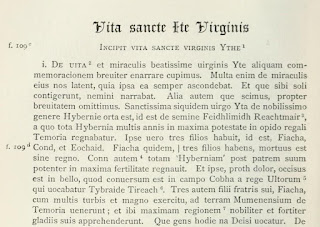
    Some fascinating glimpses of the teachings of Saint Ite and of the sanctity she manifested have been preserved in her Life. Here are a few examples taken from Dorothy Africa’s translation of Vita Sanctae Ite from Plummer’s Vitae Sanctorum Hiberniae. The Headings are mine.

    Saint Ite is transfigured

    2. One day the blessed girl Ita was asleep alone in her chamber (cubiculum); and that whole chamber appeared to people to be burning. But when the men approached it to help her, that room was not burned; and all marveled greatly at this, it was said to them from above, what grace of God burned around that comrade of Christ, who was asleep there. And when holy Ita had arisen from sleep, her entire form appeared as if it were angelic. For then she had beauty such as she had neither before or after. So also her aspect appeared then so that her friends could scarcely look at her. And then all recognized what grace of God burned around her. And after a short interval the virgin of God was restored to her own appearance, which was certainly pretty enough.

    An Angel appears to Saint Ite and Testifies to the Holy Trinity

    3. On another day when the blessed Ita slept, she saw an angel of the Lord coming toward her, and giving her three very precious stones. And when the handmaiden of Christ had arisen from sleep, she did not know what this vision signified. And the blessed (girl) had a question in her heart about this. Then an angel of the Lord came down to her, saying “What are you searching for concerning this vision? Those three very precious stones which you saw given to you, signify the holy trinity that came to you and visited you; that is a visitation of the Father, Christ his Son, and the Holy Spirit. And always in sleep and in vigils, the angels of God and holy visions will come to you. For you are the temple of the Deity, body and soul.” And speaking these things, he departed from her.

    Saint Ite Struggles against the evil one

    5. Not long afterward, the blessed virgin Ita fasted for three days and three nights. But in those days and nights through sleeping and vigils the devil openly (evidenter) fought against the virgin of God in many battles. And the most blessed virgin most wisely opposed him in all, as much sleeping as waking. On the second (posteriori) night, then, the devil appeared sad and wailing, and at day break, he departed from the familiar of God, saying in a grieving tone, “Alas, Ita, not only will you free yourself from me, but many others to boot.”

    7. And while the blessed Ita was on her way, behold, many demons came against her along the road, and began to contend (litigare) cruelly against her. Then angels of God from above arrived, and fought very hard with the demons for the bride of Christ. And when the demons had been conquered by the angels of God, they fled away through the byways, crying out and saying: “Alas for us, for from this day we will not be able to contend against this virgin. And we wished today to put our claim on her for our injuries; and the angels of God have freed her from us. For she will root up our habitation from many places and will snatch many from us in this world and from the nether regions.” But the virgin of the Lord, with the consolation of the angels of God, meanwhile advanced to the church; and in it was consecrated by the churchmen at angelic order on the spot, and took the veil of virginity.

    Saint Ite’s Asceticism

    10. The most blessed Ita made great efforts to keep two and three day fasts, and frequently four days. But the angel of the Lord, on a day when she was exhausted by fasting, came to her, and said to her “You afflict your body without measure by these fasts, and you ought not to do so.” But the bride of Christ (was) unwilling to ease her burden, (so) the angel said to her “God has given such grace to you, that from this day until your death you shall have the refreshment of celestial food. And you will not have the power not to eat at whatever hour the angel of the lord will come to you, bringing you food.” Then the blessed Ita prostrated herself and gave thanks to God, and from that bounty (prandium) the holy Ita gave to others to whom she knew it was worthy to be given. And without any doubt she lived thus until her death on the heavenly allotment administered by the angel.

    Saint Ite Demonstrates The Gift of Prophecy

    12. God even bestowed upon the holy Ita such great grace in prophecy that she knew whether the sick would survive their illness or die.

    Saint Ite Heals the Sick and Raises the Dead

    14. Then the most glorious virgin of God returned to her cell. And when the familiar of God was nearing her community, she heard from nearby a great and immense wailing. For three dead nobles were there, who had died on that day; and their friends were wailing and mourning for them. And they, knowing that holy Ita was passing by, came down,and asked the familiar of God in a doleful tone that she might come and pray for their souls at least. Holy Ita then said to them: “That thing more that you wish beyond prayer for their souls, in the name of Christ may it happen for you.” They did not know what to make of this speech at that point. The blessed Ita made the statement because she knew, being full of the spirit of prophecy, that it (or she?) in the name of God would revive them from death. Then the holy one went with them to where the dead were, and while praying she marked the prone bodies with the sign of the holy cross; and they arose living at her command. And the bride of Christ asserted (assignavit) that they lived before everyone.

    15. In that place there was then a certain paralyzed man in the clutches of a very great illness, and his friends, having beheld the revival of the dead, took him up and brought him to the holy Ita, that she might cure him. For they had no doubt that one who could revive dead men could cure a sick one. Then the familiar of God, observing the great misery of that man, looked to heaven, and said to him: “May God pity you”. And as she spoke, the made the sign of the holy cross on him. Most marvelous to say; when the familiar of God marked the hitherto paralyzed man, he stood up whole and unharmed on the spot before all, as if he had never been seized by paralysis. Then the shout of the whole people was lifted to heaven, praising God, and giving thanks tohim, and glorifying his familiar with deserved honor. Afterward, the familiar of God went on with her companions to her cell.

    The Teaching of Saint Ite on What is Pleasing to God

    22. At one time the holy Brendan (Clonfert) was asking the blessed Ita about the three works which are fully pleasing to God, and the three which are fully displeasing, the servant of God replied: “True belief in God in a pure heart, the simple life with religion, generosity with charity; these three please God fully. However, a mouth vilifying people (detestans homines), and a tenacious love of evil in the heart, confidence in wealth; these three fully displease God. Holy Brendan and all who were there, hearing such a statement, glorified God in his familiar.

    The Teaching of Saint Ite to her Nuns on the Holy Trinity

    11. One day a certain holy devout virgin came to the holy Ita, and spoke with her about divine precepts. And while they were conversing, that virgin said to the holy Ita: “Tell us in God’s name, why you are held in higher esteem by God than the other virgins whom we know to be in the world. For to you sustenance from heaven is given by God; you cure all the feeble with your prayer; you speak of past and future events; everywhere you drive out the demonic, daily God’s angels speak with you; you carry on in meditation on and prayer to the holy Trinity without hindrance.” Then the holy Ita said to her: “You answered your own question by saying ‘Without hindrance you carry on in prayer to and meditation on the holy Trinity.’ For who ever shall have done so, will always have God with him, and if I was such a one from infancy, all these things, as you have said, properly pertain to me.” That holy virgin, having heard this speech from the blessed Ita about prayer and meditation on God, departed rejoicing for her cell.

    23. A certain holy virgin, wishing to discover in what manner the most holy Ita was living in her most secret place, in which she was accustomed to be free for God alone, went out at a certain hour, in order to see her. She, then reaching there, saw three very bright suns, just as the natural (mundiali) sun lighting up the whole spot and surrounding area. And she was not able to enter out of terror, but at once turned back. The mystery of this portent would be hidden from us, but for the gifts of the holy Trinity, which made everything from nothing, which the most holy Ita assiduously served in body and soul.

    The Repose of Saint Ite

    36. Afterwards the most blessed patroness Ita was broken by illness; and she undertook to bless and advise her settlement (civitatem), and the clerics and people of Ua Conaill, who had taken her as their patroness. And having been visited by many holy persons of both sexes, amid the choirs of saints, with rejoicing angels in the path of her soul, after the greatest numbers of virtues, in the sight of the holy Trinity, the most glorious virgin Ita passed on most happily 18 days before the Kalends of February. The most blessed body of whom, with many persons having gathered from all around (per circuitum), with many miracles performed, which still have not ceased to be displayed there, most gloriously, after the solemnities of masses, in her monastery which she the very holy Ita, a second Brigit in her merits and morals, established, from the field, was taken (traditum est) to the tomb, reigning with our Lord Jesus Christ, who with God the Father and the Holy Spirit lives and reigns, God in the age of ages. Amen.

    http://monasticmatrix.osu.edu/cartularium/life-saint-ita

    Content Copyright © Omnium Sanctorum Hiberniae 2012-2015. All rights reserved.