December 19 is the feastday of one of my favourite Irish saints – Samthann of Clonbroney, County Longford. The Martyrology of Oengus devotes its entire entry for this day to her:
C. xiv. cal. Ianuarii.
19. Blithe unto my soul,
with the vastness of her host,
be the fair pure manna of elemental God,
Samthann of Clúain Brónaig !
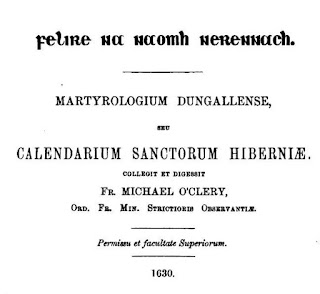
The later Martyrology of Donegal reads:
19. C. QUARTO DECIMO KAL. JANUARII. 19.
SAMHTHANN, Virgin, of Cluain-Bronaigh, in Cairbre in Tethbha, near Granard. She was of the race of Fiatach Finn, monarch of Erin. The age of Christ when she went to heaven was 734.
We are blessed in having a surviving Life of Saint Samthann which records how, having forsaken her aristocratic husband on their wedding night to follow the religious life, she came to the monastery of Clonbroney and was put in charge by its founder, Saint Fuinech. The following excerpts from the Vita Sanctae Samthannae Virginis have been taken from Dorothy Africa’s translation:
5. At that time the foundress of Clonbroney, the blessed virgin Fuinech, dreamt that sparks of fire in the likeness of Saint Samthann came and consumed the whole monastery, and then rose up in a great flame. She told her dream to the sisters and gave this interpretation: “Burning with the fire of the Holy Spirit, Samthann will make this place shimmer by virtue of her merits and in the splendour of miracles”. For that reason, Fuinech sent for Samthann and gave her the community.
Like Saint Brigid of Kildare, with whom she has much in common, many of Saint Samthann’s miracles concern food and in the one recorded below, she also emerges as a saint with a sense of humour:
6. After she had taken charge, first she wanted to construct an oratory of trimmed timber, and so she sent for carpenters and other workmen to bring in timber from forests nearby. One of the carpenters, observing the paucity of the provisions and the number of workers, thought to himself “Oh, if only we could have forty wheaten loaves with butter and cheese and milk, for such a quantity of bread suffice us.” Man is not frustrated in his desire for something his soul has desired. For through the merits of holy Samthann, all he had thought he saw placed before him. The intimate of Christ, giggling, said “The thought of your heart is fulfilled is it not?” And he said to her “Indeed so Mistress, there is neither something in addition, or anything missing.” Then all gave thanks to God and ate their fill.
But, as an Irish saint, it doesn’t do to cross her, even at a distance:
16. Once the holy servant of Christ desired to build a large hall for the work of the sisters, and sent Nathea the prioress with the craftsmen into the forest of Connacht for pine timber. When they had searched for three whole days without finding the wood, the weary group decided on the fourth day to return home. While they slept that night, the blessed Samthann suddenly appeared in a dream to her disciple Nathea, saying “Tomorrow morning cut down bog willows at the root, and you will find enough pine lying there.” At daybreak, they did just so as she instructed, and found the pine they desired. But the owner of the woods, seeing such a heap of pine, said, “unless you buy them, you will not get these trees.” Nathea said to him “we will buy them willingly”. The following night Samthann appeared in a vision to that man. She spoke in a threatening voice, saying “What tempts you fellow, to withold these things offered to God?” Then she struck his side with a staff, saying “wretch, unless you do penance, know that you will die very soon.” Next morning, that man, stung by penance, gave them the lumber outright. When word got out, the inhabitants of the region praised God as manifest in the holy Samthann. They provided sixty yokes of oxen and conveyed all that wood back to the monastery.
But, of course, the Life balances such accounts of the saint’s displeasure with accounts of her mercy. Below is my very favourite instance of her clemency, where Saint Samthann deals leniently with a young whippersnapper who fails to show her the proper respect:
23. Once the community of brothers on the isle of Iona sent some of their members to the holy Samthann with a boatload of wool. While they were clearing the level surface (of the sea), the calm of the air changed suddenly. The waves, raised by the heightening of the winds, menaced them angrily with death. A lad among them spoke up foolishly, saying, “Let’s throw the granny’s wool overboard lest we sink”. The navigator of the ship refused to allow this, and said, “Certainly not, with the old lady’s wool we shall either live or die”. With this remark, such serenity of the sea ensued that the wind disappeared altogether and they resorted to rowing. Then the same boy piped up again, “Why can’t the granny provide us any wind now?” The navigator responded, “we believe that God will assist us for the sake of her merits”. At once the wind filled their sails and they capitalized on this gift for three whole days and nights until they reached the harbour at Colptha. When they had arrived at the monastery of the blessed virgin, they saluted her as they entered and kissed her hand. When the aforesaid lad approached her, the virgin said “Now what was that you were saying about me at sea when the storm threatened you with death?” The boy was confounded into silence with shame. She said to him “Never doubt this, if ever dangers corner you, call upon me boldly”.
The Life ends with a beautiful image of Saint Samthann’s journey to heaven at the end of her earthly life:
26. On the very night in which her spirit returned to heaven, the holy abbot Lasran, of whom we spoke earlier, awoke and saw two moons, one of which dipped towards him. He was mindful of his own request, for he had asked her that when she passed to the celestial realm she would bend toward him. Recognizing her in the guise of a star, he said, “Well done, Samthann, faithful servant of God, for now you are ushered into the rejoicing of the Lord, your spouse.” In this fashion she faded away, climbing into the sky, where eternal life is enjoyed for ever and ever, Amen.
Dorothy Africa, trans., Life of the Holy Virgin Samthann, in T. Head, ed., Medieval Hagiography – An Anthology (Routledge, 2001), 97-110.
Amen indeed!
A further selection from the Life of Saint Samthann can be read here.
Content Copyright © Omnium Sanctorum Hiberniae 2012-2015. All rights reserved.


 OMNIUM SANCTORUM HIBERNIAE