Tag: Saints of Westmeath

  • Saint Aedhan of Cluain-Maelain, March 20

    Another of our many obscure holy men is recorded in the Irish calendars at March 20. Canon O’Hanlon reckons that the locality Cluain-Maelain associated with the Saint Aedhan noted on this day is probably Clonmellon, County Westmeath:

    St. Aedhan, of Cluain-maelain, probably, Clonmellon, County of Westmeath.

    The Martyrology of Tallagh records this holy man, at the 20th of March. The place may be identical with that locality, formerly denominated Cluain-Milain, i.e., Milan’s Lawn or Meadow, now Clonmellon, a small town in the barony of Delvin, and county of Westmeath. Marianus O’Gorman records Aedanus, of Cluain-moelain, at this date. We find the name, Aedhán, of Cluain-maeláin, also set down, in the Martyrology of Donegal, as having a festival, at this date. The Bollandists enter his feast, likewise, on the 20th of March.

    Content Copyright © Omnium Sanctorum Hiberniae 2012-2015. All rights reserved.
  • Saint Fethmec of Kiltoom, March 16

    On March 16 Canon O’Hanlon brings us this entry for Saint Fethmec of Kiltoom, a locality which he places near to Castlepollard, County Westmeath:

    St. Feithmech or Felmac, of Cill-Toama, now Kiltoom, County of Westmeath.

    The Bollandists very briefly notice this saint, at the present day, but they style him, incorrectly, Tetmechus Episcopus de Kill-tuama. On the 16th of March, we read in the Martyrology of Tallagh,  he record, Esp. Felmac o Cill Cuanda (no Tuama). From the prefix, we must regard this saint, as having been a bishop. Yet, we find simply, Feithmech, of Cill-Toama, set down in the Martyrologies of Marianus O’Gorman and of Donegal, as having been venerated on this day. Under the head of Cill Cuana, Duald Mac Firbis enters Fethmech, Bishop of Cill Cuana, i.e., Fethmech, Bishop of Cill Tuama, or (Cill) Toama. The former should now be written Kilquan, and the other Kiltoome. There are many places, in Ireland, bearing these names. The locality here indicated is thought to have been Kiltoom, near Castlepollard, county of Westmeath. During the eighth and ninth centuries, certain abbots of this place are recorded, in the Annals of the Four Masters; and, yet, we have not been able to find the present saint’s name among them.

    Content Copyright © Omnium Sanctorum Hiberniae 2012-2015. All rights reserved.

  • Saint Etchen of Clonfad, 11 February

    On 11 February we commemorate  Saint Etchen (Éidchéan, Etchenius, Ecian, Echen), the bishop and patron of Clonfad, County Westmeath. The entry for his feast day in the Martyrology of Oengus tells an interesting tale:

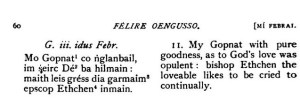
    11. Etchen, i.e. in Cluain fota Baetain in Fir bile.

    Bishop Etchen from Cluain fota Baetain aba in Fir bili is in the south of Meath, and of the Dal Mescorp of Leinster is he. It is Colum cille that went to him to have episcopal orders conferred upon him. Then Colum cille sits under the tree to the west of the church, and he asks where was the cleric?

    “There he is,” says a man there,”on the ploughing-field below.”

    “Meseems,” says Colum cille, “it is not proper for us that a ploughman should confer orders upon us. However, since we have come for it, let him be proved by us.”

    So first, he asks Etchen for the ploughshare. He gives it to them at once, and not the less did the oxen plough.

    “A good man is the cleric!” say they.

    “Prove him still more,” says Colum cille. He asks him for the outer ox. Etchen straightway bestows it on them ; and bishop Etchen ordered a stag which was in the forest to do that work, and he does it forthwith.

    Then Colum cille, having proved the cleric, goes to him and tells him what he had come for.

    “It shall be done,” says the cleric. Then sacerdotal orders are conferred on Colum cille, and it was episcopal orders that he wished to have. The cleric prays till the morrow.

    “That is a mistake, O cleric,” says Colum cille,”the order that thou hast conferred upon me ;- and yet I will never change it so long as I am alive. In lieu of that, now, no one shall ever come to this church to have orders conferred upon him.” And this is still fulfilled.

    The later Martyrology of Donegal reads:

    11. G. TERTIO IDUS FEBRUARII. 11.

    ETCHEN, Bishop, of Cluain-foda in Fir-Bile, in Meath. He was of the race of Laeghaire Lore of the Leinstermen. And it was he that commanded the wild ox to come to him to plough, when he bestowed the order of priest upon Colum Cille in place of the order of bishop. And Colum Cille said that he would not accept of any different orders as long as he should live ; and this indeed he observed, and no one ever came to that church to receive orders from that time forth, A.D. 577. The life of Colum Cille, chap. 38, agrees with this.

    So the calendars identify Saint Etchen as the bishop who ordained Saint Colum Cille (Columba) but mistakenly only to the priesthood and not to the episcopacy. Neither is Saint Colum Cille the only great Irish saint to be linked to Bishop Etchen. The translator of the Martyrology of Donegal has added a footnote saying that a later hand has added a postscript saying “It is he that is called Etianus in Latin, and Echenus in the Life of Brighid, chap. 101.” According to O’Hanlon, the link to Saint Brigid is that she once enjoyed the hospitality of Saint Etchen’s parents and interceded for her childless hosts to conceive.

    Not much is known of Saint Etchen prior to his appearance in the sources as the founder of the monastery at Clonfad and as the bishop who somehow made a mistake in the rite of ordination he administered to Saint Colum Cille. O’Hanlon and other earlier writers were at something of a loss to explain this incident, a popular theory was that it had been intended for Saint Colum Cille to be ordained per saltum i.e. he would be ordained directly from the rank of deacon to that of bishop without first going through the priesthood. It may be that Bishop Etchen had reservations about this and ordained the deacon Colum Cille instead to the priesthood in the usual way. O’Hanlon suggests that perhaps the incident is an attempt by later writers to explain why the great Saint Colum Cille did not hold episcopal rank. He goes on to summarize the records of Bishop Etchen’s feast in calendars from home and abroad:

    The death of Bishop Etchen is recorded in the Annals of the Four Masters at “577. St. Etchen, Bishop of Clonfad, died on the 11th of February.” His festival, on that day, was kept with great solemnity, at Clonfad, in the southern part of ancient Meath. The foreign Martyrologists, Hermann Greuen, Canisius, Ferrarius and others, note this celebration. Our native calendarists, likewise, mention this saint, with distinctive praise.

    The simple record Etchan, bishop, occurs in the Martyrology of Tallagh, at the 11th of February. The Calendar of Cashel, Marianus O’Gorman, Maguire, and the Scholiast on St. Oengus, specially note him, as the minister of St. Columba’s ordination. In the ancient Martyrology, belonging to the Cathedral Church of the Holy Trinity, Dublin, this saint is entered as a bishop at the iii. Ides of February, corresponding with the present day. It seems strange, however, that his name has been omitted from the calendar, which is prefixed. This is probably the Etianus set down for this day, in the anonymous catalogue of national saints, published by O’Sullivan Beare. Under the head of Cluain fota, Duald Mac Firbis enters Bishop Etchen, from Cluain-fota, son of Maine, the poet, of the race of Conchobar Abratruadh.

    At the 11th of February, the Martyrology of Donegal notes the feast of St. Etchen, Bishop of Cluain-foda, in Fir-Bile, in Meath. Scotland, likewise, naturally held the present holy man, in great veneration, because he was the ordaining minister of its great national Apostle. In Ireland, at the 11th of February, the holy bishop and confessor, Etchen, is said to have departed to Christ, according to the Kalendar of Drummond.


    Content Copyright © Omnium Sanctorum Hiberniae 2012-2015. All rights reserved.