Tag: Saints of Tipperary

  • Saint Cera of Kilkeary, January 5


    January 5 is the feast of Saint Cera of Kilkeary. My previous posting on Saint Cera was the account from The Lives of the Irish Saints, now we have another, this time from Canon O’Hanlon’s predecessor, Father John Lanigan. Father Lanigan wrote a four-volume ecclesiastical history of Ireland in the 1820s and often took quite a critical and sceptical tone regarding the work of earlier authorities such as Colgan and Archdall. Some of his instincts and insights were quite correct though and his work is still very readable. Lanigan’s style was to write a paragraph and then provide copious notes to back up what he had said, as you will see from his account of Saint Cera:
    The holy virgin St. Cera, alias Chier, died in 680. (155) She is said to have been the daughter of one Duibhre, and of an illustrious family of Muskerry in the now county of Cork. It is supposed that she was the St. Chier, who, together with five other virgins, applied to St. Fintan Munnu, when residing in Heli (Ely O’Carrol) for a situation to establish a nunnery, and to whom he is said to have assigned the place, where he had lived himself, afterwards called Tech-telle. (156) That St. Cera spent some time in this place I do not find any sufficient reason for denying; (157) but it is very doubtful whether she got it from Fintan Munnu, or whether he had ever resided there. (158) How long she remained in Heli we are not informed. Returning thence to her own country she founded a nunnery, called, from her name, Killchree, now Kilcrea, (159) a few miles S. W. from the city of Cork, which she governed until her death. The reputation of this saint was very great, and her festival was kept at Kilcrea not only on the 5th of January, the anniversary of her decease, but likewise on the 16th of October, as a day of commemoration.
    (155) Colgan, treating of this saint at 5 January, has, from the Irish annals, A. 679. i. e. 680 for her death.

    (156) Archdall places Tech-Telle or Teaghtelle in the county of Westmeath, because Colgan says that, from having been in Heli, it afterwards was comprized in the western Meath, But by western Meath Colgan, and the older writers whom he quotes, understood not only the present Westmeath, but likewise the King’s county, in which Tech-Telle ought to be placed, whereas no part of Heli ever extended as far as what is now called Westmeath. Tech-Telle, or the house of Telle, got its name from St. Telle, son of Segen, who was contemporary with Fintan Munnu, and accordingly lived in the early part of the seventh century, and whose memory was revered on the 25th of June. (See AA. SS. p. 15. and 713.) Archdall has for this saint another Teach Telle at Teltown in the county of East Meath. And why? Because Colgan, speaking of him (at 713 ib.) places Teach-Telle in Midia, or Meath in general. But he had elsewhere (p. 15.) observed, that the part of Midia, in which Teach-Telle lay, was the western; and we have just seen that it was in the tract now called the King’s county. It is plain, on comparing the passages of Colgan, that he knew of only one Teach-Telle. As to Teltown, a place not far from Kells to the East, there is no reason to think that it owes its name to any saint, and it is more than probable that it is the same, at least in part, as the ancient Tailten, celebrated for the sports held there in former times. (See Not. 6. to Chap, v.)

    (157) She is stated to have been in that place before it was occupied by St. Telle. The only difficulty is that Telle flourished before the death, in 635, of Fintan Munnu. But St. Cera seems to have been young at the time she is said to have been there. Supposing that this was about 625, her having lived until 680 contains nothing contradictory or unchronological.

    (158) See Not. 78. to Chap. xv.

    (159) Colgan, in the Acts of this saint, which he has endeavoured to patch up, pretends that she had founded the nunnery of Kilcrea, before she went to Heli. The only reason, that appears for this position, is that he thought, and indeed very strangely, that she was the St. Ciara who is mentioned, in the Life of St. Brendan of Clonfert, as a holy virgin, contemporary with him, and living in Muscrighe Thire. He confounded Muscrighe Thire with the Muskerry of Cork, not recollecting, as he often does elsewhere, that the former was the tract now called Lower Ormond in Tipperary, whereas the latter was known by the name of Muscrighe Mitine. This is not the worst part of his hypothesis; for he knew that St. Brendan was dead since 577. And yet he would fain make us believe that a person, who lived until 680, was a distinguished saint in his days. To enable us to swallow this anachronism, he says she might have reached the age of 130. Harris was so led astray by this stuff, that he assigned the foundation of Kilcrea to the sixth century. Archdall says nothing (at Kilcrea) about the time of this foundation; but (at Teachtelle) he introduces St. Cera building an abbey, as he calls it at Teachtelle, before the year 576. Passing by these absurdities, I shall only add that, if there was a St. Ciara or Cera in Brendan’s time, she was different from the one of Kilcrea, and that she belonged to Lower Ormond. Colgan observes that, besides the St. Cera of Kilcrea, three other holy virgins of the same name are mentioned in the Irish calendars.
    Rev. J. Lanigan, An Ecclesiastical History of Ireland, Volume III (Dublin, 1829), 129-131.

    Content Copyright © Omnium Sanctorum Hiberniae 2012-2015. All rights reserved.
  • Saint Sínech of Crohane, October 5

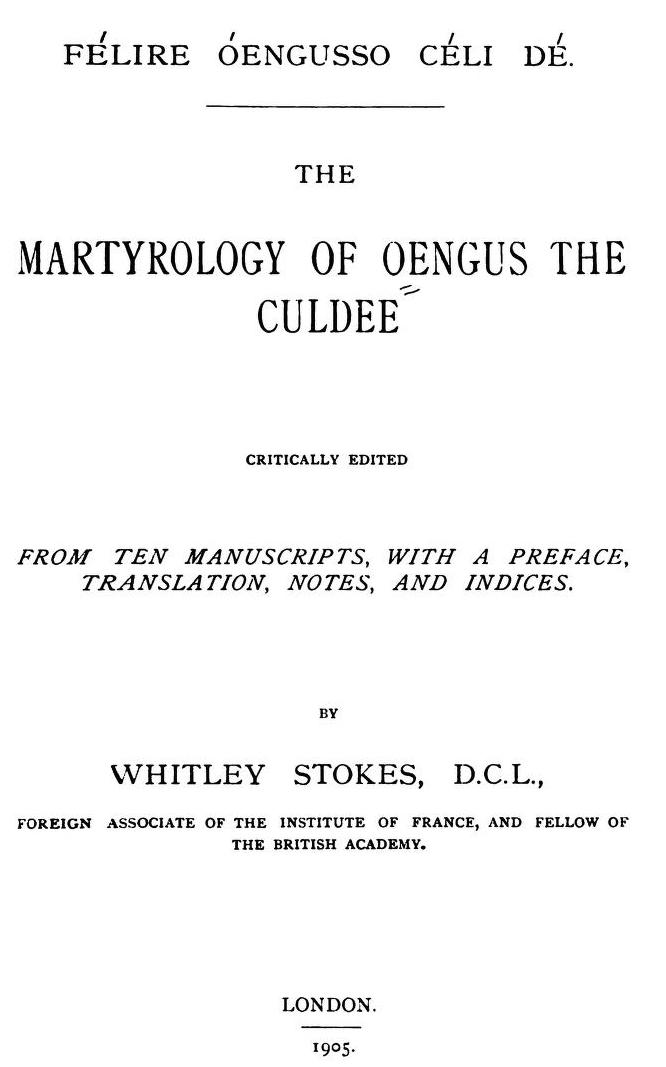
    The Martyrology of Oengus commemorates a holy woman of County Tipperary, Sínech daughter of Fergnae, on October 5:

    E. iii. nonas Octobris.
    Blog dond liic lógmair
    la slóg martir namrae,
    Sínech ingen Fergnae
    Crúachan Maige Abnae.
    5. A fragment of the precious stone,
    with a host of marvellous martyrs,
    Sínech Fergnae’s daughter,
    of Cruachu Maige Abnae.
    Scholiast Notes

    5. A fragment of the precious stone, i.e. Sínech daughter of Fergnae, or good (ergna) is she herself, in Cruachan Maige Abna in Eoganacht of Cashel. Sínech, i.e. Fergna is her father’s name. Or she is ergna, i.e. good, from Cruachan Maige Abna, etc.

    Saint Sínech is also remembered in the later Martyrology of Donegal:
    5. E. TERTIO NONAS OCTOBRIS. 5.
    SINEACH, daughter of Fergna, of Cruachan Magh-Abhna, in Caenraighe. She was of the race of Eoghan Mor, son of Oilioll Olum, according to the Naomh-Senchas.
    According to this website Saint Sinech is the patroness of Crohane, County Tipperary and the writer helpfully provides information from Canon O’Hanlon:
    St Sinech is given as the Patroness of Crohane. The Mart. of Donegal commemorates her on Oct. 5th. says she was the daughter of Fergna of Cruachan Magh Abhna and of the race of Eoghan More, son of O. Olum according to the genealogical history of the Irish saints. The book is wrong in placing Magh Abhna in Co. Limerick.
    O’Hanlon says “she is mentioned also on Oct 5th by the Feilire of St Aengus, and as the daughter of Fergna of Cruachan Muige Abnae in Onacht Cashel”. Maurice Lenihan says “the virgin is likely the sister of St Senachus, Bishop, who was with St Ruadhan and St Columba of Terryglass among the pupils and disciples of St Finian of Clonard”. Crohane must be identified with the Cruachan of St Sinech he says, and the denomination of Magh Abhna has been reformed into Mowney a neighbouring parish in the barony of Slieveardagh. Her acts are not known to exist. Up to 1810 says O’Hanlon, her festival was remembered in Ballingarry on Oct 5th.
    Crohane-Cruachan Muighe Abhnae. Church ruins are in Drangan parish. In the Feilire Aenguis, Crohane is given as the round hill of Moy-Owney. This parish is bounded on the west by the parish of Killenaule, on the east by the parish of Mowney, on the north and north east by the parishes of Lickfinn and Ballingarry. The parish is in Slieveardagh Barony, and an amount of its land would be at present in Ballingany parish, though the old church ruin is in Drangan. This is the place called Cruachan Muighe Abhnae i.e. Croghane Mowney in the Festiology of Aengus, at Oct 5th for the glossographer places it in the territory of Eoghanacth Chaisil. This is rendered absolutely certain by the existence of the well of the Patron Saint and of other names of places in its vicinity, which the ancient authorities place in Eoghanacth Chaisil as Doire na bFlann etc. The name signifies the round hill in the plain of Abhna, which may be interpreted the plain of the river. Magh Abhnai, the name of the plain is still retained in that of the parish of Moy-Owney which bounds Crohane on the east.

    Content Copyright © Omnium Sanctorum Hiberniae 2012-2015. All rights reserved.

  • Saint Elair of Monahincha, September 7


    September 7 is the commemoration of an island-dwelling saint of County Tipperary, Elair of Monahincha. This site was one of those visited in person by Canon O’Hanlon who explored Monahincha in May 1870 as part of his research for the Lives of the Irish Saints. Saint Elair’s island retreat has links with two other saints of the Irish church, Cronan of Roscrea and Canice of Kilkenny, as Canon O’Hanlon explains:

    St Elarius or Helair, Patron, Anchoret and Scribe of Monahincha, near Roscrea, County of Tipperary. (Eighth and Ninth Centuries.)

    The published Martyrology of Tallaght records a festival in honour of Elair of Locha Cre, at the 7th of September.

    This, however, does not accord with the ii. of Nones for this month— although thus set down—and as found in the Book of Leinster copy. The situation of Lough Crea is said first to have attracted the notice of the celebrated St. Cronan before he commenced the erection of his chief religious establishment at Roscrea. In the midst of this “Stagnum Cree” there was an “insula modica,” or moderately-sized Island—now known as Monahincha— and here St. Cronan,it is said, first built a cell. Monahincha lies towards the left, on the high road leading from Borris-in-Ossory to Roscrea; but, the old church is hidden from view, owing to ornamental plantations which surround it in various directions. The greater religious establishment, however, seems to have been fixed at Roscrea —even in the time of St. Cronan— when it is probable Monahincha became a dependent on it, about the beginning of the seventh century. Already have we referred to some remains of antiquity in this town, formerly a place of considerable historic importance, especially in our ecclesiastical annals. After St. Cronan, the earliest saint recorded as having connexion with Inis Loch-Cre, is Coluim or Colum—resolvable into Columba. His period, however, has not been determined; but, it is probable, he preceded the present holy superior in point of time.

    St. Elarius or Helair is called the son of Fintan, sprung from the race of Kein, and his brothers are said to have been Saints Aidan and Conrach. His mother is called Sinacha, third sister to the great St. Columbkille. This latter statement of Colgan must be rejected, if we take into account the date assigned for the death of Elarius. While Sinacha must have been born in the earlier part of the sixth century, the birth of this present Elarius took place, it is probable, at least two hundred years later. The feast of St. Hilair is found in the Martyrology of Marianus O’Gorman, at the 7th of September. In one place, Colgan notes a St. Hilarius Mocukein, a monk of Durrow, to whom he assigns a feast at the 7th of September. We cannot be assured, however, that he was identical with the present Elarius or Helair. On the contrary, he and his brothers, St. Aidan and St. Conry or Conrachus —stated to have been of Kevin’s race —must have lived in the sixth century, if their mother was Sinecha, the sister of St. Columkille. The present saint was undoubtedly of a different family, and he was principally venerated at the place, now known as Monahincha, which the neighbouring people still call The Holy Island. It lies in the parish of Corbally, barony of Ikerrin, and County of Tipperary.

    The lough is now for the most part dried up, but a bog occupies its former site. The old ruins of Monahincha are remarkably beautiful in their architectural peculiarities. Moory soil still extends around, notwithstanding that the waters of the lake have been completely drawn off; while the land is thoroughly drained and reclaimed into fine pasturage, and meadow. Rich grass grows over the soil. Its remarkable old church is covered with a luxuriant growth of ivy, around the whole exterior; but this has been removed from the interior, where all the wall surfaces may be seen. There are two most beautiful doors yet remaining, and almost entire; one of these enters the nave, and the other a small choir. They are semi-circularly headed and elegantly jointed along the jamb-stones, with zig-zag carving around the arches. The fluted columns are surmounted by curious old sculptured heads. Through the ivy on the exterior corners of the nave may be traced projecting columns of rounded and chiselled stones. The ruins stand in a tolerably well preserved state, in the centre of a grave-yard, overcrowded with human remains. The interior of the old church nave is occupied by a family tomb, and around it the floor has been levelled and gravelled; while the landed proprietor of the estate, on which the ruins are situated, seems to have taken special pains to preserve the existing remains. Beside the old Church of Monahincha are some ruins of an ancient monastery.

    Not far from the ruins, some portion of the former extensive lake may be seen; but the inhabitants of the surrounding country have a tradition, that all the vast tract of bog, now extending for several miles towards a range of distant hills, was formerly covered with water, which circled the Holy Island.

    The Church of Inis Lough Cre was dedicated to the St. Helair or Hilarius, whose festival is celebrated on this day, as we are informed. The terms by which he is distinguished in our records indicate, that while he led a life of strict observance and asceticism, he was also the writer of some works, which at present seem to be unknown. Perhaps, he belonged to that band of Coelicoli or Culdees, that lived on the smaller island —as distinguished from the greater —and of which no clear traces now remain; yet, it is recorded, that the passage from one island to the other, in the twelfth century, was made by means of a boat. Helair flourished after the middle of the eighth, and beginning of the ninth century. The death of this Elarius, Anchoret and Scribe, of Lough Crea, is entered in the Annals of the Four Masters, at 802; in those of Clonmacnoise, at 804; in those of Ulster, at 806; but, as we are told by Dr. O’ Donovan, recte, it should be 807. His age at the time of his departure is not known. His name and festival are entered on this day, in the Martyrology of Donegal. In the table appended to this latter work, the name of our saint has been Latinised, Helarius.

    Although Inis-Loch-Cre does not figure very prominently in our Irish Annals, the “Holy Island” appears to have obtained celebrity as a place of pilgrimage and to have had a resident superior in the twelfth century. After the death of St. Cronan, the religious institute he established at Roscrea appears to have flourished in piety and learning, for centuries succeeding his period. A copy of the Four Gospels, called Glass-Kennic, or the Chain of St. Canice, is said to have been there preserved to the time of Archbishop Ussher. Also at Roscrea was recovered the Book of Dimma, a scribe, the son of Aengus, the son of Carthin. Another work, known as the Annals of Roscrea, was probably composed in the monastery there established. A succession of Roscrea Abbots, sometimes styled Bishops, in our Annals, is recorded from A.D. 800 to 1174, when the parent institution seems to have gradually declined, and little account is had regarding it, when its ancient bishopric merged into that of Killaloe…

    Content Copyright © Omnium Sanctorum Hiberniae 2012-2015. All rights reserved.