Tag: Saints of Tipperary

  • Saint Maolán of Tullaghmelan, December 25

    Among the Irish saints who celebrate their feast days on the Feast of Christ’s Nativity is Saint Maolán of Tullaghmelan. Not much is actually known of him save that he is remembered as the founder of the church of Tullaghmelan. Diocesan historian, Father Patrick Power, writes of this locality:

    Tullaghmelan Parish

    THE Parish, which is about average size, lies on the north bank of the Suir along the Co. Waterford boundary line. Its name Tulaigh Maoláin (“Maylon’s Height”) does not appear ecclesiastical, yet it is the tradition of the locality that Maolan was the founder of the church. In fact, an effigy of stone still preserved in the precincts of the ruin is said to be his.
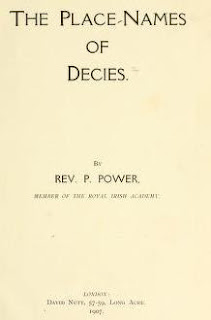
    Rev. P. Power, The Place Names of Decies, (London, 1907), 353.
    The Irish calendars record the saint at December 25 with the Martyrology of Donegal listing:

    25. B. OCTAVO KAL. JANUARII. 25.

    MAELÁN, Bishop.

    whilst the Martyrology of Gorman describes him as ‘great Maelán, void of weakness’.
    The earlier Martyrology of Tallaght lists ‘Melani episcopi’ on this date, along with three other native saints.
     
    Content Copyright © Omnium Sanctorum Hiberniae 2012-2015. All rights reserved.
  • Saint Colum of Terryglass, December 13

    December 13 is the feast of a saint known for his ascetic life – Saint Colum of Terryglass, County Tipperary. Saint Colum (also known as Columba or Colman) was a disciple of Saint Finnian of Clonard, whose feast we celebrated yesterday, and features among that elite group known as the Twelve Apostles of Ireland. He was chosen by the ‘Tutor of the Saints of Ireland’ as the man to give his master the Holy Communion on his deathbed, as the Irish Life of Saint Finnian explains:

    2646. Once he sent his pupil, even bishop Senach, to find out what the folk of his school were doing. Different, in sooth, was that at which each of them was found, yet all were good. Colomb, son of Crimthann, was found with his hands stretched forth, and his mind contemplative in God, and birds resting on his hands and on his head. When that was told to Findian he said : ‘ The hands of that man,’ saith he, ‘shall give me communion and sacrifice at the ending days.’

    And this prophecy was fulfilled in a miraculous fashion:

    2769. Now, when it came to the ending days of this holy Findian, his guardian angel sent him to Inis Mac n-Eirc on Luimnech, and brought Colomb, son of Crimhthan [with his gillie], with his book-satchel, on two clouds to Clonard. And Findian received communion and sacrifice from his hand, and sent his spirit to heaven at the end of a hundred and forty years.

    Whitley Stokes ed.and trans. Lives of Saints from the Book of Lismore, (Oxford, 1890).

    The Irish Calendars agree in recording Saint Colum’s feast on December 13. The entry for today in the early Martyrology of Oengus reads:

    13. For the dear multitudinous day,
    may they come with many thousands,
    Baethan the pious of Cluain,
    Colomb the abstinent of Tir (dá glais).

    while the later Martyrology of Donegal gives some information on the translation of the saint’s relics:

    COLUM, of Tir-dá-glas, son of Ninnidh, of the race of Cathaoir Mór, king of Erin, who is of the race of Labhraidh Lorc, son of Ugaine Mór, etc. ; and Mincloth, sister of Caemell, daughter of Ceannfionnan, son of Ceis, son of Lughar, was his mother.

    Him Aenghus calls Colum Mac Crimhthainn, and other authors call him Mac Ui Cremhthannain. It was he that gave the sacrifice to Finnen, of Cluain-Eraird ; and he was a disciple of Finnen.

    Macaoimhe, of Tir-dá-ghlas, and Odhran brought his relics to Inis Cealtra, as Ciaran of Saighir had foretold in his own Life, chap. 6, and as Mochaemhog had foretold when he was baptizing Odhran.

    Content Copyright © Omnium Sanctorum Hiberniae 2012-2015. All rights reserved.
  • Four Tipperary Saints – Forthcoming Title from Four Courts Press

    Four Tipperary Saints

    The lives of Colum of Terryglass, Cronán of Roscrea, Mochaomhóg of Leigh and Ruadhán of Lorrha

    Translated into English by Pádraig Ó Riain

    When St Patrick was leaving Munster via the Little Brosna river, close to Tipperary’s northern boundary, he is said to have given a blessing to the province’s people, its men, women and children. Much of this blessing must have lingered over north Tipperary, because no fewer than four of its saints were made the subjects of written Lives, Ruadhán and Colum from the neighbouring parishes of Lorrha and Terryglass, Crónán of Roscrea, and Mochaomhóg of Leigh in Twomileborris. The Lives written for these saints in Latin, translated here for the first time into English, contain much that is of interest, not only to Tipperary people, but to all who wish to know more about the history of early Irish Christianity. Written many centuries after the golden age of the saints, these texts tell us a great deal about the fortunes of their churches, and about the aims and associations of the communities devoted to them. Pádraig Ó Riain, in this new translation, gives access to these four Lives to a brand new audience.


    Pádraig Ó Riain is Professor Emeritus of Early and Medieval Irish at University College Cork, and the previous holder of Visiting Professorships at Bochum and Freiburg in Germany and at Aberystwyth in Wales. He is a former holder of the Parnell Fellowship at Magdalen College, Cambridge, and was the first Irish scholar to be awarded the Humboldt Prize. A former President of the Irish Texts Society and a former Member of Council of the Royal Irish Academy, Professor Ó Riain is the author of numerous publications on Irish hagiography, placenames, personal names, and textual transmission. He is the author of the best-selling A dictionary of Irish Saints (2011).

    Paperback
    160pp; ills. November 2014
    ISBN:
    978-1-84682-550-7
    Catalogue Price: €19.95
    Web Price: €17.95