Content Copyright © Omnium Sanctorum Hiberniae 2012-2015. All rights reserved.
Tag: Saints of Laois
-
Saint Sincheall of Killeigh, June 25
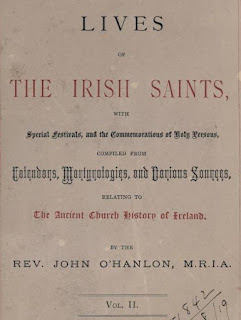
June 25 is the commemoration of a County Offaly saint, Sincheall of Killeigh. There is a saint of this name associated with the household of Saint Patrick who is commemorated on March 26, he is distinguished as Sincheall the Elder and may have been related to the present saint. The Irish calendars preserve this distinction and the two separate feastdays, as Canon O’Hanlon explains:ST. SINCHEALL THE YOUNGER, OF KILLEIGH, KING’S COUNTY.[SIXTH CENTURY.]THE present holy man appears to have figured, at an early period, in our ecclesiastical history, although few particulars regarding him have come down to our times. At this date, in the Martyrology of Tallagh, a festival is registered, in honour of Sincheall the Younger. The holy man bearing this name, and known as the Elder St. Seancheall, was the son of Ceanannan, or Ceannfhionnan, and he was venerated, at the 26th of March. Of him we have already treated, at that date; and, so far as we can ascertain from our Genealogies of the Irish Saints, the present St. Sincheall the Younger must have flourished contemporaneously with his namesake, to whom he was related, and not in a very remote degree. A certain district of ancient Ofalia territory was denominated Droma Foda, or “the long ridge;” and this was truly descriptive of an extended elevation over a plain, which is prolonged from the Slieve Bloom Mountains to the Hill of Allen, and from Cruachan co the Hills of Killone near the Great Heath of Maryborough. There was likewise a Cill Achaidh celebrated in our ecclesiastical Annals, and it was situated in Eastern Breifney. The Elder St. Sinchaell seems to have been the first Abbot, and probably the founder of Cill or Gleannachaidh of Droma Foda ; the term Cill having been prefixed, after St. Sincheall the Elder had placed his church there. Wherefore, the denomination Cill Achaidh Droma Fota signifies “the Church of the Field of the long Ridge.” Such a rising ground is treacable immediately over the village of Killeagh, and it stretches to the south-west. This place was identical with the present neat group of houses, in the barony of Geashill, King’s County. At this village are several traces of old monastic buildings; some of which, however, are almost effaced. But, a considerable part of the more modern portions of an abbey which was there has been incorporated with a fine-looking old mansion and its offices, near that village. In the “Feilire” of St. Aengus, at the 25th of June, the Feast of this St. Sinchell occurs. On this, too, there is a comment, which identifies him with Cell Achid Sinchill, in Offaly. It seems probable enough, that the present holy man spent some time in the monastery of Killeigh with the Elder St. Sincheall, and that he succeeded him in the government of a community there established. This was probably sometime after the middle of the sixth century. It is stated, that soon after the arrival of the English, the family of Warren had established a nunnery here, for nuns of the Augustinian Order. According to the “Annals of the Four Masters,” O’Conor Faly erected a monastery at Cill Achaidh in 1393 for Friars of the Order of St. Francis. A part of this modern religious house is said to be still standing, while tradition relates, that it was formerly very extensive, and that the friars who dwelt there were very numerous. It is the opinion of John O’Donovan, that the ruins of both these religious foundations are near the present Protestant church and the cemetery adjoining.No less than nine holy wells were to be seen near the village; and the old inhabitants had a tradition, that these were dedicated only to the Patron. Wherefore, they should be denominated St. Sincheall’s Wells; but, at present, they are locally called Killeagh Holy Wells. Formerly, they were much resorted to by great numbers of people, for the cure of various diseases. These several springs are in a rich meadow field near Killeigh. Even yet, they are resorted to by the people, who perform stations. No particular day, however, is selected for this purpose. The water is exceedingly clear and well-tasted, and for the most part, the tiny rivulet—for there is only one chief stream—is covered with green cresses. The memory of the patron saint—probably St. Sincheall the Elder—now appears to be lost. There is still extant a list of pious customs and usages, which regulated St. Sinchell’s school. It also comprises very instructive axioms and proverbs, replete with the wisdom of our ancestors in the Faith. This collection appears, however, to have been the work of the Elder St. Sincheall. It seems likely, moreover, that these usages had been received and practised by the Younger St. Sincheall. We find no further account regarding the Acts of the latter holy man. It is probable, he lived and died in the monastery at Killeigh, although the year and place of his departure are not found in our Annals. At the 25th of June, however, the feast of St. Sincheall the Younger is set down, in the Martyrology of Donegal… -
Saint Mac Nissi of Clonmacnoise, June 13
June 13 is the commemoration of Saint Mac Nissi, a sixth-century abbot of Clonmacnoise. He shares his name with the episcopal patron of the northern diocese of Connor whose feast is celebrated on September 3. Today’s saint is noted in the Martyrology of Oengus in the following quatrain, translated by Whitley Stokes:With Bartholomew the activethou art weak if thou hear notfrom us to the Kings (of heaven)went Mac Nissi the chaste of Cluain.Canon O’Hanlon brings this account of the saintly abbot of Clonmacnoise in volume VI of his Lives of the Irish Saints:St. Mac Nissi, Abbot of Clonmacnoise, King’s County [Sixth Century.]This holy man is mentioned, by St. Aengus the Culdee, as deserving of religious veneration from an early date. Among the Burgundian Library Manuscripts, at Bruxelles, there is a Latin Life of Moenissus. Whether he was the present saint, or the Mac Nissi, Bishop of Connor, venerated at the 3rd of September, the short account given by Mr. S. Bindon does not enable us to determine. In the Feilire of Aengus, Mac Nissi the chaste of Cluain is commemorated, on the 13th of June. We also find the name of Mac Nesi, Abbot of Cluana mic nois, occurring in the Martyrology of Tallagh, and in that of Marianus O’Gorman, as having had a festival, at the 13th of June. Nearly contemporaneously with the death of St. Ita, of Killeedy, the predecessor of Mac Nissi, and who is called the abbot Aeneas, departed this life. St. Macnessius immediately succeeded him, in the government of Clonmacnoise, at a time when this sanctuary of holiness; on the banks of the Shannon, was in the zenith of its splendour, as a house and home of retreat. He ruled from about A.D. 574, for a period of sixteen years, according to a gloss on Marianus O’Gorman. The account of his being abbot, during the lifetime of Eneas, must be taken to signify, either that he was elected at this abbot’s express wish, when on his death-bed, according to a custom of the time; or that the term abbot, said to have been applied to him by St. Ita, was rather an expression used by the author of her Life, and referable to Macnessius, at a future period. The O’Clerys place this saint’s death, at A.D. 590. The Martyrology of Donegal records him as Mac Nessi, Abbot of Cluain-mic-nois.Content Copyright © Omnium Sanctorum Hiberniae 2012-2015. All rights reserved. -
Saint Comgan of Gleann Ussen, February 27
On February 27 we commemorate an Abbot of Gleann Ussen, modern Killeshin, County Laois. There is some confusion around the identity and period in which Saint Comhghán (Comgan, Comhdan) flourished. Some of this has arisen due to conflicting accounts about his pedigree in the Irish genealogies, but also because of the attachment of the suffix ‘cend-inis’ to his name in some of the calendars. This is found in the entry in the Martyrology of Oengus for 27 February:
With the suffering of Abundus,
Great his gifts of poems ;
The feast of Comgan, Cend Inis,
The finding of the head of
John [the Baptist].In the nineteenth century Margaret Stokes translated this epithet as meaning ‘without reproach’, but some of the earlier hagiographers appear to have believed that Cend Inis (Ceann Innis or Kean-Indse) was a place in Munster associated with the saint and assigned him to the period of the seventh century. Canon O’Hanlon, however, believes that he actually belongs to the ninth century and is more firmly associated with Gleann Ussen. As he explains:
That St. Comgan was connected with Gleann-Ussen appears, from the authority of the Menelogium Genealogicum, the Martyrologies of Tallagh, of Cashel and of Marianus O’Gorman. This was the name of a remarkable glen, situated in the territory of Hi-Bairche, about two Irish miles to the west of Carlow. There exists a considerable portion of the ruins of an ancient church, called Cill Ussin, anglice Killeshin.
At Killeshin, St. Diarmaid or Diermit is said to have built or presided over a church or monastery; and, this must have been as late as the ninth century, if we are to identify him with that Diarmaid, Abbot of Gleann-Uissean, whose death is recorded at A.D. 874. Now, Comgan is generally allowed to have succeeded him ; but, at what particular date is not clearly ascertainable, for we cannot find any well-known allusion to him in our Annals.
We find him placed after St. Diarmaid, in the government of Killeshin Monastery, and he cannot have enjoyed this position, before the close of the ninth century. Probably this was about the time, when our St. Comgan was abbot over that establishment.
At this day, he is commemorated in our Irish Calendars. We find the simple entry, Comgan, of Gliuni Usin, inserted in the Martyrology of Tallagh, at the 27th of February. St. Oengus the Culdee, likewise, has placed his festival in the Feilire. The Martyrology of Donegal reads:
27. B. TERTIO KAL. MARTII. 27.
COMMAN, Mac Ua Theimhne.COMDHAN, [i.e., Diarmaid,] of Glenn-Uissen, son of Diarmaid, son of Deghadh, of the race of Cormac Cas, son of Oilill Oluim ; and Ethne, daughter of Feidhlimidh, son of Tighernach, was his mother.
The Kalendar of Cashel, the Martyrology of Marianus O’Gorman, and the Martyrology of Cathal Maguire, have entered his festival, at the 27th of February. This holy man appears to have been greatly venerated, in Ireland, where his Office, containing nine Lessons, was formerly recited.
At the iii. of the March Kalends, or at the 27th of February, we learn from the Kalendar of Drummond, that in the Island of Hibernia, the Natalis of the holy Confessor Comgan, who went to Christ, was celebrated. No further biographical statements, in reference to him, have been preserved.
In his authoritative 2011 Dictionary of Irish Saints, Pádraig Ó Riain upholds Saint Comhghán’s identification with Killeshin and that cen dinnis means without reproach. He has been confused with another saint Diarmuid of Gleann Uisean, but they are two distinct individuals. Ó Riain suggests that the importance of Gleann Uisean is reflected in its early twelfth-century ‘chief teacher’ Duibhlitir Ua hUathghaile who wrote a version in Irish of the Sex Aetates Mundi, the Six Ages of the World. Saint Comhghán himself appears in a list of saints whose aid is sought for the men of Leinster in a poem attributed to Saint Moling. Saint Comhghán thus seems to be a good example of a saint who was once ranked as an important saint of Leinster with a notable monastic foundation, but who is now shrouded in obscurity.
Note: This post was first published in 2012 and revised in 2024.
Content Copyright © Omnium Sanctorum Hiberniae 2012-2015. All rights reserved.
