Tag: Saints of Laois

  • Saint Froechán of Bó-chluain, November 20

    On November 20 there is an entry in the Martyrology of Oengus on the commemoration of what appears at first sight to be two Irish saints – Escon and Froechán:

    20. Beseech Escon with Froechan
    in front of strong (Slieve) Bloom,
    with the mysterious sufferings
    of the hosts of Bassus below the clouds.

    to which this gloss has been added:

    20. Escon with Froechán, i.e. Bó-chluain in Leix in the west of Leinster. Or bishop Froechan would be proper there, ut alii putant, a little east of Clúain eidnech. Idea dicitur Esconn ‘impure,’ because for thirty years he was unbaptized.

    I wondered what this enigmatic reference might mean and thankfully Father Michael Comerford’s diocesan history of Kildare and Leighlin was able to shed some light on the puzzle:

    In this immediate neighbourhood, but within the parish of Ballyfin, is Buchlone, a place with which is connected one, if not two, of our early Irish saints. In referring to this place in chapter on Ballyfin, the following curious extract was omitted: it is from the Feilire of Aengus, at 20 Nov:- “Beseech Esconn and Froechan, before strong (Slieve) Bloom.” To which the gloss in Leab. Breac adds: “i.e. pray Bishop Fraecan in Bochluain in Leix, to the east of Cluain Eidnech, or (it is) episcop Froechan that is here ut alii putant, escon, i.e. thirty years was he without baptism et ideo dicitur scon, impure, sed non verum. But Guid episcop Fraechain (is the true reading), i.e. Froechan was his name, and a bishop was he, and in Bochluain he is, i.e. in Leix, and in Druim Daganda in Dalaradia. He is called Escon, because he slew a King of Leinster, i.e. by the dipping with his staff which he made at him while he (the saint) was at Bo-chluain and the king in a bathing-tub at Naas, i.esca ideo dicitur quia aquam baptismatis infudit.” Dr. Whitley Stokes remarks in a note, that the meaning of this last passage obviously is that esconn is a vessel used for distributing water, and that the saint was so called because he baptized many.

    Rev M Comerford “Collections relating to the Dioceses of Kildare and Leighlin” Vol. 3 (1886)

    So it would appear that we are commemorating just one saint, Bishop Froechán of Buchlone, County Laois, who was given the name ‘esconn’ perhaps because of a connection to a baptismal vessel. He would also appear to have a northern connection as he is linked to a place in Dalariada.

    I turned to Canon O’Hanlon, this time in his capacity as a local historian, since he did not live to publish a volume of Lives of the Irish Saints for the month of November, to see what he made of this mystery. He writes:

    Almost forgotten at present, but yet situated near the old coachroad between Maryborough and Mountrath, is the former burial-ground of Bocluain. It is surrounded by high hedgerows of hawthorn, with some larger trees of that species now shading the grass-grown graves, and several rude headstones there, are now scarcely visible; yet, in former times, some kind of a church must have been erected on this site. In our Calendars, a St. Fraechan, Bishop of Bochluain, to the east of Clonenagh, in Laoighis, seems to have been venerated on the 20th day of November. The period when he flourished is not known to the writer; but it must have been during or before the eighth century; for he IS mentioned in the “Feilire” of St. Oengus, at the same date, and assigned to the same place. A scholiast on this passage states, that besides Bochluain in Leix, he was also venerated in Druim Daganda in Dalaradia. According to one tradition, he came from the north, accompanied by a saint called Escon. Others think the latter term is a corruption of the text, and that Epscop should be read, which should simply imply Bishop Froechan. His place is described as having been right before Sliabh Bladhma, now the Slieve Bloom Mountains. The etymon Bo-Chluain, in Irish, has been translated “the Cow’s Lawn” or “Meadow.” The spot here referred to lies about two miles south-west from Maryborough.

    Rev. John O’Hanlon, History of the Queen’s County, Volume 1 (Dublin, 1907), 215.

    Canon O’Hanlon’s suggestion that this troublesome word ‘escon’ might be nothing more than a textual corruption of the word ‘epscop’ (bishop) would solve this conundrum but whether it is correct I am not sure. We can at least be sure, however that a Bishop Froechán was commemorated on 20 November at this place.

    Content Copyright © Omnium Sanctorum Hiberniae 2012-2015. All rights reserved.
  • Saint Fintan Moeldubh, October 20

    October 20 is the feast day of a Saint Fintan or ‘Fintan Moeldubh’, who may have been especially venerated as a patron of Ossory, a kingdom and diocese of south-central Ireland. Confusion arises, as we shall see, because some of the Irish calendars list ‘Fintan Moeldubh’ as a single individual, while others suggest that there is both a Fintan and a Moeldubh commemorated on this day as two separate individuals. Saint Fintan Moeldubh is traditionally held to have been the second abbot of the monastic school of Clonenagh. The evidence, and the difficulties it presents, has been examined by a 19th-century writer on the history of the Diocese of Ossory, Father Edward Carrigan:

    St Fintan of Durrow, Co Laois

    DURROW

    In the Annals of the Four Masters, Durrow is referred to as Daurmhagh Ua nDuach; and, in the Martyrology of Donegal, as Dermhagh Ua nDuach. Both forms of the name signify the same thing, viz., the Oak Plain in [the territory of] Ui Duach.

    St. Fintan was formerly the Patron of Durrow. His feast was celebrated here, according to Bishop Phelan’s List, on the 16th Nov. It is impossible, however, to identify the Saint with any degree of certainty. The likelihood is, that he is identical with a St. Fintan, by some, surnamed Moeldubh. St. Fintan Moeldubh was the second Abbot of Clonenagh, having been appointed to that office by the founder of the monastery himself, St. Fintan macGaibhrene ui Echach, as he lay on his death-bed:

    “When, therefore, his [i.e. St. Fintan macGaibhrene’s] death was near at hand, knowing the day of his departure, he called his people around him, and, with the permission and blessing of the brethren and the saints who had come to visit him, their holy father, he himself appointed in his seat after him, a man noble by race and morals, and named by the same name, i.e. Fintan Moeldubh.”

    In 599 or 600. St. Fintan Moeldubh administered the last rites of the Church to St. Canice, when dying, at Aghaboe. At this time he may have been in charge of the monastery of Durrow for he cannot have succeeded to the abbacy of Clonenagh till some years later, if it be true, as recorded in the Three Fragments of Annals, that St. Fintan macGaibhrene ui Echach did not die till 610. St. Fintan Moeldubh died, according to the Annals of the Four Masters, in 626.

    The difficulty of a satisfactory identification of the Patron of Durrow is rather increased than otherwise by our Irish Martyrologies, as will appear from the following:

    (a) The text of the Calendar of Aengus, at Oct. 20th, has the quatrain:

    “Fintan Moeldubh-great that shout!-
    A fair sun at that mountain
    Of those splendid Eoganacht.”

    On this passage, Aengus’s scholiast, in the Leabhar Breac, comments as follows:

    “Fintan Moeldubh, i.e. Fintan Moeldubh in Ui Duach in Ossory, and of the Eoganacht Chaisil is he, and at Dermag Hua nDuach in the north of Ossory he is. Or, Fintan and Maeldubh are two saints, and in Cluain Immorroiss in Offaly is Maeldubh, and, quod verius [est], he was also brother of St. Comhghan of Glenn Uissen.

    “Now as to Maeldubh, some say that he was of the Eoganacht Chaisil. However, according to the truth of the history of the men of Ireland, he is of the seed of Brian, son of Echaid Muidmedon. ……………Maeldub, son of Amalgaid, son of Fothad, son of Conall glun, son of Brian, son of Echaid Muidmedon.
    “And it is that Maeldub that took Fechin of Fore into fosterage with him, and sent him to learning.”

    (b) The Martyrology of Donegal, at the same day (Oct. 20), commemorates Fintan and Maeldubh, as two distinct saints, thus:

    “Maeldubh, son of Amhalgaidh, of Cluain-Immorrois in Ui Failghe; or of Dermagh in Ui Duach in the north of Ossory. He was of the race of Brian, son of Eochaidh Muighmedhoin.
    “Fionntain, of Derrnagh in Ui Duach.”

    (c) Similarly, at the same day, the Martyrology of Tallaght has the two separate entries:
    “Fintani.
    Maelduibh.”

    (d) Again, on the same day, the Calendar of Cashel has:

    “St. Fintan Maeldubh of the territory of Eoghanacht Cassil, and the instructor of St. Fechin: that he is also sprung from the same territory of Munster, Marianus O’Gorman and Aengus Increased, testify at the cited day.”

    These extracts help to establish one point, at least, and that is, that the feast-day of the St. Fintan, venerated as patron at Durrow, was not the 16th Nov., as Bishop Phelan’s List states, but the 20th of October.

    The traditions of Durrow throw no light on St. Fintan’s history; neither do they preserve the memory of his festival day. His holy well, called “Fintan’s Well,” or rather ” Fantan’s Well,” is within Lord Ashbrook’s demesne, at the distance of about 100 yards from Durrow bridge. At its head, firmly embedded in the earth, is the rough limestone pedestal of a small cross; the socket is 5 in. long, and about the same in width and depth. The cross itself has been long missing. The small inch lying between the holy well and the river Erkina is called [St.] “Fantan’s Island.”

    THE MONASTERY OF DURROW – The foundations of what was traditionally known as “Durrow Monastery,” remained till 1835, about 60 yards north-west of the churchyard of Durrow, between the base of the “Castle Hill” and the small stone bridge crossing the Erkina at this point. The monastery was founded by St. Fintan; but nothing further appears to be known about it. If it survived the middle of the 12th century, it was probably destroyed soon after, in 1156 or 1157, when the army of Muircheartach O’Lochlainn, King of Ulster, burned Daurmhagh Ua nDuach and other monastic centres in its neigbourhood.

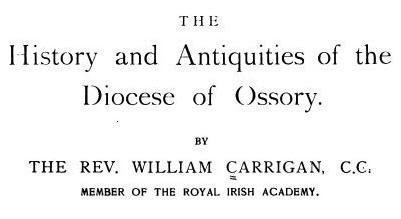
    Rev. E. Carrigan, The History and Antiquities of the Diocese of Ossory, Vol. 2 (1905).

    Tradition also links Saint Fintan Moeldubh with the ‘Apostle of Connemara’, Saint Fechin of Fore. A biographer of Saint Fechin records this incident following the repose of Saint Fintan:

    Saint Fintan Maeldubh, the second abbot of the famous monastery of Clonenagh, was a warm friend and admirer of Fechin, and seems to have wished his monks to take Fechin as their superior. When Fintan died in 626, Fechin went to Clonenagh, where the monks gave him Fintan’s staff and chrism-vessel and vestments, willed probably to Fechin by his dear friend, but the monks declined to have a stranger over them, even though the stranger were a Saint Fechin.

    Some think that it was on this occasion that Fechin parted from Clonenagh without giving the monks his blessing. What it really was which gave him offence is not known. Conscience however reproached him afterwards for giving way to anger, and, as the legend tells us, he was miraculously transported back to the monastery of Clonenagh where he gave a cordial blessing to all the religious.

    Rev. J.B. Coyle, The Life of Saint Fechin of Fore – The Apostle of Connemara (Dublin, 1915), 47.

    Content Copyright © Omnium Sanctorum Hiberniae 2012-2015. All rights reserved.

  • Saint Colman Lucell of Clonkeen, October 6

    On October 6 we commemorate one of the many Irish saints with the name of Colman who appears to have been an abbot at one of the many Irish places with the name of Clúain. This particular saint also seems to have been known as Lucell. The earliest of the calendars, the Martyrology of Tallaght, simply records the name of Colman. The Martyrology of Oengus leads with a notice of Abb Clúana in Lucell, ‘Lucell the abbot of Clúain’, and the scholiast notes record:

    6. Lucell abbot of Clúain, i.e. abbot of Clonmacnois, i.e. a successor of Ciaran of Cluain, and he is at Ross Fothairbe on the shore of Lough Mask in the west of Connaught.

    The commentator on the 12th-century Martyrology of Gorman’s entry for Lucell subach sluagach, ‘happy, hostful Lucell’, however, identifies him with Colman: .i. Colmán ab Clúana Cáoin., ‘i.e. Colman abbot of Clúain Cáin’.

    The 17th-century Martyrology of Donegal reprises all of this information, identifying Colman, as Abbot of Clúain Cáin, describing him also as Lucell and allowing the possibility that he may have been at Clonmacnoise: ‘COLMAN, Abbot of Cluain-caoin, i.e., Luicheall; or he was of Cluain-mic-Nois’.

    There are a number of places in Ireland where the placename of Clúain Cáin, anglicized as Clonkeen, is found. One is not far from the monastery of Clonenagh, founded by Saint Fintan. A diocesan historian of Kildare and Leighlin writes of this place:

    CLONKEEN

    This name, which is derived, according to Colgan, from Cluain-Caein, i.e. secessus amaenus sive delectabilis, “the beautiful lawn or meadow,”-is the title of an ancient parochial district, the church of which still exists in ruins. It is of apparently great antiquity, and is divided into two portions that would represent nave and chancel, except that there is a solid wall separating them apparently as old as the rest of the buildings and only pierced by a window high up. Dimensions: nave 45 feet by 22 feet; chancel (if it may be called so), 25 feet by 18 feet. Colgan speaks of St. Fintan having been born in Clonkeen of Leix; if so, then this place may lay claim to the honour of having given birth to one of our greatest Irish Saints.

    The following particulars are given by Archdall in Monast. Hib, in reference to Cluainchaoin (Clonkeen).
    Cluainchaoin was an ancient monastery, not far from Clonenagh.
    The following Saints are recorded as Bishops here:

    St. Fintan, a holy Anchorite, who died A.D. 860. (In the Martyrology of Donegall at 7th Feb., “Fiontain, Priest, of Cluain-Caoin,” is calendared.)

    The Feilure of Aengus, at 6th Oct., mentions “The. Lucell, Abbot of Cluain;” to which the Gloss in Leabhar Brac adds:

    “Lucell, the bright one (here used) for his name – Or Cluain Luicell, i.e. Cluain Cain, i.e. Abbot of Cluain-Luicell, i.e. Colman, son of Cull, &c” This entry refers perhaps to this place…

    Rev M Comerford “Collections relating to the Dioceses of Kildare and Leighlin” Vol. 3 (1886)

    Given however, that there are other potential candidates for ‘Clonkeen’ including the monastery of Clonkeen near Ardee in County Louth, which is known from Patrician hagiography, it doesn’t seem absolutely certain that this was the monastery of our saint. I will leave the last word to Canon O’Hanlon, this time wearing his county historian’s hat. In a footnote to a discussion of Clonkeen in Volume 1 of his History of the Queen’s County, he remarks: ‘In the similar names of Irish Saints and their places, many inaccuracies of identification occur.’

    Yes, indeed, and never more so it seems than when dealing with any saint called Colman…

    Content Copyright © Omnium Sanctorum Hiberniae 2012-2015. All rights reserved.