Tag: Saints of Kildare

  • Saint Tuilelaith of Kildare

    On January 10 Canon O’Hanlon brings us an an account of a ninth-century abbess of Kildare. The name of Saint Tuillelaith is recorded in the Irish annals rather than in the calendars.  Her memory was preserved in the works of  the seventeenth-century Franciscan hagiologists, Fathers John Colgan and Michael O’Clery.  The latter, in association with a team of other Donegal Franciscans, produced The Annals of the Four Masters, recording the history of Ireland from earliest times up to their own day. It simply records: 

    The Age of Christ, 882 

    …Tuilelaith,  daughter  of  Uarghalach, Abbess  of  Cill-dara,  died on the 10th of  January… 

    Father Colgan undertook the mammoth task of researching and writing the Acta Sanctorum Hiberniae, but sadly only lived to produce the volumes for the first three months of the year.

     As the name of this successor to Saint Brigid is the only information we have about her, Canon O’Hanlon piously muses on the vocation of Abbess Tuilelaith in Article IV for this day in Volume I of his Lives of the Irish Saints:

    Article IV. St. Tulelacia, or Tuillelaith, Abbess of Kildare. 
     [Ninth Century]
     
    This holy superioress is called the daughter of Huargalach. Her tender soul eagerly imbibed heavenly doctrine, and was wonderfully affected with the things of God. After a time, when she had grown up, she dedicated herself to Him, and took delight in nothing else but in thinking, speaking, or hearing of her Heavenly Spouse, and entertaining herself with His Divine love. She was Abbess of Kildare; and, according to Colgan, she died on the 10th of January, A.D. 882. This date also agrees with one in the Annals of the Four Masters, where she is called Tuilelaith, daughter of Uarghalach. True virtue breathed around her an atmosphere of holiness which all her subjects felt. It seemed something marvellous to meet with one so pure-minded, and so unsuspecting of evil in a world of corruption.

    Content Copyright © Omnium Sanctorum Hiberniae 2012-2023. All rights reserved.

  • Saint Beoán of Feighcullen, August 8

    August 8 is the feast of Saint Beoán of Feighcullen, County Kildare. His feast is found on all of the Irish calendars and his name also preserved in genealogical sources. There he is described as one of the seven sons of Neasán from the Uí Fhaoláin branch of the important north Leinster tribe of the Uí Dhúnlainge. Three of his brothers have their own feast on the Irish calendars at March 15. Fiodh Cuilinn, the locality associated with Beoán, is modern Feighcullen, and some of the sources record that Saint Beoán was bishop there. Canon O’Hanlon brings this account of him in Volume VIII of his Lives of the Irish Saints:

    Article III. St. Beoan, son of Nessan, of Feigh Cullen, County of Kildare. 

    According to the Martyrology of Tallagh, veneration was given at the 8th of August to Beoan mic Nessan, in Fidh Cullend. St. Beoan, the son of Nessan, is commemorated, on this day, likewise, in the “Feilire” of St. Aengus. There is a scholion annexed, stating that he was of Fid Cuillinn in Ui-Foelain. It is now called Feighcullen, a parish, partly in the Barony of East Ophaly, but chiefly in that of Connell, County of Kildare. It contains a large tract of bog. The O’Clerys state, that he was the son of Neassan, and that he sprung from the race of Cathaoir Mor, of Leinster. Near the Hill of Allen, in the County of Kildare, Feigh-Cullen was the site of an ancient church, the ruins of which existed within the memory of some still living. The rude Baptismal trough, used at this church in primitive Christian times, is now preserved at Allen. In a field adjoining the church, the foundation of an extensive building can be traced, regarding which, however, history and tradition are silent. A Beoan is set down as a disciple of St. Patrick, but his place was Kill-fiacle in Tipperary; so that he to appears have been distinct from the present saint. The Martyrology of Donegal records him at the 8th of August as Beoan, Bishop of Fidh Chuilinn, in Ui Failge. In the Calendar of Drummond, he is entered at the same date. In conjunction with two other saints bearing the same name, we find a peculiar arrangement, in the table postfixed to this Martyrology [see picture above].

    Content Copyright © Omnium Sanctorum Hiberniae 2012-2022. All rights reserved.

  • Saint Iotharnaisc of Clane, December 22

    December 22 is the feast of Saint Iotharnaisc of Clane, County Kildare, whom we met last year in a post on Saint Ultan Tua. It seems that Saint Iotharnaisc also had a Scottish link, where he appears under the Latinization of his name, Saint Ethernascus or as Saint Athernaise the Hermit or the Mute of Fife. It is interesting that he retains his reputation for maintaining the discipline of silence in both countries. Dom Michael Barrett has an entry for Saint Ethernascus in his calendar of the Scottish saints:

    22 St. Ethernascus, Confessor.

    FROM his retired life and spirit of recollection this Irish saint was known as “Ethernascus, who spoke not,” or “The Silent.” He was one of the chief patrons of Clane, in the county of Kildare. It is difficult to determine what was his precise connection with Scotland, but his office occurs with a proper prayer in the Breviary of Aberdeen. The church of Lathrisk, in Fifeshire, was dedicated to St. Ethernascus conjointly with St. John the Evangelist.

    Dom Michael Barrett, O.S.B., A Calendar of Scottish Saints (Fort Augustus, 1919), 180.

    Bishop Forbes supplies the collect for the day from the Breviary of Aberdeen:

    ETHERNASCUS, C. December 22.—

    The Breviary gives only a collect. “O God, who didst will that the soul of blessed Ethernascus, thy confessor, should penetrate to the stars of heaven, vouchsafe that, as we celebrate his venerable birthday, we may, by his intercessions, be deemed of thy mercy, in respect of his merits, meet to ascend to the joys of his blessed life, through our Lord.” There is an antiphon to the Magnificat, but no lections to the feast.

    In the Irish Kalendars, under this day, we find, in the Felire of Aengus

    Itharnaisc nad labrae.
    [Itharnaisc who spoke not.]

    In the Martyrology of Donegal, “Ultan Tua and Iotharnaisc, two saints who are (buried or principally venerated) at Claonadh, i.e. a church which is in Ui Faelain in Leinster.” This is Clane, in the county of Kildare.

    He is of Lathrisk in Fife, where we find a church dedicated to St. John the Evangelist and S. Ethernasc by David de Burnham on the v. of the Kalends of August 1243.—(Regist. Priorat. S. And. 348; 0. S. A vi p. 15.) The name Lanthrisk, or Lathrisk, contains evidently the Welsh Llan, which we find in Scotland elsewhere, as at Lumphanan, and Panmure and Panbride— the p and l being interchangeable, as we find in the Spanish where plenus becomes lleno. It is quite in accordance with probability that a Kildare saint should be found in the Church of Kenneth Macalpin. Thus we have a Cellach, at once abbot of Iona and Kildare, who died in 865.—(Grub, Eccl. Hist. i. 168.

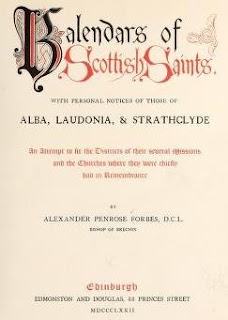
    Alexander Penrose Forbes, D.C.L. Bishop of Brechin, Kalendars of Scottish Saints, (1872), 334.