Tag: Saints of Kerry

  • Saint Fíonán Cam of Kinnity, April 7

    April 7 is the feast of an interesting saint, Fíonán (Finan) Cam, of Kinnity, County Offaly but also associated with various locations in County Kerry.  The Martyrology of Oengus records on this day:

    7. Finan the squinting,
    of Cenn Etig,
    around whom is
    much of clamour :

    There is a gloss on this entry, added by later anonymous commentators, which reads:

    Finán the Crooked of Cenn Etig. Of Húi Luchta was he, i.e. of Corcu Duibne, and of Ciarraige Luachra was his mother. That crookedness was in his eyes, i.e. he looked crookedly at his fosterfather when he was asking something for his guests. “Thou hast leave to be thus, semper,” says the foster father, even Brenainn son of Findlug.
    Fíonán Camm, i.e. crooked was his eye, of Cennetig in Sliab Bladma. Of the Corcu-duibne was he.
    A salmon of red gold came: it went in the west after sunset, against the womb of white Beccnat, (Finan’s mother) so that it became her husband, (i.e.) when she was bathing in Loch Lein: ut dicitur: Now thou hast no earthly father: the Holy Ghost has saved thee, has fostered thee.
    Inde alius dixit:
    Becnat, daughter of vast Idgna, the precious stone that was not scanty: like the Son of the Virgin, Finán Camm was born of her.
    In Becnat’s womb thou wast for a while, for thou wast conceived thro’ God’s word: an earthly father thou hast not, the Holy Ghost has saved thee, has fostered thee.
    Finan Camm brought wheat into Ireland, i.e. the full of his shoe he brought. Declan brought the rye, i.e. the full of his shoe. Modomnóc brought bees, i.e. the full of his bell and in one ship they were brought.
    Finan is entitled to true circuits, a measure of wheat for every household, the full of his brazen shoe: a tribute that no great saint had taken.
    Well, there is certainly much to unpack here! Let’s begin with his title of ‘The Crooked’. The Irish word cam means bent or crooked and when applied to an individual usually signifies some sort of curvature of the spine or limbs. In the case of Fíonán Cam, however, the bend is in his eyes, hence his title of ‘Fíonán the Squinting’. The commentator references Fíonán’s foster-father, Saint Brendan in relation to this and the Latin Life of Saint Fíonán confirms the relationship between the two. It tells us, in a trope typical of hagiography, that Saint Brendan predicted the future greatness of their son to Saint Fíonán’s parents, who as a child undertakes seven years of study of the monastic life with his saintly mentor. Brendan later directs Fíonán to the place of his resurrection at Kinnity, where he establishes his own monastery.
    Then we pass to the extraordinary conception of Saint Fíonán, which the commentator tells us involved a salmon. This too is upheld in the surviving written Lives of the saint, although in the opening to the Latin Life, translated by Pádraig Ó Riain in his 2018 collection Four Offaly Saints, the fish does not approach Fíonán’s mother while she is bathing in the lower lake at Killarney, but rather descends upon her during a vision:
    Holy Fíonán belonged to the family of Corca Dhuibhne; his father’s name was Mac Airdhe and his mother was called Beagnaid. This is how he was conceived; his mother saw a fish of reddish colour airborne from the direction of the rising sun, which entered her womb through her mouth, and she conceived from it. She told this to a wise and religious man who said to her: ‘The child in your womb will be a holy man, and he will have grace from God’.
    Wherever his mother went, for as long as he was in her womb, not a drop of rain, snow or hail touched her garment; her spittle cured every illness and feebleness, and whatever she served of food, however little or poor, it was enough for one and all.

    P. Ó Riain, Four Offaly Saints- The Lives of Ciarán of Clonmacnoise, Ciarán of Seir, Colmán of Lynally and Fíonán of Kinnitty (Four Courts Press, 2018), 81.

    It seems that the object of this episode is not to glorify Beagnaid, the expectant mother, but to show that the miracle-working power of her saintly son was present from the very beginning. The idea that his conception does not involve a human father, despite the fact that the name of Saint Fíonán’s sire is one of the first things the writer of the Life tells us, is perhaps designed to emphasize the purity of the saint as well as his likeness to Christ.
    The final section of the commentator’s annotations claims that Saint Fíonán is responsible for the introduction of wheat to Ireland. Daphne Pochin-Mould in the entry for Saint Fíonán on page 159 of her 1964 book The Irish Saints, makes this observation:
    The gloss on the entry for Finan Cam in the Martyrology of Oengus records the curious tradition that “Finan Camm brought wheat into Ireland, i.e. the full of his shoe he brought. Declan brought the rye, i.e. the full of his shoe. Modomnóc brought bees, i.e. the full of his bell and in one ship they were brought. Finan is entitled to true circuits, a measure of wheat for every household, the full of his brazen shoe: a tribute that no great saint had taken.” This recalls the shrine of Brigid’s shoe in the National Museum, and makes one wonder whether at one time a shoe of Finan Cam was similarly enshrined and venerated, and carried on the due collecting circuits.

    I haven’t encountered this tradition of shoes and dues collections before and would like to know more about it. The most recent thinking on the shoe shrine of Saint Brigid though is that it dates to the early eighteenth century.

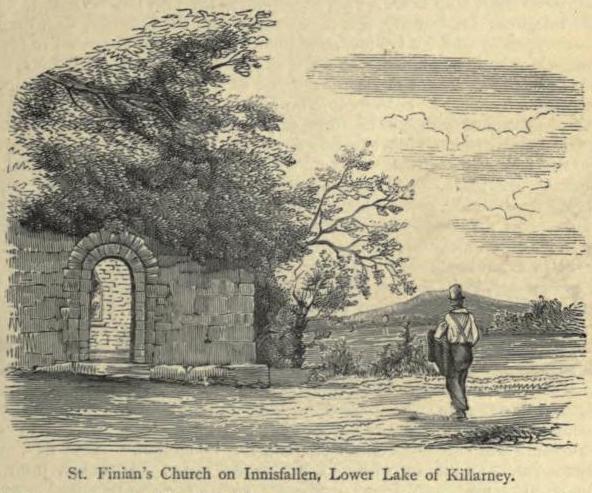
    As we have seen, the Martyrology of Oengus associates Saint Fíonán with Kinnitty alone but the Latin Life places him at various locations in County Kerry. The List of Homonymous Saints preserved in the twelfth-century Book of Leinster records eleven saints who share the name Fíonán, so perhaps it is not surprising to find that Saint Fíonán Cam has become entangled with Saint Fíonán Lobair ‘the leper’ of Swords, County Dublin. Fíonán Lobair is credited with the patronage of the church at Innisfallen, which may be because, according to Pádraig Ó Riain’s Dictionary of Irish Saints, in south Kerry Saint Fíonán’s feast was celebrated on 16 March, the feast day of the leprous one of Swords. Modern scholarship suggests that despite this confusion over the feast date it is the Kerry native, Saint Fíonán Cam, who is the true patron of Innisfallen.

    Content Copyright © Omnium Sanctorum Hiberniae 2012-2023. All rights reserved.

  • An Odysseus of the Irish Church


    May 16 is the feast of one of the most famous of the Irish saints, Brendan the Navigator. The account of his voyaging was one of the most popular works of the Middle Ages and survives in over one hundred and twenty manuscripts written in a variety of European languages. In the 1905 account below we see why the Navigatio Brendani appealed so powerfully to the medieval imagination. Here Saint Brendan is portrayed as ‘an Odysseus of the Irish Church’ who, like the Classical hero, visits a number of island locations and encounters all manner of strange natural phenomena and bizarre creatures. As a Christian hero, however, there are distinctly Christian themes to be found in the Brendan voyage – paradise and hell, Judas and of course the great fish which recalls the biblical story of Jonah and the whale: 

    An Odysseus of the Irish Church


    It must always remain a matter of surprise that the Brendan legend, with its picturesque details, has not taken a more definite place in English literature. For it has about it the same flavour of romance and daring adventure upon the high seas which lends so deep a fascination to the stories of Elizabeth’s great captains. Wrapped in grey wings of mystery, the figure of the Saint broods amongst the ocean mists of the long past, where, seen momently through rifts, his stature seems more than that of mortal man, and his hardy deeds crowned with a charm of blessings. There are many versions of his wanderings, in part sprung from the germs of truth, in part, no doubt, overlaid by the imaginations of the monks, who, poring over Holy Writ and Homeric enterprise, clothed “melodious Brendan” with borrowed attributes, dreamed him into Ionian perils, failed his sails with adventurous winds, such as would bear him into the wonders of the world’s morning. That the monastic mind dwelt upon his history and delighted in it seems to be proved, for there is an ancient French legend of his doings which runs to two thousand verses, and a German poem has seventeen hundred and fifty-two. Little can be given of the life of this strenuous Saint in a short contribution like the present, but those who feel inclined to learn more of him will find a good guide in the “Brendaniana” of the Rev. D. O’Donoghue (Dublin: Browne and Nolan).

    St. Brendan was born in Altraighe, Tralee. He was of Royal lineage. Miracles attended his birth, before which event his mother dreamed that her bosom was full of gold and her breasts white like snow. She told her vision to Bishop Erc (the earliest Bishop of Kerry, the “sweet-spoken Brehon” of St. Patrick), and he answered her: “There shall be born of thee a child of power, who will be full of the grace of the Holy Ghost.” When a year old the child was carried by Bishop Erc to his foster-mother, St. Ita. Of this time it is quaintly written: 

    “Angels in the guise of fair virgins
    Were fostering Brendan,
    From one hand to another,
    Without much hurt to the babe.”

    Over and over again Brendan’s character —strong, impetuous, and passionate — led him to acts that issued in heavy penances. The first recorded of these savours of a very human boy. When about ten he went driving with the Bishop, who, going away to preach, left Brendan reading psalms in the carriage. “Then a young maiden, gentle, modest, of a princely family, drew nigh to the carriage: and she looked at him and saw his face was beautiful and bright.” Taken with his beauty, she wished to play with him, and made “a sportive bound” into the carriage. Brendan resented her advances, and tried to drive her away with angry words. “Go away home,” he cried, “and have illwill to whoever left you here!” Thereupon he seized the reins and lashed her soundly, until she ran away crying and complaining to the King and Queen, her father and mother. For this piece of boyish intolerance he was condemned to do penance by remaining alone in a cave. In his devotions he sings: 

    “The sound of the voice of melodious Brendan
    In the cave near Fenit,
    A thousand paces on every hand,
    His high fine voice was heard.”

    Perhaps this early solitude turned his heart to the love of remote and solitary places, where he recurrently secluded himself in later years. As he attained to manhood, we find him wandering, preaching, founding abbeys, travelling on foot, rowing over wild seas to outlying islands, fasting on Inishglora or another of his beloved “deserts of the sea,” singing masses to the accompaniment of storm-music; and all the while we feel that the heart of the born rover, the pioneer, the wanderer, beat under his monk’s habit of rough woven stuff. Finally, his stern eyes turned to the unsailed ocean of the West: he could no longer restrain himself from going forth upon those long voyagings whither his intrepid fancy had preceded him. Two reasons are given for his taking ship on this perilous quest — one, his desire to save souls; another, that he was driven to go as a punishment. For Brendan, having read a book — presumably of travels — very strange and incredible, waxed indignant at such extravagances, and threw the book into the fire, Therefore God, to punish him for his incredulity, commanded him to forsake his country and parents, and traverse the wide ocean for seven years, that he might see “with his own eyes those wonders, and greater than those wonders, he deemed so unworthy of his belief.”

    Thus began the wanderings of the Irish Odysseus, the earliest of all those brave spirits who fell under the spell of “the magic of the sea,” whose longings drew them through innumerable hardships to tempt the flood that lips the setting sun. Brendan and his disciple made light vessels with wicker sides and ribs, covered with cowhide, much like the curraghs in use to this day upon the islands off the West Coast of Ireland ; and in these frail craft adventured out upon the vast of waters, knowing of no shore to steer for, no port of refuge within the breathless distances of the horizons: —

    “Then,” to quote from a translation of the Latin version, “Brendan, son of Finlugh, sailed over the loud-voiced waves of the rough-crested sea, and over the billows of the greenish tide, and over the abysses of the wonderful, relentless ocean, where they paw in the depths the red-mouthed monsters of the sea and many great whales. They were thus for the space of five years upon the ocean, so wonderful, so strange, and utterly unknown to them; and during all that time no man chanced to meet them, and not one of all the crews suffered any want, nor did any injury befall either body or soul of’ any one. And this was a wonder indeed, for Brendan had not allowed them to bring any provisions with them, but he told them that God would provide food for them wherever they might be, just as He fed the five thousand with the five loaves and fishes.”

    It is obviously impossible to do more than touch upon the fringe of the web of miracles, incidents, and dangers that has woven itself round these voyagings. There is a chord in almost every heart that vibrates when the keynote of romance is struck. It is then small wonder that the deeds of Brendan, the greatly daring, the man of unquailing faith, should echo and re-echo, amplified and glorified, through the centuries. Early in their wanderings, he with his companions came, “by the purveyance of God,” to a full, fair island, filled with green pasture, wherein were the whitest and greatest sheep that ever they saw, for every sheep was as great as an ox. “There they took comfort for a short time, and were told to sail again until they reached a place, like Paradise, where they should keep their Eastertide.” This prophecy being fulfilled, they landed upon the island, “weening to” them they had been safe, and made thereon a fire for to dress their dinner, but St. Brendan abode still in the ship. And when the fire was right hot and the meat nigh soden, then this island began to move; whereon the monks were afraid, and fled anon to the ship, and left the fire and meat behind them, and marvelled sore at the moving. And St. Brendan comforted them, and said it was a great fish named Jasconye, which laboureth day and night to put his tail in his mouth, but for greatness he may not.”

    Thus they kept not only that Eastertide, but subsequent ones, on the back of the “whale,” as the fish is elsewhere called, this miracle recurring every Easter for the keeping of tho feast. That familiarity taught its usual lesson to tho monks may be gathered from some words of the Saint uttered at a later date. They had come to a region where the sea was calm and pellucid, and through the clear water they could behold terrific sea-monsters gambolling far below in the depths. The brethren grew afraid at the sight, but Brendan reminded them of their safety on the back of the whale, where they not only lighted fires, but even cut off pieces of the creature’s flesh, which they dressed and ate. Thereupon the Saint sang Mass in a loud and strong voice, and the charmed monsters swam up to hear and circled round the boat, but at a distance. The next discovery was the Island of Birds — “their number was so great and they sang so merrily that it was an heavenly noise to hear.” Upon the prayer of the Saint to know what these birds meant one of them is permitted to speak: “Sometime we were angels in heaven, but when our master, Lucifer, fell down into hell we fell with him for our offences, some hither, some lower, after the quality of their trespass: and because our trespass was but little, therefore our Lord has set us here out of all pain … to serve Him in the best manner that we can.” Other islands they touched at, each having its own marvel. One was a home of demons where a monk landing was for some old sin snatched away and cried woefully that he could by no means return. Another is described as black and treeless, smoky and covered with smiths’ forges. We may surely read in a volcanic island here, and an iceberg as the underlying fact of a mighty column of clear crystal reaching into the sky, with a canopy about it of gold and silver. On a certain Sabbath they descried upon a low rock a man so cruelly drenched and buffeted by the waves that Brendan cried out in pity of him. But the man answered that he was Judas, who by the mercy of God was allowed on Sabbath days and during the period of certain feasts of the Church to sit upon that rock as an assuagement of the pangs which he endured in hell. But the island St. Brendan called after his own name is perhaps the most interesting of all. It was mountainous and lapped by seas of changeless summer. In maps of the time of Columbus it is found two hundred leagues west of the Canaries. But none have ever landed on St. Brendan’s Isle since his own day. It has been seen, so tradition has it, in serene and clear weather, a mirage upon the horizon, but it has ever remained unapproachable and unattainable. Those who ventured near its shores were driven by furious tempests far from it. An old Spanish chronicle graphically says of it, “which cannot be found when sought for.” From time to time many expeditions were fitted out to search for it, one so late as in the year 1721.

    Brendan passed in safety through his Odyssey of wanderings. He lived, alas! to lay his curse on Royal Tara. The old annals of Clonmacnoise tell the tale. The last King Diarmait had long been a friend of the Saint, but having seized a certain chieftain for the crime of slaying a Royal herald, he refused, in spite of the entreaties of St. Brendan and the Church, to give up his prisoner, who suffered the death-penalty. Whereupon Brendan prayed that “no King or Queen could or would ever dwell in Tara, that it should be waste for ever without Court or Palace, and so it fell out accordingly.” Like the glories of Tara, the Saint and his voyagings are dipped within the haze of time; we catch but glimpses of the truth. It is better so, better that the accurate end of Brendan’s long sea-pilgrimages be lost, for as in a picture which inspires us with yearnings to know all that lies just beyond the last touches of the artist’s brush — what dream-country that, winding road leads to: how look the folk who tread the streets of that now-gone white-turreted city: what unimaginable happenings lie waiting for us could we but pass into the green gloom of that woodland— so it should be with these old-world voyagings. It is fitter we should never know the name of the ultimate beaches that welcomed the Saint’s weary rovers from the sea.— 

    Hesketh Prichard, in the Spectator. 


    Permanent link to this item

    https://paperspast.natlib.govt.nz/newspapers/EP19030919.2.94

    Bibliographic details
    Evening Post, Volume LXVI, Issue 70, 19 September 1903, Page 11 
     

    Content Copyright © Omnium Sanctorum Hiberniae 2012-2021. All rights reserved.

  • The Sailor Saint of Erin

    May 16 is the feast of Saint Brendan of Clonfert. I have already reproduced a rather voluminous account of his life which can be accessed from the tab on the home page, but it is useful to have a shorter reminder of his illustrious career too. Below is one of the syndicated articles which appeared in the New Zealand press in 1923 and is a part of their Papers Past digitized collection. In it the author draws together many of the most famous episodes from the hagiography of Saint Brendan and reminds us that the account of his voyaging was something of a medieval blockbuster. The work Brendaniana mentioned in the article is also available online through the Internet Archive. Finally, I suspect that the ‘Minniah of Loch Erue’, listed in the opening paragraph as one of the Twelve Apostles of Ireland is a typo for Ninnian of Loch Erne.

    The Sailor Saint of Erin

    (By P. D. Murphy, in the Missionary.)

    To the average Catholic St. Brendan is a shadowy, indeed, a mythical figure, who lived, if he lived at all, in a remote corner of Ireland hundreds and hundreds of years ago. But in his native land he is a very real personage, the patron saint of two important dioceses, and one of that group of zealous missionaries, known as the Twelve Apostles of Erin, the others being his namesake of Birr, Ciaran of Clonmacnoise, Ciaran of Saigher, Columba of Tir-da-Glass, Columba or Columbcille of lona, Mobhi of Glasnevin, Rodan of Lorrha, Senanus of Iniscarthy, Minniah of Loch Erue (sic), Lasserian, and St. Canice of Kilkenny. Brandon Hill in Kerry is called after him; so too, is Kilbrennan in Scotland. There was a church dedicated to him in Forfarshire, and in Teneriffe is a shrine which bears his name. He is mentioned in the Lives of the Saints, a copy of which reposes in the Burgundian Library in Brussels. A manuscript life of the saint is one of the most cherished possessions of the family of the Duke of Devonshire. There is a copy of Brendan’s acts in the famous Book of Kilkenny, and there are various entries concerning him in the still more famous Book of Lismore. The Navigatio Brendani was in popular demand in the Middle Ages, and copies of it still preserved in European libraries are of almost priceless value. There is also a work entitled Brendaniana, compiled by a Kerry priest, which is full of interest to those who are interested in the lives of early pillars of the Church in Ireland.

    Brendan, surnamed “the navigator,” partly no doubt because of his passion for the sea, and partly to distinguish him from Brendan of Birr, who was known as “the prophet,” was born in the last quarter of the fifth century in the County of Kerry, near where the town of Tralee now stands. Like many of the early Irish saints, he was of noble birth, being descended from Fergus Mac Roy, who was King of Ireland in the first century. His parents, Finnlugh and Cara, were devout people who lived under the religious rule of Bishop Erc, “the sweet-spoken brehon (i.e., lawgiver) of Patrick.” According to tradition, shortly before the saint was born one Becc Mac De, a prophet, paid a visit to Airde, a wealthy man of the neighborhood, and on being asked, “What unknown event is soon to happen here?” he replied: “There will be born this night, between you and the sea, your true and worthy king, whom many kings and princes will devoutly honor, whom he will bear with him to heaven.” Next morning Airde set out to find the new-born babe, and coming to the house of Finnlugh he was ushered into the child’s presence. Airde at once knelt down and presented Brendan with thirty cows newly-calved and their thirty calves. It is also recorded that the night the child was born Bishop Erc saw a strange light, and many angels passing on their Avay to the house of Finnlugh, whereupon the learned Bishop visited the child, and, taking him in his arms, said: “O man of God, receive me thy faithful votary, and many will rejoice at thy birth, as my heart and soul now greatly rejoice thereat.”

    There is a well in the neighborhood where it is popularly believed the infant was baptised. This spring is known as Tubber-na-molt, or Wethers’ Well, because, according to legend, three sheep arose from its waters during the ceremony.

    When Brendan was a year old he was, in accordance with the custom of the time, put out to fosterage, his foster-mother being St. Ita, the Brigid of Munster. Fosterage, it may here be remarked, was a tribal custom which had existed in Ireland for centuries. It was not a system of baby-farming, but an institution recognised by law and adopted by rich and poor alike as a means of knitting the clan more closely together. The old Brehon Code clearly defined the duties of foster-parents, and penalties were imposed on all who failed to discharge these duties. Boys of the peasant class were instructed in farming and kindred pursuits, while their sisters were taught household management and plain needlework. The sons of parents more generously endowed with the world’s goods were trained to the use of arms, and their daughters were initiated into the mysteries of domestic science and delicate embroidery.

    Brendan spent five years with St. Ita, who “gave him exceeding love, for she saw the ministering of angels about him, and the grace of the Holy Ghost manifestly upon him.”

    Then along with his sister Briga, who later became a nun, he was placed under Bishop Erc for a further period of five years. At the end of that time, when Brendan had been instructed in the Old and New Testaments, he set out to study in the monasteries, which even at this early period were attracting students and ecclesiastics from the continent of Europe.

    Having visited his first teacher, St. Ita, with whom he remained three days, he crossed the Shannon into Connacht, which at that time included all the land west of the river. Here he met a soldier named Mac Lenin, whom he converted, and who afterwards became known as St. Colman, patron of the diocese of Cloyne. Brendan spent some time under St. Jarlath at Tuam, and then journeyed. into Roscommon. On the way he is reputed to have raised a dead man to life, and the matter reaching the ears of the King the young student was summoned to the palace, where an offer of a tract of land was made to him. But Brendan declined the offer and continued his journey in the pursuit of knowledge. When at length he felt he had acquired all that he had set out to learn be returned to Bishop Erc, by whom he was shortly afterwards ordained.

    “Thenceforth,” says the manuscript life of the Saint, “the love of the Lord grew exceedingly in his heart, and he desired to leave his country and land, and parents and family, and he earnestly besought the Lord to grant him some place, secret and retired, far apart from men. While he slept that night be heard the voice of an angel from heaven saying to him: ‘Arise, O Brendan, for God will grant to thee what thou hast prayed for —even the Land of Promise.’ Brendan then retired to the mountain called Sliabh-Diadche, and there fixed his future abode.”

    From this quiet retreat he exercised spiritual jurisdiction over all that territory from Tralee in Kerry to the shores of Lough Corrib in Galway. His fame spread abroad and students from far and near came to study under him. He gave himself freely to the work, but solitude had an irresistible attraction for him. Throughout his life, whenever it was at all possible, he sought the secluded glen rather than the beaten highway, and there passed his time in prayer.

    Some years later, when he was living at Ardfert, a visiting priest told him of a wonderful island out in the Atlantic to which Mernac, an Irish monk, had withdrawn for solitude. Brendan pondered over the story, and finally made up his mind to set out in search of the romantic isle. He took the members of his little community, 14 in number, into his confidence, and one and all agreed to accompany him on his voyage. In preparation for the journey they spent 40 days in fasting and prayer. Then when everything was ready they sailed for Aran to take leave of St. Enda, Brendan’s faithful friend. Their boat, according to Brendaniana, had wicker sides and ribs, over which was fastened cowhide tanned in oak. St. Enda heartily approved the project and the party returned to Kerry, where they took on board provisions for 40 days and an adequate supply of cooking utensils. Then Brendan blessed the vessel, and all embarked in the name of the Blessed Trinity.

    For 12 days and nights they pursued their course, and then a calm set in. The crew took to the oars and exerted themselves to the utmost. When nearly four weeks later their provisions had almost run out, and the members of the expedition were in the last stages of exhaustion, land was sighted away to the north. It proved to be an island, the character of whose coast was such as to chill the hearts of Brendan and his companions. It was rocky and precipitous, and for three days they sailed round it hoping to discover a landing place. When it became apparent there was none they headed the boat into a cove surrounded by high cliffs. Brendan blessed the place and managed to get the party ashore, where they were met by a dog which led them to a mansion “laid out with couches and seats and water for washing the feet.” After they had eaten the repast which they found awaiting them, all except Brendan retired, and he, we are told, spent the night in prayer. Three days later they resumed . their hazardous undertaking, and after a short voyage landed on another island, where they celebrated the Easter festival. Again they put to sea and in due time reached what appeared to be a barren tract. Here they spent the night and next morning, after Mass, some members of the party set about preparing breakfast. All at once they were amazed to notice that their camping ground was moving. In great alarm they ran to Brendan and informed him of their discovery, but the Saint set their fears at rest when he told them it was not an island they were on, “but a fish, the largest of all that swim in. the ocean.”

    Pentecost found them on another island, which they called the Paradise of Birds. Then followed three months at sea, tossing about at the mercy of the wind, suffering much from exposure and hardship. They discovered many other islands, but were eventually driven back to the Paradise of Birds. Here one day, while Brendan was praying near his boat, a bird appeared and perched on the prow of the vessel. The little creature clapped his wings loudly and then delivered this message to the intrepid navigator:

    “The Almighty and Merciful God has appointed for you four different places, at four different seasons of the year, until the seven years of your pilgrimage will be ended. On the festival of the Lord’s Supper you will be each year with your procurator; the vigil and festival of Easter you will celebrate on the back of the great whale; with us here you will spend the Paschal Time until the Octave of Pentecost; and on the island of St. Ailbe you will remain from Christmas until the festival of the Purification of the Blessed Virgin Mary. After those seven years, through many, and divers perils, you will find the Land of Promise of the Saints which you are seeking, and there you will abide for 40 days; then God will guide your return to the land of your birth.”

    And so it turned out to be. For seven long years Brendan and his companions sailed the seas in their frail craft, visiting many strange islands, and enduring great hardships. And at the end of that time they reached the Land of Promise of the Saints, which in the opinion of many competent scholars was none other than the great continent of America. They found the country rich and fertile, with great woods and many rivers. In the course of their wanderings they came one day to a river larger than any they had hitherto encountered, and while they lay on the bank a heavenly messenger appeared and confided to the Saint that his mission was at an end.

    “This is the land you have sought after for so long a time,” the messenger continued, “but you could ..not hitherto find it, because Christ Our Lord wished first to display to you His divers mysteries in this immense ocean. Return now to the land of your birth, bearing with you as much of those fruits as your boat can carry, for the days of your earthly pilgrimage must draw to a close when you may rest in peace among the saintly brethren. After many years this land will be made manifest to those who come after you, when the days of tribulation may come upon the people of Christ.”

    Without further ado, Brendan and his little company returned to their ship and set sail for Ireland, which they reached in due course. The Saint re-established himself in his little cell on the bleak side of Slaibh-Diadche to which he repaired after his ordination. Solitary though he was by nature, he soon realised that there was work for him to do in the conversion of those of his own countrymen who had not yet been brought into the Fold. For fifteen years he labored in Munster and Connacht, and then about the year 540 he extended his mission into Britain, where he was welcomed by Gildas, the distinguished ecclesiastic who was an alumnus of the great school at Armagh. He travelled widely in Britain, visiting Wales, Scotland, and the Orkney Islands. His mission in Scotland preceded that of Columbcille by some 20 years, and that he cherished an affection for that country is evident from St. Adamnan’s life of the Apostle of Iona, wherein it is recorded that four great founders of monasteries came to visit the first and greatest of the Irish missionaries in his self-imposed exile. “These were,” says Adamnan, “St. Comgall, founder of the great monastery and school of Bangor; St. Canice, founder of Aghaboe and Kilkenny; St. Cormac, a disciple of St. Columba; and St. Brendan of Clonfert, the greatest founder of monasteries of them all.”

    Altogether he spent ten years in. Britain, after which he returned to Ireland, where he built several churches and monasteries. But the outstanding event of his career was the great establishment he set up at Clonfert, which, according to the Annals of Innisfallen, he began on the very date of the battle of Cooldrooney, as the result of which Columbcille, the Dove of the Church, went into voluntary exile in Iona. At this time Brendan was verging on 80 years of age, but still full of mental and bodily vigor. He addressed himself to his new task with that enthusiasm which characterised all his labors. The monastery grew apace and even during the lifetime of its founder, was recognised as one of the great schools of Ireland. Some idea of the magnitude of Clonfert may be gathered from the fact that it housed no fewer than three thousand monks who instructed thousands of students, both native and foreign.

    Brendan ruled over Clonfert for many years, and desired to be buried within its hallowed precincts. When he saw that his end was approaching he went down to his sister Brigda, at the convent of Annaghdown, and there some days later he passed away. At his own request his remains were conveyed back to Clonfert, and there they were interred in the presence of “a great multitude of holy men assembled from all quarters on the occasion.”

    The Sailor Saint of Erin,New Zealand Tablet, Volume L, Issue 4, 25 January 1923

    Content Copyright © Omnium Sanctorum Hiberniae 2012-2020. All rights reserved.