Tag: Saints of Fermanagh

  • Saint Siollan of Devenish, May 17

    On May 17 we commemorate Saint Siollan, a seventh-century abbot of the monastery at Devenish Island, County Fermanagh. Canon O’Hanlon’s account of the saint and his lakeland home begins and ends with a romantic flourish:

    St. Siollan, Bishop of Daimhinis, or Devenish Island, County of Fermanagh.
    [Seventh Century.]

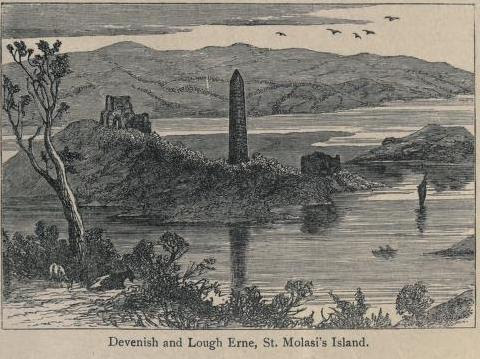
    It is a sight never to be forgotten, when Lough Erne seems, as it were, holding her mirror to the relics around St. Molaisse’s monastery. The round tower—simple, erect, and exquisitely tapering skywards—looks a fit emblem of hope, as the descending sun illumes its cap with golden light; while, down in the silent depths of the lake—less distinct, of a deeper and more dreamy shade—extends the reflection, as if veiling the mysterious past. The name Sillan, a Bishop—without any further designation—occurs in the Martyrology of Tallagh, at the 17th of May. We have Sillanus Episcopus, likewise, in the Franciscan copy of the Tallagh Martyrology, at the 17th of May. The Bollandists also enter his festival, on the same authority. In the Acts of St. Berach, allusion is made to a holy man, named Sillanus, who was miraculously restored to life, at a place called Rath-ond, but, of whose history little more seems to be known. A conjecture is offered, by Colgan, that he may be identical with the present holy man, yet this is hardly probable. The following identification is doubtless the true one, where at this date the Martyrology of Donegal records the veneration of Siollan, Bishop [of Daimhinis]. This has the English signification of “deer island.” His place of habitation was on the historic and beautiful Island of Devenish, so picturesquely situated, on Lower Lough Erne, about two and a-half miles below the town of Enniskillen, and in the county of Fermanagh…

    …The death of St. Molaisse, the founder of Devenish, is assigned to A.D. 563, and he was succeeded by St. Natalis, or Naal, the period of his demise not being stated. The next in succession, as revealed in our Annals, was St. Sillan. His term of incumbency seems assignable to the seventh century, and with the abbatial it is likely he exercised episcopal functions. We learn, that the present bishop died, on the 17th of May, A.D. 658, according to the Annals of the Four Masters. Under the head of Daimhinis, Duald Mac Firbis enters, Siollan, bishop of Daimhinis. Summer finds Devenish clothed in rank, luxuriant herbage. Except in the grey walls and the solitary hut of a herd, no trace of man is there to be seen. But, when the grass dies, and when winter has stripped this ancient home of its cattle, food, and verdure, the old gardens of the community can be traced, in many a boundary line. Even the presence of herbs and plants, which, though old in the soil, are not found in other islands of the lake, or on the surrounding hills, is indicated by the solitary habitant who acts as guide, and who lives upon this insulated spot.

    Content Copyright © Omnium Sanctorum Hiberniae 2012-2015. All rights reserved.

  • The Sons of Terchur, April 13

    On April 13 the earliest of the Irish calendars, the Martyrology of Tallaght, commemorates a group of saints associated with the lakeland area of County Fermanagh, the Sons of Terchur. There are quite a few saints grouped under their patronymic to be found in the Irish calendars. In some cases we have names preserved for the individuals but in many others they are simply known collectively. The memory of the sons of Terchur is carried forward into the 17th-century Martyrology of Donegal, but without any further detail. Canon O’Hanlon fills up some of the space in his article by a romantic description of the scenery of the saints’ locality, accompanied by an engraving, and by way of contrast to their holy way of life selects a later medieval episode from the Irish Annals:

    The Sons of Terchur, of Loch-mac-Nein.

    On the 13th of April, we find entered, in the Martyrology of Tallagh Mac Tarchair, Locha mic Nina. This place was identical with Lough-Mac-Nen, now Lough Macnean, situated between the counties of Fermanagh, Cavan and Leitrim. The very romantic scenery, about the margin of Lough Mac Nean, is enhanced greatly by that beautiful sheet of water, extending between the counties of Fermanagh and of Leitrim, while several islands seem to float over its surface. On one of these, called Innisshee, there is a crannog, and it lies to the left of the Hanging Rock, a magnificent cliff over the Lake, and which is shown in the engraving. The Island itself is in the centre of the Lough, and the view as presented in our illustration is that appearing from Belcoo. A bridge at this village carries the road across to the northern extremity, which is situated in the county of Cavan.

    The sons of Terchur, are mentioned, in the Martyrology of Donegal, as having had veneration paid to them, on this day. They are also said to have been of Loch-mac-Nein; but, whether their place of retirement was on an Island, situated in the lake itself, or whether it was to be found on the shores which border it, we have now apparently no clue left us, which could serve to discover that particular site.

    In the year 1499, the Annals of the Four Masters’ state, that Con Carragh and John O’Roorke took Melaghlin Mac Rannall, a prisoner, and they conveyed him to Inis-Ochta, an Island on Lough Mac Nen. But Rory Maguire rescued the prisoner, and slew these two sons of O’Roorke. It seems hurtful to generous and refined feeling, that deeds of violence should be associated with so charming a locality; and, even more so, when it is known, that holy men had once sanctified those places which are historic, by their living presence, although we can only learn of them and their associations with the scene, through the patronymic above recorded.

    Content Copyright © Omnium Sanctorum Hiberniae 2012-2015. All rights reserved.

  • Saint Ferghas of Inis-Caoin, March 29

    A saint from the beautiful lakeland county of Fermanagh is commemorated on March 29 – Ferghas, son of Enda, of Inis-Caoin on Lough Erne. Finding himself with little information about the saint, Canon O’Hanlon instead writes an enthusiastic account of the beauties of his locality:

    St. Ferghas, son of Enda, of Inis-Caoin, Lough Erne.

    Ferghas, son of Enda, of Inis-Caoin — now Iniskeen — in Loch Eirne, is set down, in the Martyrology of Donegal, as having a festival, at this date. The place, with which he was formerly connected, was on an island of moderate dimensions, and this was situated a few miles from the town of Enniskillen, on the beautiful Lough Erne. That glorious sheet of water, including the River Erne, of rare beauty and magnificence, has a wide and winding extent of sliore, in the counties of Cavan, Fermanagh and Donegal. From various surrounding hills and mountains, its panoramic splendours are exhibited to the gaze, and in every possible novelty of colour and grouping. Over two hundred islands break the water surfaces. The Erne flows in a north-west course, almost centrally through the county of Fermanagh. It is supplied with many tributary streams, along the forty miles of its tortuous channel; being divided into the upper and lower lake.
    About midway on an island in the Erne, the elegantly-built and thriving town of Enniskillen stands, two handsome bridges, having five arches each, connecting this borough with the mainland. The romantic scenery both above and below this town is unrivalled. The upper lake has numerous indentations along its margin, on either side, and so thickly are its islands grouped, that at first sight it would seem a matter of extreme difficulty for a pilot, to find the proper channel. Its course gives the tourist a general idea of an inundated country. The islands are usually very fertile and verdant, while many are richly wooded. Projecting headlands on the river banks are often covered with fine timber, rising with stately trunks and branching tops, from the low and often marshy grounds. Herons and aquatic fowl breed along the rush-lined shores. Nothing can exceed the variety of landscape features here introduced. Swelling hills and more distant mountains frequently give a grand, and, an undulating, outline, to the prospect. The lower lake has a greater expansion of water, unimpeded by islands; although the latter are found to be not less numerous, while descending its stream.


    When St. Ferghas lived in Iniscaoin cannot be discovered; but, in the table, which is added to the Martyrology of Donegal, its compiler remarks, there is a parish church of St. Fergus of Iniscaoin, without cure of souls, because its rectory was secular or impropriate. The Bollandists barely allude to this holy man, as Fergussius, son of Ennius, of Inis-Caoin, in Lough Erne, and quote the Martyrology of Tallagh, as their authority yet, neither in the published work, nor in the Franciscan copy of that record, do I find any corresponding entry.

    Content Copyright © Omnium Sanctorum Hiberniae 2012-2015. All rights reserved.