On July 10 Canon O’Hanlon brings details of a Saint Aedh, described in the Martyrologies as a ‘Deacon’. He identifies the locality associated with this holy man as Clonmany, County Donegal. Pádraig Ó Riain’s entry for the saint, however, places him instead in the County Fermanagh parish of Magheraculmoney and suggests that he is identical with Saint Maodhóg of Ferns. Deacon Aedh has a second feast day on August 31, one he shares with a couple of namesakes. So, he is one of the Irish saints who well illustrates the difficulties in trying to work through the evidence from genealogical, martyrological, and place name sources. Ó Riain’s account of the saint can be found on page 70 of his A Dictionary of Irish Saints (Dublin, 2011), below is that of Canon O’Hanlon from Volume VII of his Lives of the Irish Saints:
Deacon Aedh, of Cuil-Maine, now Clonmany, County of Donegal.
Veneration was given, at the 10th of July, to Aodh Deochain in Crichmaine, according to the Martyrology of Tallagh. Elsewhere this record styles him Mac Maine. Marianus O’Gorman remits his feast to the 31st of August, as the Bollandists, who notice him at the 10th of July, observe. At the the same date, an entry appears in the Martyrology of Donegal, regarding Deacon Aedh, of Cuil-Maine. This was the ancient name of the parish of Clonmany, in the north-western part of the barony of Inishowen, and county of Donegal. This church was served by a vicar, to the close of the fifteenth century. The village here is pleasantly situated on a small rivulet, which rising in the adjoining mountains finds its course to the Atlantic Ocean. Another festival, in honour of the present saint, seems to have been observed, on the 31st of August.
On January 23 the Irish calendars commemorate Saint Lucán of Tamhnach. The problem appears to be in identifying whether the locality associated with the holy man lies in the lakeland county of Fermanagh, or in County Dublin. Canon O’Hanlon’s account though starts off by saying that the place name Tamhnach is not a common one in Leinster and is illustrated by Wakeman’s sketch of the Fermanagh site:
St. Lucain or Lucan of Tamhnach, or Tawny.
In reference to the etymological meaning of this saint’s place, we are told, that Tamhnach (Tawnagh) signifies a green field, which produces fresh, sweet grass. This word enters very generally into names in Ulster and Connaught, especially in the mountainous districts; it is found occasionally, though seldom, in Leinster, and still more seldom in Munster. In modern names it usually appears as Tawnagh, Tawny, and Tonagh, which are themselves the names of several places. In the north of Ulster the aspirated m is often restored, and the word then becomes Tamnagh and Tamny. In composition it takes all the prreceding forms, as well as Tawna and Tamna. We find, according to the Martyrology of Donegal, that Lucán of Tamhnach, was venerated on this day. And in the Martyrology of Tallagh, we meet a nearly similar entry, on the 23rd of January. The Irish form of his place, is Anglicized, Tawny. There is a Tamhach-an-reata, now Tawny—said to be in the parish of Derryvullan, barony of Tirkennedy and county of Fermanagh. Not far removed from this, on the townland of Derryvullan, in a parish bearing this same name, is represented a “holy well,” beside the modern Protestant church, and close to Tamlacht Bay, on the River Erne. In Tamlacht, belonging to this parish, there is an ancient church, and “St Patrick’s well,” which flows beside a gigantic tree. There is likewise a parish, called Taney or Tawney, in the half-barony of Rathdown, and county of Dublin. Here the old church-site and cemetery may be seen delightfully situated on a green knoll, near the railway station at Dundrum. Prior to 1152, it is said, this was a rural see. St. Laurence O’Toole, in 1178, confirmed its possessions to Christ Church Cathedral, Dublin, under the title of “Churchtown with the Grange of Clonskene.” It does not seem an easy matter to determine the site of this saint’s church nor his period.
On November 12 we commemorate Saint Sinell of Cleenish island in County Fermanagh. The Martyrology of Gorman lists ‘Sinell, Mianach’s mighty son’ among the saints commemorated on this day, as does The Martyrology of Donegal. Yet Saint Sinell seems to have been a more important saint than these unremarkable calendar entries might suggest. Indeed, Father John Colgan recorded the name of ‘S. Senellus, Abbas Monasterii Cluain-inis in lacu Ernensi‘ on a list of The Twelve Apostles of Ireland in his Acta Sanctorum Hiberniae [1]. This would place our saint among the elite group of students of Saint Finnian of Clonard, ‘tutor of the saints of Ireland’.
It seems too that Saint Sinell had a reputation as a teacher of monasticism in his own right. Whilst there is no Lifeof Saint Sinell extant, It is common for hagiographers to identify the monastic teachers who shaped the careers of the Irish saints. And just as Sinell is claimed to have been a pupil of Saint Finnian, so Saint Columbanus, according to his biographer Jonas, was initially taught by a monk called Sinilis or Senilis. Previous writers were confident that Sinell of Cleenish was the monk Sinilis, but the current generation of scholars are less certain. Unfortunately, Jonas does not name the place where Sinilis taught, recording only that after Columbanus left his home in Leinster he went to ‘a holy man named Senilis, who at this time was distinguished among his countrymen for his unusual piety and knowledge of Scripture’. Recent scholarly consensus has instead centred around the learned Sillán or Silnán, also known as Mo Sinu maccu Min, master of the computus and abbot of Bangor, the monastery which prepared Columbanus for his great European mission. He would appear to be a credible alternative given that the Hymn in Praise of the Abbots of Bangor describes Sillán as a ‘famous teacher of the world’. A third candidate though has been suggested by Dr Alex Woolf who writes:
….Jonas had introduced his readers to a venerable man and teacher, Sinilis, with whom Columbanus studied before entering into monastic profession at Bangor. Sinilis has been identified in the modern scholarship with a future Bangor abbot, Mo Sinu moccu Min (d. 610). An alternative identification, however, may be the Sinell (d. 603) who became bishop of Moville in succession to Uinnianus in 579.
In support of his suggestion Wolff notes that Saint Columbanus cited the correspondence of Bishop Uinnianus in his own works. He felt this might indicate a link between Columbanus and Moville, which in any case is not very far from Bangor. [2]
But the reputation of Saint Sinell of Cleenish as a monastic teacher is not solely dependent on a disputed link to Saint Columbanus. The Life of Saint Fintán Munnu records that:
6.
Thereafter Fintán departed to read with the wisest man in the whole of Ireland and Britain who was a strict abbot of a church by the lakes of Erne, and he stayed with him for 19 years, reading the Scripture, and there were nine other young men with him. And they were under a very strict [monastic] rule, such that they were not permitted to sieve the flour, but the flour with its chaff used to be mixed with water in a bowl and cooked over stones heated by fire, and this was their daily meal. [3]
This places Saint Sinell squarely in the mould of those sixth-century Irish monastic leaders who were distinguished not only for their learning but also for their ascetiscism.
Further testimony to the stature of Saint Sinell among the saints of Erne is provided by the Life of Saint Naile .
XIII. (29) So then there was convened a conference of meeting and consultation of the clerks of the district assuredly, and of the high saints of Lough Erne without doubt. And there came to attend it Tigernach the long-fair-sided, prompt to recite his hours; Ronan of the appropriate speech, graciously acute; Sinell of the mild appearance, prompt in genuflexion; ….
(33) …And the clerks asked Sinell the virtuous who without contradiction should perform the baptism, for he was bishop over the noble saints, and was the oldest of the freeborn clerks…. [4]
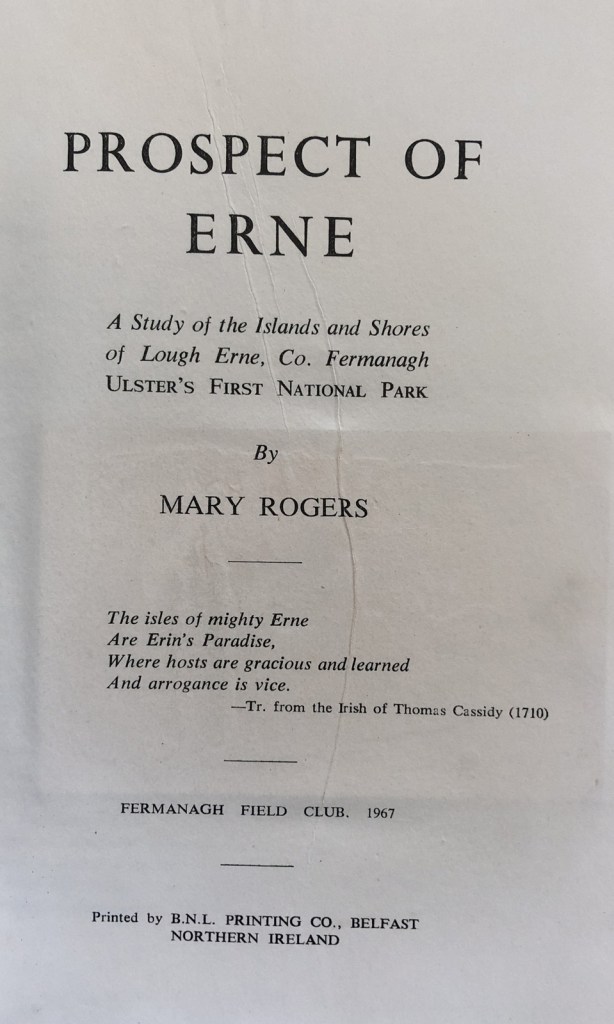
Writing in 1967 Mary Rogers said of Cleenish:
The island is large , containing 438 acres. … There is little on the island now to suggest the thriving monastic school of the sixth century. Here, Archdall tells us “Sinell, son of Manacus, or Maynacur, was abbot about the middle of the sixth century.” St. Sinell was a disciple of Finian of Clonard, and in his turn became the teacher of the great Columbanus, who studied Latin, the scriptures, perhaps Greek and Hebrew. Sinell was called “the wisest man in Ireland,” so it was not surprising that the apostle of Gaul and north Italy came here for the his early studies before starting on his great missionary career. The curriculum was wide, including grammar, rhetoric, poetry, history, geometry and astronomy, and the rule was harsh. “The monks of Sinell, Abbot of Cleenish, were not allowed to sift their corn, but were compelled to mix the chaff with the corn and water in a basin, this mixture being cooked with stones, heated in the fire.” The strict fast of the monks was sometimes relaxed for guests, and it is possible that the students did not suffer the full rigours of the religious. Perhaps the very harshness of the rule attracted the ascetic Irish: St. Fintan (or Munnu, as he was sometimes called) lived on Cleenish with Sinell upwards of 18 years. When Columbanus began his European mission in 589, he cannot have had too many forebodings about future hardships, having the experience of the rule of Cleenish behind him!
One story of St. Sinnell, unconnected with the island, shows him in a more gracious light than has been shed by the account of his austere rule for his monks. The holy well dedicated to St. Patrick near Belcoo that flows out in two different directions, and was known for its cures of nervous and paralytic disorders, is said to have sprung up in answer to Sinell’s prayers. The “pattern” was revived here in 1955, visits to three bullaun stones, the old church and the holy well are paid in the course of the ritual, performed between the last Saturday in July and August 15th, the time associated with Lughnasa. [5]
There is another interesting reference to Saint Sinell and a holy well in the sources. In his contribution to a 2005 volume of studies on the diocese of Clogher archaeologist Cormac Bourke highlighted:
A shrine, now lost, which was by implication portable, is referred to in one of the surviving excerpts from a Clogher diocesan register complied in the 1520s. Called the Deargan, ‘red one’, it was said to have been used by St Sinell mac Manaig of Cleenish, County Fermanagh to prime a well. [6]
The entry from the Register of Clogher cited by Bourke makes clear that Saint Sinell ‘primed’ or prepared the well for its holy function by use of his shrine. Indeed the Register records not only the story of the well and the shrine, but also the tale of how Saint Sinell acquired his land:
There succeeded to him Bishop Sinell, in whose time here emerged the well of living water which is called Glais Deargan, called from glais and from deargan Sinyll, or called from clays (that is, a ditch) and deargann, because the Blessed Sinell having made a ditch for water placed his shrine, called deargann, in it and then at the saint’s prayer the living water issued which is called glais deargann and now issues and will issue until the Day of Judgment. The same Sinell also revived from the dead the daughter of the king of Airghialla and restored her alive to her father, for which reason her father gave to him and to the church the land which is commonly called Cairttha-Sinyll. To him, Sinell, is consecrated the church called Clainynis-Locha fa-Erne [Cleenish]….
Bourke wonders too if another artefact found in the vicinity of Cleenish might be associated, if not with our saint, at least with his island. In 1956 a wooden horn ‘shaped from a solid piece of yew, to which a mouthpiece and mounts of bronze are attached by rivets’ [8] was discovered during dredging of the Erne near to the church of Saint Senach at Derrybrusk, opposite Cleenish island. He offers an intriguing speculation about the horn’s possible purpose:
On Cleenish, on the side furthest from Coolnashantan/Derrybrusk, lay the church of Sinell mac Manaig, and it is not impossible that the horn was used at the river crossing to sound signals to a ferryman.
As support for this conjecture, Bourke cites a letter of 1517 written by the Papal Nuncio to the court of Henry VIII who noted ‘we sounded a horn and gave a signal with a white cloth tied to a pole’ as his method of alerting the ferryman whilst waiting to cross to Station Island at Lough Derg, County Donegal. [9]
It is a pleasing image to think of the peace of Lough Erne being broken by the sounding of this wooden horn when the monks of Cleenish needed to leave their island home.
Thus the evidence suggests that Saint Sinell of Cleenish, whether or not he was the teacher of Columbanus, had a reputation for the sanctity, learning and asceticism typical of monastic saints of the mid sixth-century. The Annals do not appear to record the date of death of Saint Sinell but do note that at the year 1100 ‘This year the church of Saint Sinell of Clain-iais was founded.’ This is interpreted by most commentators as referring to either a rebuilding or to a re-dedication of the original church of Saint Sinell.
Note: This post, first published in May 2026 replaces the original post on Saint Sinell from 2015.
Notes and References
[1] (The Acta Sanctorum Hiberniaeof John Colgan, facsimile edition, Dublin, 1948, p. 405).
[2] Alex Woolf, ‘Columbanus’s Ulster Education’ in Alexander O’Hara, ed., Columbanus and the Peoples of Post-Roman Europe (OUP, 2018), p.91.
[3] Roy Flechner, trans., Life of Saint Fintán, alias Munnu, abbot of Tech Munnu (Taghmon, Co. Wexford esearch.ucc.ie/celt/document/T201046.
[4] C. Plummer, Miscellanea Hagiographica Hibernica (Brussels, 1925), 110-114.
[5] Mary Rogers, Prospect of Erne – A study of the Islands and Shores of Lough Erne, Co. Fermanagh (Belfast, 1967), 102-104.
[6] C. Bourke, ‘Medieval Ecclesiastical Metalwork from the Diocese of Clogher’ in H. Jefferies, ed., The Diocese of Clogher, (Dublin, 2005), p.27.
[7] K. W. Nicholls, The Register of Clogher, in Clogher Record, Vol. 7, No. 3 (1971/1972), pp. 361-431.
[8] John Purser, ‘Reconstructing the River Erne Horn’ in Ulster Journal of Archaeology, Third Series, Vol. 61 (2002), pp. 17-25. The paper includes an interesting illustration from The Vespasian Psalter showing King David amongst a group of musicians, some of whom are playing exactly the same sort of horn as found in the Erne.
[9] Bourke, op.cit., p.33 ; Mary Purcell, ‘St. Patrick’s Purgatory: Francesco Chiericati’s Letter to Isabella d’Este’, Seanchas Ardmhacha: Journal of the Armagh Diocesan Historical Society, Vol. 12, No. 2 (1987), pp. 1-10 at p.7.