Tag: Saints of Down

  • Saint Tuan of Tamlacht, April 1

    A County Down saint, Tuan of Tamlacht, is commemorated on April 1. In his account below, Canon O’Hanlon expresses his irritation at the medieval commentator Giraldus Cambrensis, who confounded this saint with a legendary figure called Ruanus and concluded that he was 1500 years old when he died! As Professor Padráig Ó Riain, in his new Dictionary of Irish Saints, wryly remarks ‘ Not inappropriately, Tuán’s feast fell on 1 April’….

    St. Tuan, of Tamlacht, County of Down.

    The Bollandists record,”Tuanus filius Carilli,” in their collection, at this date, and they quote as authority, the Irish Calendar next mentioned. The Martyrology of Tallagh, at the 1st of April, inserts the name of Tuan, son of Cairill. This saint is said to have been called Ruanus, by Giraldus Cambrensis; yet, we do not find any warrant for such an assertion, although, indeed, that writer has an account of a Ruanus, who is reported to have survived a great pestilence, which devastated Ireland, A.M. 2820. The incredible statement is made, that he survived to the time of St. Patrick, who baptized him, and that he lived to be 1,500 years old, when he died. This is one of the many fables, with which Giraldus Cambrensis was pleased to overload his writings. According to the Martyrology of Donegal, Tuan, son of Coirell, of Tamlachta, in Boirche, had veneration paid him, at this date. The previous identification serves, for this particular locality.

    Content Copyright © Omnium Sanctorum Hiberniae 2012-2015. All rights reserved.
  • Saint Flann of Bangor, December 15

    December 15 is the feast of Saint Flann, a seventh/eighth century successor to Saint Comgall as abbot of Bangor. The Martyology of Oengus says that at this date we commemorate ‘the feast of Flann the modest ruler, the abiding successor at Bangor.’ His death in the eighth century is recorded in the Annals  which also link him to Antrim:

    A.D. 722. ” St. Flann, of Aentrebh (Antrim), Abbot of Beannchair, died.”
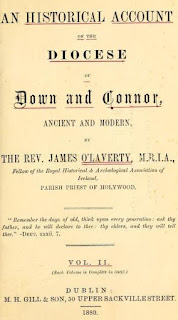
    One of the most glowing tributes to the monastic foundation over which Saint Flann ruled was written by Saint Bernard of Clairvaux in his Life of Saint Malachy. The quotation below has been taken from the diocesan history of Down and Connor by Father O’Laverty:
    “There had existed in this place, under the founder Comgellus, a most noble institution, inhabited by many thousands of monks, the head of many monasteries, a place truly sanctified and so fruitful in saints, which brought forth fruit so abundantly to God, that one of the sons of that holy congregation, Luanus by name, had himself alone founded one hundred monasteries, which I mention for this reason, that the reader may from this single instance form a conception of the number to which the remainder of the community amounted. In short, so widely had its branches extended through Ireland and Scotland, that these times appear to have been expressly foreshadowed in the verses of David—’ Thou visited the earth, and hast plentifully watered it,’ &c. Nor was it only into the countries I have mentioned, but even into distant lands, that crowds of saints, like an inundation, poured, one of whom, St. Columbanus, penetrating into these our regions of Gaul, built the monastery of Luxieu, and there became a great multitude. So great do they say it was, that the solemnisation of the Divine offices was kept up by companies, who relieved each other in succession, so that not one moment, day or night, was there an intermission of their devotions.”
  • Saint Sinell of Moville, October 1


    Today we enter the month of October and I regretfully have to part company from my guide, Canon O’Hanlon. Although he had intended to publish the lives of the Irish saints for the entire year, this was never realized, and although I understand that the archive exists which would make this possible, the remaining volumes were never issued. Complete volumes for the months January to September were published before Canon O’Hanlon’s death in 1905; I am not sure of the exact status of the October volume, I think it may have been published in part and I will have to see if I can track any of it down.  Whilst the Lives of the Irish Saints is perhaps the single most useful and convenient resource, its absence provides an opportunity to explore some of the other sources. So, let’s have a look at a northern saint commemorated today, Sinell of Moville, beginning with a description of his monastery Moville (Magh-Bile, Movilla) in County Down and its founder Saint Finnian:

    Moville, or Movilla, is at present the name of a townland less than a mile to the north-east of Newrtownards, at the head of Strangford Lough, in the county Down. This district was in ancient times famous for its great religious establishments. Bangor, to which we shall refer presently, is not quite five miles due north of Moville…Further south, but on the western shore of the same Lough, anciently called Lough Cuan, were the Abbey of Inch, the famous Church of Saul, in which St. Patrick died, and the Church of Downpatrick, in which he was buried with SS. Brigid and Columcille. And in one of the islands in the same Strangford Lough, now called Island Mahee, quite close to the western shore, was that ancient monastery and school of Noendrum, of which we have already spoken. Religious men from the beginning loved to build their houses and churches in view of this beautiful sheet of water, with its myriad islands and fertile shores, bounded in the distance by swelling uplands, that lend a charming variety to this rich and populous and highly cultivated county.

    …Finnian is said to have returned to Ireland and founded his school at Moville about the year A. D. 540, that is some twenty years after his namesake of Clonard had opened his own great school on the banks of the Boyne. The name Maghbile means the plain of the old tree, probably referring to some venerable oak reverenced by the Druids before the advent of St. Patrick. At present there is nothing of the ancient abbey-school except a few venerable yews to mark the city of the dead, and an old ruined church on the line of the high road from Newtownards to Donaghadee. This old church, which was one hundred and seven feet in length, in all probability did not date back to the original foundation of the place, although it undoubtedly stands on the site of St. Finnian’s original church. The spot was aptly chosen, sheltered by an amphitheatre of hills from the winds of the north and east, and commanding far away to the south a noble prospect of Lough Cuan’s verdant islets and glancing waters.

    St. Finnian died in A.D. 589, according to the Annals of Ulster, at a very great age.

    Insula Sanctorum et Doctorum or Ireland’s Ancient Schools and Scholars by the Most Rev. John Healy (6th edition, Dublin, 1912), 245 , 249, 254.

    The 19th-century Anglican writer, Bishop William Reeves, appended a calendar of saints to his work on the northern dioceses of Down, Connor and Dromore which records the feast day of this successor to Saint Finnian as preserved in the Irish Annals:

    His cowarbs or successors are noticed by the Four Masters, as follows:-

    A.D. 602, ” S. Sinell, Bishop of Moville, died on the 1st day of October.” Tigernach at 603, calls him, “Muighe epscop“: The Chronicon Scotorum, “Maighibile epscop“: The Annals of Ulster (at 602), “Episcopus Campi bili”

    Rev. W. Reeves, Ecclesiastical Antiquities of Down, Connor and Dromore (Dublin, 1847), 152.

    The Martyrology of Donegal lists ‘SINELL, Priest, of Magh-bile’ whereas the Martyrology of Gorman simply lists Sinell, but the notes add ‘priest, of Mag Bile, and bishop of Mag Bile afterwards’.

    Content Copyright © Omnium Sanctorum Hiberniae 2012-2015. All rights reserved.