Tag: Saints of Clare

  • Saint Acobran of Kilrush, January 28

    January 28 is the feast of Saint Acobran of Kilrush, about whom not a great deal appears to be known. We have already met this saint, for in a post on a trio of saintly brothers commemorated on 28 November, I mentioned the contention of the English writer, Sabine Baring-Gould, that one of these brothers, also called Acobran, was to be identified with today’s saint. If our Acobran did indeed go off to Cornwall and later on to France as Baring-Gould claims, Canon O’Hanlon knows nothing of it, and it would not be like the good Canon to fail to claim such a career for an otherwise obscure Irish saint. On the contrary, in the Lives of the Irish Saints Acobran is depicted as a shadowy figure whose very location is the subject of doubt, with the Martyrology of Donegal initially identifying him with Kilrush, County Clare but then suggesting in the table appended to the Martyrology that this particular Kilrush is to be found in County Kildare. In the late 1830s when O’Donovan and his co-workers were carrying out their Ordnance Survey work in the parish of Kilrush, County Clare a letter noted ‘According to the Irish Calendar the Saints Mellan and Occobran were venerated at Cill Rois in the Termon of Inis Cathaigh on the 28th of January, but neither of them is now remembered in the Parish’. It may be that the cult of the most famous saint of Inis Cathaigh, Saint Senan, overshadowed and eventually displaced that of Saint Acobran. Canon O’Hanlon, as he often does when there is not much to say about a saint, goes into a description of church ruins associated with Saint Senan, but below are the essentials of what he has to tell us of Saint Acobran:

    St. Acobran of Kilrush, Probably in the County of Clare.

    …Without any other distinction, he is mentioned in the Martyrology of Tallagh, at the 28th of January, But we are not left in doubt regarding his locality, if we depend on the succeeding statement. According to the Martyrology of Donegal, we find Accobhran, of Cill-Ruis, in the Termon of Inis-Cathaigh, as having a festival celebrated on this day. In a table postfixed to this Martyrology, his place is thought to have been Kilrush, in the county of Kildare. He is said to have been otherwise called Occobhran, whence Ocobrus, Ocoras [Desiderius). The place usually designated for this saint is the present Kilrush, a parish in the barony of Moyarta and county of Clare. The present saint, to whatever place he belonged, appears to have lived in or before the eighth century. This is proved from the “Feilire” of St. Aengus the Culdee. With its English translation, Professor O’Looney has furnished the following stanza from the Leabhar Breac copy in the R. I. A.

    G. u. kl. With Acobran we celebrate
    The passion of eight noble virgins;
    They gained a triumph of righteousness,
    The great Miserian host.

    These latter seem to have been martyrs in Africa, and to have been part of a band, commemorated in St. Jerome’s ancient Martyrology….

    Content Copyright © Omnium Sanctorum Hiberniae 2012-2015. All rights reserved.
  • Saint Mughain of Cluain-Boirenn, December 15


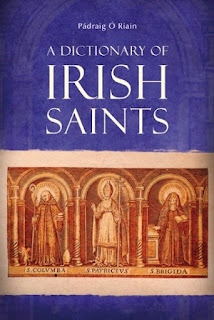
    On December 9 we commemorated two of the daughters of Oilill, Feidhealm and Mughain. I mentioned then that Mughain has a second commemoration on December 15, at least in the locality of Cluain-Boirenn, which Pádraig Ó Riain identifies as possibly being modern Cloonburren, County Roscommon. It is only one of a number of localities associated with this holy lady, Ó Riain’s Dictionary of Irish Saints lists various others, including Kilmoon in County Clare where traditional devotion continued at the holy well up until the early nineteenth century, even though a feast day was no longer remembered for the saint. The Martyrology of Donegal records:

    15. F. DECIMO OCTAVO KAL. JANUARII. 15. 

    MUGHAIN, Virgin, of Cluain-Boirenn.

    whilst the earlier Martyrology of Gorman notes:

    15. F. 

    Mogain [1] against every great battle. 

    [1] a virgin, from Cluain Bairenn.

    Reading Professor Ó Riain’s research leaves the impression that this holy woman was once an important saintly figure, even if today her reputation is much more obscure.

    Content Copyright © Omnium Sanctorum Hiberniae 2012-2015. All rights reserved.

  • Saint Cronan of Tomgraney, October 19

    October 19 is the commemoration of a County Clare saint, Cronan of Tomgraney. The Martyrology of Donegal records:

    19. E. QUARTO DECIMO KAL. OCTOBRIS. 19. 

    CRONAN, of Tuaim Greine.

    The website of the Clare County Library has a page which explains the origins of the place name associated with our saint and which mentions him as the founder of its monastery. Sadly by the nineteenth century, the Ordnance Survey scholar, John O’Donovan, was dismayed to find that little local knowledge of the saint had survived, not even the memory of when his feast day was commemorated. Another nineteenth-century source, the Cyclopedia of Biblical, Theological, and Ecclesiastical Literaturealluded to some of the difficulties in disentangling the founder of Tomgraney from others of the same name:

    Cronan (Croman, or Chronan) is a very frequent name in Irish hagiologies, and has several synonyms, as Cuaran, Mochuaroc, and frequently Mochua, Cron and Cua having in Irish the same meaning.

    13. Of Tuaim-greine (now Tomgraney, in the barony of Upper Tulla, County Clare), commemorated October 19. This saint appears twice in the Mart. Doneg., first in the original hand at October 19; and next in the second hand, on the authority of Mar. O’Gorman, at November 1. Among the saints of the family of St. Colman of Kilmacduach (Feb. 3), or house of the Hy-Fiachrach, Colgan gives “St. Cronan, son of Aengus, son of Corbmac, etc., February 20 or October 19;” and Mart. Doneg. at February 20 also mentions that there is a Cronan with this pedigree (Todd and Reeves, Mart. Doneg. pages 55, 279,293; Colgan, Acta Sanctorum, page 248, c. 2).

    James Strong and John McClintock, eds., The Cyclopedia of Biblical, Theological, and Ecclesiastical Literature (Haper and Brothers; NY; 1880). [extract from online edition here.]

    Modern scholar, Pádraig Ó Riain in his dictionary entry for the saint explores the evidence from literary sources and place names and confirms the difficulties of the earlier hagiologists in establishing a single identity and feast day for this saint.


    Content Copyright © Omnium Sanctorum Hiberniae 2012-2015. All rights reserved.