Tag: Saints of Carlow

  • 'Three Colmáns to Help Us', December 14


    As regular readers of the blog will know the problem of trying to disentangle Irish saints who all share the same name is never more acute than when we are dealing with saints called Colmán. There is a source called the List of Homonymous Saints, preserved in the twelfth-century manuscript known as the Book of Leinster, which lists over two hundred saints called Colm or Colmán. On December 14 we find three saints of this name listed on some of the Irish calendars. The twelfth-century Martyrology of Gorman notes: 

    Three Colmáns to help us

    while the seventeenth-century Martyrology of Donegal records:

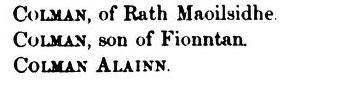
    COLMAN, of Rath Maoilsidhe.
    COLMAN, son of Fionntan.
    COLMAN ALAINN. 

     The first of the trio is associated with the monastery of Rath Melsigi, modern Clonmelsh, County Carlow, a spiritual and intellectual powerhouse which prepared a number of Anglo-Saxon saints, most notably Saint Willibrord and his companions, for their European mission. In the absence of other information we cannot clarify what Saint Colmán’s role was at this foundation or when he may have exercised it.
    The second of the three, described as the son of Fintan offers a patronymic to distinguish himself but alas, this too does not help us locate him in time or place. 
    The final Colmán sounds like a pleasant chap, álainn in modern Irish is an adjective usually translated as ‘beautiful’ but in its older form álaind, Whitley Stokes, the translator of the Martyrology of Gorman, has rendered it as delightful’.

    Content Copyright © Omnium Sanctorum Hiberniae 2012-2022. All rights reserved.

  • Saint Breacc Fele of Bealach-fele, January 15

    It is perhaps appropriate that the holy man we commemorate today is related to the people of Saint Ite of Killeedy, as January 15 is her feast day. Saint Breacc Fele, who also seems to have been known by the name ‘Mobrioccu’ (Mobrigue), was also of the Déise of Munster, as Canon O’Hanlon explains:

    St. Breacc Fele, of Bealach-Fele.

    [Probably in the Seventh Century]  
    On the 15th of January, the Martyrology of Tallagh enters the name of Brice fheli, of Bealach fheli. He is somewhat differently alluded to elsewhere; for we have a clue to his family given in a later calendar. We find recorded, in the Martyrology of Donegal, on this day, Breacc Fele, of Bealach Fele. He is here said to be of the family of Fiacha Suidhe, son to Feidhlimidh Reachtimhar. This holy man, Brecus, as the name is Latinized, was the son of Silaus, son to Dubtach, son of Fergna, son to Muredach, son of Sinell, son to Brecan, son of Aengus Lethain, son to Eugenius Breac, son of Artchorb, son of Fiach. Thus he had a common ancestor with St. Ita, and he belonged to the Desii race, in the south of Ireland. He lived three generations later than St. Ita. The place where he was venerated has eluded our search, if it be not Ballyfoile, the Anglicized form of the Irish word Bealeach Foele, i.e., “the pass or road of Foele.” It is now the name of a townland, in the parish of Kilmadum, and county of Kilkenny, according to some writer in the local newspapers His further remarks, probably somewhat erroneous, may serve to establish an identity between St. Mobrigue and the present St. Breacc Fele. His death is thus recorded in the Annals of the Four Masters at A.D. 730:—”St. Mobrigue, of Bealach-Fele, died.” The name of this saint is said to form part of the name for the next parish, i.e., Kill-ma-de-mogue. This probably means the Church of my Mogue or Mobrigue, adds the writer, but we believe incorrectly. The site of the original church of this saint, he continues, which is also most probably the place of his burial, is well known by the denomination of Kill-Mogue, on Mr. Comerford’s land, only a few fields from the old castle of Ballyfoile. It is shown by the same name on the Ordnance Townland Survey, where it is marked, “a burial place for children.” In the neighbourhood, this ancient cemetery is said to be used only for unbaptized children and strangers. We do not think it probable, as the writer avers, that Mobrigue—while it may possibly be contracted into Breacc—can at all be softened down to Mogue. He regards St. Mobrigue as the patron of Ballyfoile.

    Content Copyright © Omnium Sanctorum Hiberniae 2012-2016. All rights reserved.

  • Saint Cróine, January 27

    January 27 is the feastday of an early female saint, Cróine, one of many Irish saints to have been recorded on the Irish calendars, but who has left no Vita to give further details of her life. As Canon O’Hanlon explains, there is even no certainty as to the locality in which she may have flourished, the Martyrology of Tallaght identifying her with Inuse Lochacrone which may suggest a County Sligo location, and the 19th-century scholar John O’Donovan placing her at Kilcroney, County Wicklow. The latest work on the Irish saints, Pádraig Ó Riain’s 2011 Dictionary of Irish Saints, places her instead at the County Carlow location of Ardnehue (Ceall Inghean nAodha) and sees her as one of three daughters of Aodh. Ó Riain acknowledges the confusion of this holy lady with others of the same name, including Cróine of Inis Cróine, who may be one of a number of possible doubles.

    St. Croine, Virgin, of Kill-Crony, in the County of Wicklow, or at Inishcrone, County of Sligo.

    A festival in honour of Croni of Inuse Lochacrone is entered in the Martyrology of Tallagh, at the 27th of January. The locality named is possibly identical with the present Inishcrone, near the River Moy, in Tireragh barony, county of Sligo. A strong castle of Eiscir-Abhann, stood here. Inishcrone town, with the ruined church and graveyard, is in the parish of Kilglass, and near the rocky shore, at Killala Bay. Again, there was a Cill-Cruain, now Kilcrone, an old church, giving name to a townland and parish in the barony of Ballymoe, in the county of Galway. We find that Croine, virgin, of Cill Croine, is recorded, likewise, in the Martyrology of Donegal, on this day. She is of the race of Máine, son of Niall. Her place has been identified with Kill-crony, in the county of Wicklow, and as giving no name to a modern parochial district, it may have been denominated from the establishment of a cell or nunnery here, by the present saint, while possibly clerical ministrations had been supplied by the religious community or pastor, living at Kilmacanoge, in remote times. More we cannot glean regarding this holy woman yet, we may conjecture, she must have flourished at a very early period.

    Content Copyright © Omnium Sanctorum Hiberniae 2012-2015. All rights reserved.