Tag: Saints of Armagh

  • The Blessed Aidus Hua-Foirreth, June 18

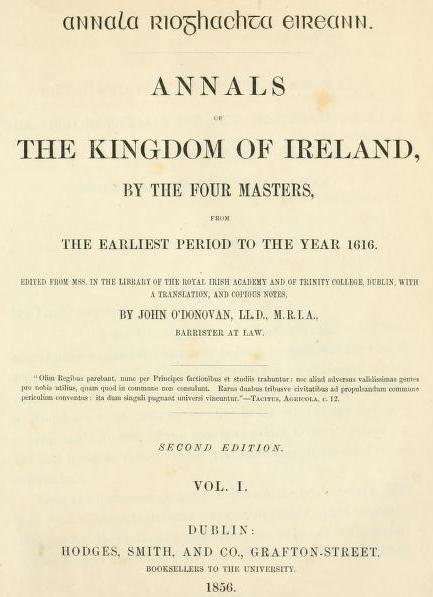
    On June 18 Canon O’Hanlon brings a brief account of a tenth/eleventh century cleric of Armagh, Aidus Hua-Foirreth. He is distinguished from most of the other holy men who appear on this blog in that his name is not recorded on the calendars of the Irish saints but rather in the Irish Annals. The Annals of the Four Masters record:

    The Age of Christ, 1056. Aedh Ua Foirreidh, chief lector and distinguished Bishop of Ard-Macha, died on the 14th of the Calends of July, in the  seventy-fifth year of his age, as is said:

    Of brilliant fame while he lived was
    Aedh O’Foirreidh the aged sage ;
    On the fourteenth of the Calends of July,
    This mild bishop passed to heaven.

    Canon O’Hanlon cannot add much more detail except to acknowledge the role played by the great seventeenth-century hagiologist, Father John Colgan, in flagging up the memory of this learned bishop:

    The Blessed Aidus Hua-Foirreth. [Tenth and Eleventh Centuries]

    In his Appendix to the Acts of St. Patrick, Colgan has introduced the name of the Blessed Aidus Hua-Foirreth, chief scholastic, and bishop of Armagh, or rather suffragan, who died on this day. But that  writer adds little more, which might give a clue to his identity, except that he died A.D. 1056, in the seventy-fifth year of his age. The Bollandists, following Colgan’s statement, notice him, at the 18th of June.

    Content Copyright © Omnium Sanctorum Hiberniae 2012-2015. All rights reserved.

  • Saint Nuad of Armagh, 19 February


    A ninth-century Archbishop of Armagh, Saint Nuad (Nuada or Nodtat), is commemorated on February 19. Canon O’Hanlon records:

    St. Nuad, St. Nuada or Nodtat, Archbishop of Armagh

    [Eighth and Ninth Centuries.]

    At the 19th of February, Colgan and the Bollandists have entered some biographical notices of this holy archbishop, who enjoyed the supreme ecclesiastical dignity in Ireland for a brief period. Nodtat or Nuada, bishop, is mentioned in the Martyrologies of Tallagh, of Marianus O’Gorman, and of Donegal, on this day. He was at first a monk, and also an anchorite. From this state of life, and even against his own will, he had been promoted to the abbatial, and thence translated to the archiepiscopal dignity. His birth-place or residence is said to have been situated at Lough Uama. This signifies the “lake of the cave,” the water being said to rise out of a cavern, and the position is also assigned to Breiffny. Here, it is thought, he led the life of an anchoret. The lough, to which allusion has been made, was in the present county of Leitrim. It sometimes flowed back into that cave, whence it issued ; and, the people living on its borders especially believed, that this was an indication of the Dynast’s approaching death, or that of his children. Ancient Breffny comprehended the present counties of Cavan and of Leitrim. It was divided into Upper and Lower, or East and West Brefiny. In the latter division, called Brefiny Hy-Ruairc, our saint must have lived, until he was called to a higher dignity, on the death of St. Torbach Mac Gorman. This event took place, on the 16th of July, A.D. 812. Archbishop Nuad visited Connaught, A.D. 810 or 815; and, he is there reported, to have made a reformation of some abuses, which had crept into the churches. The Catalogue of the Armagh Primates allows three complete years, for the presidency of Nuad ; but, these must be understood, with the addition of some months, reckoning from the death of Torbach, on the 16th of July, A.D. 812, to the 19th of February, A.D. 816. Other authorities, however, place his demise before this date, viz., at the year 811 or 812. Under the year 811, this passage occurs in the Annals of Ulster, “Nuad of Loch-Huama, bishop, anchorite, and Abbot of Armagh, fell asleep.”

    Lanigan’s Ecclesiastical History of Ireland says that ‘in 811 Nuad made a visitation of some part of Connaught and on that occasion relieved some churches there from an annual offering, which used to be made to that of Armagh’ (Vol 3, p.252).

    The Ancient List of the Coarbs of Patrick lists Nuada as the 33rd holder of the episcopal see of Armagh.

    Content Copyright © Omnium Sanctorum Hiberniae 2012-2015. All rights reserved.
  • Saint Thomian of Armagh, January 10


    On January 10 we commemorate Saint Thomian, a seventh-century successor to Saint Patrick at Armagh, whose ministry was dominated by the Paschal Dating Controversy. In his notes to the updated edition of Archdall’s Monasticon Hibernicum, Bishop P.F. Moran provides this summary of Saint Thomian’s life, noting with approval his appeal to Rome to settle the contentious matter of the correct dating of Easter:
    St. Thomian (Tomyn, Tomene, or Toimen) Mac-Ronan succeeded in 623. He was the most learned of his countrymen, in an age most fruitful of learned men. The “Martyrology of Donegal ” refers his feast to 10th January:
    10. C. QUARTO IDUS JANUARII 10.
    TOIMEN, Successor of Patrick, A.D., 660.
    The “Annals of Ulster” have, A.D. 660, “Tommene, Episcopus Ardmachse, defunctus est.” The “Four Masters,” at the same year, have, “St. Tomene, son of Ronan, Bishop of Ardmacha, died. ” One of the most important ecclesiastical questions that occupied the attention of the early Irish bishops occurred during the pontificate of St. Thomian. The Paschal controversy then agitated the entire island. The Synod of Magh-lene (A. D. 630) in which the Bishops of Leinster and Munster were assembled, under the influence of St. Cummian, decided that the Roman usage should be their guide; and Ven. Bede mentions that, in 635, the Southern Irish, “at the admonition of the bishop of the Apostolic See,” had already conformed to the Roman rite. Not so, however, the Northerns. St. Thomian, in order to secure uniformity, addressed, in conjunction with the Northern bishops and abbots, a letter to Pope Severinus, in 640. When their letter reached Rome, the Apostolic See was vacant, and the reply which came was written, as usual in such cases, by the Roman clergy. This fact is an admirable example of the fidelity with which the early Irish Church adhered to the statute of St. Patrick in the “Book of Armagh,” that difficult cases should be sent “to the Apostolic See, that is to say, to the chair of the Apostle Peter, which holds the authority of the city of Rome.”