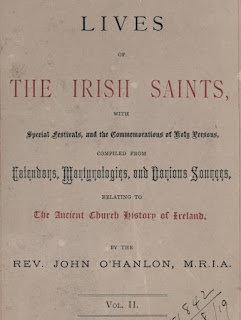
The saint commemorated by Canon O’Hanlon in his lead article for 28 August is one who is far removed from any conventional idea of sanctity. For Feidhlimidh, a prince of the royal house of Munster, appears to have distinguished himself more for the destruction of churches than for their maintenance. Eventually, he burns one church too many at Clonmacnoise, whose patron, Saint Ciaran, administers some rough justice, after which the royal rogue spends the rest of his days in repentance for his former misdeeds. It’s an intriguing story and one which I would be interested to explore further. Canon O’Hanlon sees a message for us all in the strange story of Feidhlimidh, son of Cremthann, and his account is reproduced below in full with some of the original footnotes incorporated into the main body of the text:
FESTIVAL OF FEIDHLIMIDH, SON OF CREMHTHANN, KING OF MUNSTER.
[EIGHTH AND NINTH CENTURIES.]
ALTHOUGH we find various allusions to the subject of our present memoir, in the Annals of Ireland; yet, those accounts are brief and disconnected, so that it is a difficult matter from such notices, to form an exact judgment regarding this King’s career and character. That his life and actions can be generally approved must be a subject for discussion among modern historians, since we find many conflicting opinions brought down to us by tradition. At this date, Colgan had promised to treat at some length on this prince, who is said to have descended from a high worldly rank, that he might be exalted in the court of Heaven. This change of purpose seems to have occurred, only towards the close of his life. His reign was marked by broils and contentions; but, he usually came off victorious, as we find recorded in the Irish Annals. The national and social state of Ireland, and the position he filled, may have rendered some of those intestine wars evils that could not well be avoided; but ambition and greed are likely to have influenced his conduct, before penitence and contrition enabled this prince, to repair in a great measure the bloodshed and wrongs he had inflicted on others. Notwithstanding such a record, he is praised by several of the Munster bards and chroniclers, while his name has been inscribed among those, whose festivals are commemorated in our Calendars.
Veneration was given, as we are told, to Feidhilmidh MacCrimthain, at the 28th of August. Thus is he noticed in the Martyrology of Tallagh. In the Book of Leinster copy, his name is found contracted, at this date. He descended from the race of Aenghus, son to Naetfraech, son of Lughaidh, as stated by the O’Clerys. His father’s name was Crimhthann, and he is said to have been of Claire. His son, who afterwards ascended the throne of Munster, was born probably towards the close of the eighth century. The young prince appears to have received a liberal education; for it is related, that he was an excellent scribe—which means according to Irish acceptance— a writer, although none of his compositions have come down to us. Nor is the school in which he studied known. It is stated, also, that Feidhlimidh entered into Holy Orders, and that afterwards he presided as Archbishop over Leath Mogha, otherwise in the See of Cashel. However, there is no sufficient warrant for such a statement. Moreover, in his enumeration of the Archbishops of Cashel, Sir James Ware does not record any earlier bishop than Cormac MacCullinan, who flourished towards the close of the ninth and beginning of the tenth century.
From what has been stated in the Irish Annals regarding Feidhlimidh, we are led to infer, that he must have succeeded in the principality of Munster, in or about the year 820. He was remarkable for personal courage and force of character— qualities which were sufficient to excite the admiration of his followers, and to cause his interested and over-partial panegyrists in prose and verse to overlook or conceal his many deficiencies. Having been recognised as a King over Ireland, by some authorities, without defining the term or the number of years; his reign has been synchronized with the period when Gaithen, the son of Cionaedhe, was chief over Laeighis or Leix, a territory contained within the present Queen’s County. He is also noticed, as having lived about that period, when the death of the Ostman tyrant Turgesius took place. Moreover, he is supposed by Giraldus Cambrensis to have been a King over Ireland, and the seventeenth predecessor of Roderick O’Conor, the latest recognised monarch, who died towards the close of the twelfth century.
Our native Annalists, for the most part, do not class Feidhlimidh among the supreme monarchs of Ireland; although some of the Munster chroniclers and bards, who state that he ruled twenty-seven years over that province, reserve seven of these for jurisdiction over all the otlier provincial kings and chiefs of the nation. This claim nevertheless can hardly be allowed; but, having been a highly successful raider in his time, provincial tradition probably assigned that elevation to him, and caused it to be circulated for belief in other districts of the country. However, it cannot be doubted, that he not only exercised the power and privileges of a King throughout the province of Munster for a long period; but, his influence and fame as a warrior caused him to be feared and respected, even by the recognised sovereign of Ireland, and by all the subordinate kings and chiefs. Our Annals contain many brief records of his acts. Thus, in the year 823, it is related, that the Law of Patrick was established over Mumhan by Feidhlimidh, son of Crimhthann. He is said to have immediately succeeded Fiacha Airtre, who ruled for fourteen or fifteen years over that province, but, the date for whose death we have not been able to ascertain. The Law of Patrick to which allusion has been made seems referable to some tribute or contribution allowed by the other provinces of Ireland, and as an acknowledgment of primacy over the Irish Church, in the See of Armagh. We find frequent allusion in the Annals, to visits made by the Archbishops and Abbots, to different places and at various times, in order to renew or establish that Law. Moreover, the kings and chiefs of those territories and districts were ready to enforce the obligations it involved, so far as their power extended. It is less pleasing for us to recount the many destructive raids or expeditions noted in our Annals.
In the year 823, we read that Galinne of the Britons was burned by Feidhlimidh, son of Crimhthann, with its whole dwelling-place and the oratory. Other authorities place that incident at earlier periods. It would seem, that the King of Munster had planned another expedition for the invasion of Connaught. That very same year 823, we find a victory was gained by Cathal, son of Ailill, over Feidhlimidhin Magh-Ai, where many fell. However, this reverse of his career is stated to have occurred in 834, by the O’Clerys, and it is related by an Irish poet, to have been at a place named Loch-na-Calla, or Lake of the Shouting, owing to the rejoicing of the Ui-Maine, on account of their victory over Feidhlimidh. The name of that place seems now to have become obsolete. Moreover, the Annals of Clonmacnoise relate, that Delvin Beathra was burned by King Felym or Feidhlimidh, son of Crimhtann, in 823; while those of the Four Masters place this event in 824; and those of Ulster have it at A.D. 826. Although undoubtedly remarkable for his prowess in arms and for personal valour, yet the King of Munster is not noticed in our Annals, for exercising either against the Danes or Norwegians, whose inroads upon various parts of Ireland are recorded during his career. He wanted the spirit of patriotism to render his deeds heroic; nor can it be said, that the reigning monarch Conchobhar was energetic or capable in suppressing such raids. Rather were internecine contests, among the Irish kings and princes, events most prominent during this period. In 824, there was a royal meeting at Biorra or Birr, between Conchobhar, son of Donnchadh, King of Ireland, and Feidhlimidh, King of Munster, according to the Annals of Clonmacnoise; this event is noticed in the Annals of the Four Masters, at the following year; while the Annals of Ulster have it at A.D. 826. The objects had in view for holding this meeting, nor the subjects there discussed by the monarch and by his nominally subordinate prince, have not been disclosed in any account with which we are familiar; but, it seems probable enough, that the King of Ireland suspected and feared the aspiring and ambitious aims of the Munster potentate, and sought explanations or some sort of understanding to restrain his acts, or to divert them into a more desirable course of policy. Weighed in the scale of subsequent events, there are just grounds for supposing, that Feidhlimidh was anxious to employ means, and to seek aid beyond his own province, for acquiring sway over the rest of Ireland. If we are to receive the account of the Rev. Dr. Keating, Feidhlime received provocations from the northern half of the Island, which was known under the designation of Leath Cuin. Carrying his arms into that part of the country, he sorely distressed its inhabitants, and he plundered without distinction from Birr to Teamhair Breag. We are told, moreover, that he met with opposition at Tara, and which he overcame with some difficulty. In a conflict, his forces engaged Jonrachtach, the son of Moalduin. This seems to have been intended for what is related, at the year 828, when the Annals of Clonmacnoise record the coming of the forces of Munster and of Leinster to Fynore —also called Finnabhair-Breagh—to destroy, prey and spoil Moybrey. This account is set down at A.D. 829, in the Annals of the Four Masters; while the Annals of Ulster place it at A.D. 830. Again, the burning of Fore by Feidhlimid is recorded as having occurred at a.d. 830. The Annals of the Four Masters, at A.D. 831, have an account of the burning of Tearmann-Chiarain by this king and also of the plundering of Dealbhna-Beathra three times. The Annals of Clonmacnoise, however, place these events at A.D. 829.
It would appear, that similar devastations were continued by him the year following, 832, when a great number of the family of Cluain-mac-Nois were slain, and all their termon was burned by Feidhlimidh, to the very door of their church. It is stated, that while this king was brave in action, generous in success, anct unbroken in adverse fortune, he secured the co-operation and retained the fidelity of the two great provinces of Minister over which he reigned; and being munificent, insinuating, amiable, religious, but not pious, he for a considerable time gained friends, in all the other provinces of Ireland. He is said to have occasionally made the clergy instruments of his ambition, and to have harassed them in turn when they would not go all his lengths. Moreover, as we read, he treated the family of Dearmach, or Durrow. in like fashion, as he did that of Clonmacnoise, and also to the door of its church. The Annals of Ulster place such outrages, at this same year, while those of Clonmacnois refer them, to A.D. 830. In the meantime, during the reigns of Aedh Ornidhe and of Concobhar, monarchs of Ireland, the Northmen, while making inroads on the country, received no opposition from the King of Munster, who covered the south, and who was powerful enough to have prevented their incursions. It is even stated, that through interested motives, he basely enjoyed the miseries of his countrymen.
The Annals of Ulster place the death of Concobhar mac Donncha, King of Ireland, at A.D. 832. The same year is stated to have been the first for his successor, Niall Caile, son to Aedh Oirdnaidhe; but, the true year, as we are told, is A.D. 833. In the “Chronicum Scotorum,” at the year 836, is an entry regarding the taking of the oratory at Cill-dara, against Forannan, Abbot of Ard-Macha, with the congregation of Patrick besides, by Feidhlimidh, son of Crimhthann, by battle and arms; and, as stated, they were taken prisoners with their submission. This is related to have happened, A.D. 835, in the “Annals of the Four Masters.” The “Annals of Ulster” agree with this latter date; while those of Clonmacnoise have A.D. 833, for such transaction. In 836 occurred the plundering of the race of Cairbre Crom by Feidhlimidh, son of Crimhthann.
In the year 837, a great royal meeting between Niall Caille and Feidhlimidh, son of Crimhthann, took place at Cluain-Conaire-Tomain, now Cloncurry, in the County of Kildare. The ” Annals of Ulster” agree with this date; while those of Clonmacnois have A.D. 835. It is stated, that the Monarch of Ireland had invited the King of Munster to that interview, in hopes of compounding their mutual differences, in order that they might act in concert against their common enemy the Northmen. Instead of effecting such a salutary measure, as appears by what follows, ambition urged the latter treacherous potentate, to take advantage of the difficulties besetting the Monarch, and to supplant him, if possible, in the government of the whole kingdom. In the year 840, an army was led by Feidhlimidh to Carman; while another army was led to meet him by Niall to Magh-ochtair, a plain in the barony of Ikeathy and Uachtarfhine or Oughteranny, in the north of the present County of Kildare. A mysterious allusion by some Irish poet to this encounter states, that the crozier of the devout Feidhlimidh was left in the shrubbery, which by right of the battle of swords, Niall by force bore away from them.
It is stated in the old Annals of Innisfallen, that Feidhlimidh, son of Crimhthann, received homage from Neill, son of Aedh, King of Tara, in the year 824—but more correctly in 840—and that Feidhlimidh then became sole Monarch of Ireland, and sat in the seat of the Abbot of Cluain-fearta. However, although the King of Munster aspired to such a position, it is a mistake of writers on Irish historical matters to suppose he ever attained it. At the year 843, the Annals of Clonmacnoise relate the burning of the Termon lands belonging to St. Kieran, without respect of place, saint, or shrine; on which account, Feidhlimidh incurred a merited punishment, inflicted by the patron saint of Clonmacnoise. After his return to Munster the following year, he was overtaken by a flux, which brought him to the grave.
Notwithstanding his irregularity and great desire of spoil, the Annals of Clonmacnoise state, that Feidhlimidh was by some numbered among the scribes and anchorites of Ireland. It is generally believed, that Feidhlimidh governed the province of Munster for twenty-seven years. After such a term of rule, he voluntarily abdicated his temporal state, for a more spiritual life; and, to atone for his former excesses, he resolved to spend the remainder of his days in works of penance. He therefore embraced the austere life of an anchoret—but in what place we are not informed—and he thus prepared for his last end, distinguished by virtues and merits, so that he deserved to be classed among the saints. In Dr. O’ Donovan’s ” Annals of the Four Masters,” it is said he died on the 18th (? 28th) of August, A.D. 845, and of his internal wound, inflicted through the miracle of God and of St. Ciaran. The popular tradition was, that while taking rest in his bed, St. Kieran appeared to him in his habit, and with a pastoral staff. With the latter he gave King Fedlim a thrust, which caused an internal wound, and from this stroke he never afterwards recovered.
Moreover, some lines from an Irish poem are quoted, which are in a strain both of lamentation and of eulogy. Thus rendered into English :—
“Alas! O God, for Feidhlimidh; the wave of death has drowned him!
It is a cause of grief to the Irish that the son of Crimhthann of Claire lives not.
It was portentous to the Gaeidhil when his last end arrived;
Slaughter spread through sacred Ireland from the hour that Feidhlimidh died.
There never went on regal bier a corpse so noble;
A prince so generous under the King of Ailbin never shall be born.”
Notwithstanding that the career of Feidhlimidh mac Crimthainn appears to have been one of turbulence and depredation, and that his death is said to have been brought about, as a punishment for his sacrileges; it seems strange, that when recording his death, at A.D. 846, the Annals of Ulster describe this Munster potentate as an excellent scribe and anchorite. With the high eulogy of being the best of the Scoti, a scribe and an anchorite, the “Chronicon Scotorum” enters the demise of this prince, at A.D. 847 ; while the author quotes some lines of an Irish poet, in lamentation for his death. The Martyrology of Donegal also records him at the 28th of August, as Feidhlimidh son of Cremthan, King of Munster.
From all we can learn, this King was distinguished by intellectual gifts, and by energy of natural disposition; yet neither of such qualifications could entitle him to our respect, did he not feel remorse for various misdeeds, and repent for a long catalogue of crimes, which were perpetrated during the time he was invested with temporal dominion. Like another royal penitent, before he had been called out of this world, Feidhlimidh in the trouble of his soul and body recognised his own weakness and dependence, having recourse to humble supplication, that the Lord should not rebuke him in indignation, nor chastise him in wrath, while he had renounced the works of iniquity, and had shed tears of remorse for his many transgressions. Thus it happened in the case of Mary Magdalen, who from being a great sinner, afterwards became a great saint; and with St. Paul, who from being a bitter persecutor of Christians afterwards became a glorious Apostle in the Church. To the last moment of life, God is merciful to even the greatest sinners, and accepts their sincere repentance with forgiveness, while if they persevere in justice to the end, He has promised also to them the rewards of Heaven.

 OMNIUM SANCTORUM HIBERNIAE