Tag: Martyrdom

  • The Martyrdom of Saint Tanco

    February 16 is the feast of Saint Tanco (Tanchon, Tatta) of Verden (Werda), an Irish missionary in early ninth-century Saxony who was martyred when some local pagans reacted violently to the destruction of their sanctuaries.  Saint Tanco is numbered among the saints of the Benedictine order, and below is a rather graphic account of his martyrdom from a calendar originally compiled by seventeenth-century Benedictine, Father Agidius Ranbeck, OSB. Although the writer begins by referring to Scotland as the homeland of Saint Tanco, this reflects the medieval usage of the term ‘Scotia’ to refer to Ireland:

    Among the noble band of missionaries and martyrs whom Scotland sent forth to spread the light of the Faith
among the heathen nations of Germany and Gaul, we must celebrate S. TANCO. Though the son of noble and wealthy parents, he at an early age entered the Monastery of Amarbarcum, and there, by his unremitting toil, his devotion to prayer, his fasts and watchings, his gentleness towards others while most rigorous to himself, he so gained the love and respect of all, that on the death of the Abbot he was
 unanimously chosen by the Community to be their head. His elevation brought no change in his manner of living. In his own person he set his brethren a perfect example of how to live up to the Rule of S. BENEDICT; yet he tempered his severity with such gentleness that all his orders were executed by his monks with the greatest readiness.

    Our Saint’s soul, however, longed for a wider field. The example of COLUMBA and GALL and countless other Saints incited him to undertake a campaign against the false gods still worshipped in many parts of Germany.
Communicating his intention to his monks, he selected from among them a band of comrades, and proceeded to the country of the Saxons. There, visiting all the villages and towns, he kept sowing the good seed; but the harvest did not answer to his expectations. The savage and ignorant pagans openly mocked the devoted missionaries; so our Saint, leaving some of his companions to look after the few converts he had made, next went to Flanders. In this country, and in the territories adjoining it, his labours were most successful, numbers joining the Church.

    S. TANCO’S name was now celebrated throughout Flanders and Gaul; his fame penetrated even to the royal palace. The inhabitants of Werda as yet were very ignorant of the blessings of Christianity; moreover, they were sunk in the most loathsome vice and wickedness. In his zeal for the Faith, the Emperor Charlemagne sent for S. TANCO, and asked him to take charge of the See of Werda, then vacant. Our Saint consented; but the task was no easy one. In his diocese idols were still openly worshipped, and the most terrible crimes were of daily occurrence. On foot, at the head of the monks whom he had brought with him from his native land, the Bishop went from village to village, encouraging the faint-hearted, denouncing the guilty, and performing miracles to convince unbelievers. Yet his descriptions of the happiness that awaits the pious and of the punishment in store for the wicked were treated as old wives’ tales. Finding his words of no avail, he attacked their idols wherever he found them; he smashed the statues of the false gods, overthrew their altars, and levelled their temples to the ground. At this the fierce barbarians became so enraged, that they beat out their Bishop’s brains with clubs, cut off his legs and arms with their swords, and left the trunk, pierced with a thousand wounds, swimming in its gore, A.D. 815.

    The Saints of the Order of Saint Benedict – January, February, March – from the Latin of F. Agidius Ranbeck, OSB, (translated by J.P.Molohan) ed. Rev J.A. Morrall, OSB (London, 1896), 224-228.

    Content Copyright © Omnium Sanctorum Hiberniae 2012-2023. All rights reserved.
  • Saint Killian of Würzburg, July 8

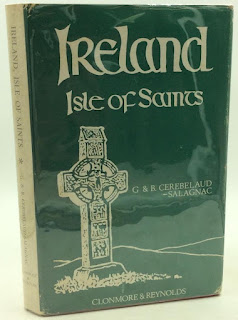
    8 July is the feastday of Killian of Würzburg, an Irish missionary saint and martyr, whose memory is still very much alive today. I have previously published an account from Abbé McGeoghegan here and now bring a reminder of the martyrdom of Saint Killian and his companions from the English translation of another French work, Irlande Ile des Saints, by G and B Cerebelaud-Salagnac:

    Let us now set out for Thuringia, in the footsteps of Killian (or Cilian). He would have been born about the year 640 in County Cavan. When he became a monk, and was first moved by the missionary grace, he went to the Continent with eleven companions (always the number twelve, clearly regarded as perfect). Passing through northern Gaul they reached the Rhine which they crossed and came to the castle of Würzburg, where lived Gozbert, Duke of Thuringia. Gozbert heard Killian readily, even when the monk pointed out to him that his union with Geilana, his brother’s widow, was incestuous (this was the commonly accepted view at that time). He renounced Geilana. This woman conceived a deep resentment against the monk and from then on she only lived to revenge herself. About the year 689 she brought about the murder of the Bishop, along with two of his companions, Colman and Totnan.

    “A custom, similar to that which was to be found among the Jews, had been in common practice among the people of Würzburg, and it had just been adopted by Prince Gozbert himself. He had taken as his wife his brother’s widow, whose name was Geilana (or Geila). The prince had feelings of love and affection for her. It soon became Saint Killian’s duty to explain to him the Church’s ruling on this matter…. He did this gently and in the most persuasive way … the first time he approached this subject, the king showed great aversion to this idea of separation, but when he became aware that this was necessary, if he wished to live according to his profession of faith, he consented, in a Christian spirit of
sacrifice. The king’s resolution came to the knowledge of Geilana. She was not prepared to bow to the royal decision. Her arguments and her cunning were, however, without effect, for the prince’s will was unshakeable. She then began to burn with unquenchable rage against the servants of Jesus Christ, and decided to seize the first opportunity for taking a terrible revenge; this was not long in appearing.

    “The prince was called to a long distance on a military expedition in the
year 689; his cruel wife was able to find some hardened criminals, whom she hired to carry out her plan of vengeance, Although miraculous warnings had been given, it is said, to Saint Killian and his companions about this plot, they did not wish to save their lives by flight, nor even by seeking the protection which they would have easily found among the people of Würzburg. Saint Killian exhorted his companions to be steadfast, assuring them that their souls could not be injured by the assaults of their enemies. The holy missionaries began to prepare themselves, by prayer and by fasting, to face the danger by which they were threatened. On July 8th, 689 (according to certain authors 688), while Saint Killian and his companions, among whom were Colman and Totnan, were meeting together, these murderers, armed with swords, entered the room where they were. St. Killian offered himself the first to the executioners, and was immediately struck down at their feet. His companions fell in the same fashion. In order to conceal the marks of this slaughter, the bodies of the martyrs were taken away by night and buried secretly. The cross, the book of the Gospels with their other books and belongings, were thrown into the same grave….

    G and B Cerebelaud-Salagnac, Ireland Isle of Saints (Dublin, 1966), 107-8.


    Content Copyright © Omnium Sanctorum Hiberniae 2012-2022. All rights reserved.

  • New Blog on the Irish Martyrs

    Today, the Feast of the Irish Martyrs, I am launching De Processu Martyriali, a new blog dedicated to all those who gave their lives for the Catholic faith in the sixteenth and seventeenth centuries. I will be taking the same approach as I do here and hope to bring a mixture of classic accounts and insights from  modern scholarship. I am particularly interested in uncovering the stories of the less well-known martyrs. The new blog takes its name from a catalogue of Irish Martyrs by David Rothe, Bishop of Ossory (1573-1650) and you can visit it here.

    Content Copyright © Omnium Sanctorum Hiberniae 2012-2020. All rights reserved.