Tag: Irish Saints

  • Saint Colman of Drumlease, June 19

    At June 19 we commemorate one of the many Irish saints who bear the name of Colman but about whom nothing is known. This one is associated with Drumlease, County Leitrim, as Canon O’Hanlon explains:

    ST. COLMAN, OF DRUIM LIAS, NOW DRUMLEASE, COUNTY OF LEITRIM.

    ON this day, veneration was given to Colman, of Dramlias, said to have been in Luighne, by Marianus O’Gorman. This we read, also, in the Martyrology of Donegal. In the Table appended, the Carthusian Martyrology is quoted, after the entry of this saint’s name and place. The latter is now known as Drumlease, and there is an old church now in ruins, near the eastern extremity of the beautiful Lough Gill. It is situated in the barony of Dromahaire, and in the county of Leitrim. The monastery at this place was burned, in the year 1360. It lay in West Breifne. There is also a village of Drumlish, in the parish of Killoe, in the barony and county of Longford. A Manuscript Calendar, which belonged to Professor Eugene O’Curry, enters a festival for St. Colman of Druim Lias, at the 19th of June.

    Content Copyright © Omnium Sanctorum Hiberniae 2012-2015. All rights reserved.

  • The Blessed Aidus Hua-Foirreth, June 18

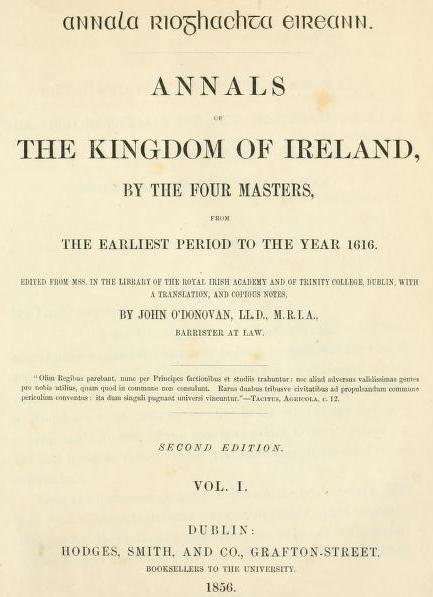
    On June 18 Canon O’Hanlon brings a brief account of a tenth/eleventh century cleric of Armagh, Aidus Hua-Foirreth. He is distinguished from most of the other holy men who appear on this blog in that his name is not recorded on the calendars of the Irish saints but rather in the Irish Annals. The Annals of the Four Masters record:

    The Age of Christ, 1056. Aedh Ua Foirreidh, chief lector and distinguished Bishop of Ard-Macha, died on the 14th of the Calends of July, in the  seventy-fifth year of his age, as is said:

    Of brilliant fame while he lived was
    Aedh O’Foirreidh the aged sage ;
    On the fourteenth of the Calends of July,
    This mild bishop passed to heaven.

    Canon O’Hanlon cannot add much more detail except to acknowledge the role played by the great seventeenth-century hagiologist, Father John Colgan, in flagging up the memory of this learned bishop:

    The Blessed Aidus Hua-Foirreth. [Tenth and Eleventh Centuries]

    In his Appendix to the Acts of St. Patrick, Colgan has introduced the name of the Blessed Aidus Hua-Foirreth, chief scholastic, and bishop of Armagh, or rather suffragan, who died on this day. But that  writer adds little more, which might give a clue to his identity, except that he died A.D. 1056, in the seventy-fifth year of his age. The Bollandists, following Colgan’s statement, notice him, at the 18th of June.

    Content Copyright © Omnium Sanctorum Hiberniae 2012-2015. All rights reserved.

  • Saint Séadna, June 16

    On June 16 we commemorate Saint Séadna (Setna), one of at least a dozen saints who bears this name and most of whom are obscure figures. This one, however, was associated with Saint Patrick, as Canon O’Hanlon explains:

    St. Setna, Son of Tren, Bishop.

    According to the Martyrology of Tallagh,  Setna MacTreno, a Bishop, had a feast on the 16th of June. Marianus O’Gorman also notices this Setna Mac Tren. The feast of this holy man has been assigned to the 16th of June, by Colgan. At the present date, that writer promised to treat more at large about the present saint. In the Acts of St. Patrick, we have a narrative regarding the cruel disposition of Tren or Trian, the son of Fiec, and a remarkable visitation of God which overtook him. He is said to have been cruel to his workmen, and the holy Apostle, having remonstrated with him in vain, at length declared, that a visible judgment of God should come upon him. This denunciation he disregard. However, the saint’s prediction proved to be true. Ascending his chariot, the horses ran headlong into a lake. Owing to this circumstance, it was afterwards known as Loch Trena or the Lake of Trian. The wife of Trian, moved by this catastrophe, asked the saint’s forgiveness, and obtained a blessing for herself, and for the children, she then bore in the womb. Two sons were afterwards born, at the same time. One of these was called Jarlath while the other was named Setna or Sedna. This event is said to have occurred in Mudornia, in the province of Ulster. The latter was baptized by St. Secundin, the disciple of St. Patrick. St. Setna and his twin-brother, St. Jarlath, were born at Rath-Trena, of the noble and ancient family of the Dal-Fiatach. Their country was in the present county of Down. The name of the district, in which it had been situated, was Uachthar or Uachthar-Thire, which extended so far west as Slievenaboley. Jocelyn states, that St. Jarlath was born in Midernia, which Colgan corrects to Mudorna. In his edition of Ware’s Bishops, Harris writes, that it was the barony of Mourne, in the southern part of the present county of Down. However, Dr. O’Donovan states, that barony did not obtain such a name, until the twelfth century, and that St. Jarlath was born in Cremorne, or Crich-Mudhorna, in the present county of Monaghan. St. Setna was elevated to episcopal rank, but his See does not appear to be known. According to the Martyrology of Donegal, veneration was given on this day, to Setna, son of Tren, Bishop. In the Irish Calendar, belonging to the Royal Irish Academy, and compiled for the Irish Ordnance Survey, at the xvi. of the July Kalends, or June 16th, his feast is entered.Content Copyright © Omnium Sanctorum Hiberniae 2012-2015. All rights reserved.