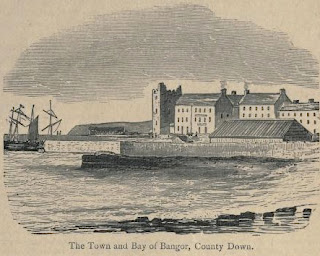
September 10 is the feast of Saint Finnian of Moville. As I mentioned in the previous post on his life here, this holy man is the subject of much debate among the modern generation of scholars. A hundred years ago Archbishop John Healy was able to present a coherent account of Saint Finnian as patron of Moville, County Down, who had simply spent some time outside Ireland, both in Scotland and in Rome. The Archbishop was at pains to distinguish Saint Finnian from his namesake at Clonard, only to muddy the waters by repeating Colgan’s suggestion that he may have been confused with Saint Fridian of Lucca. This can be discounted. Modern scholars, however, are still a whole lot less confident in identifying Saint Finnian of Moville as a distinct individual, and in a volume of essays on the history of County Down, I read two studies of Saint Finnian, whose conclusions I will summarize below.
In the first paper, St Finnian of Movilla: Briton, Gael, Ghost?, David Dumville reassesses the evidence for this sixth-century monastic founder. He finds that the only potentially early source comes from the now lost but partially reconstructable Chronicle of Ireland. In the version preserved in the Annals of Ulster it reads as the first entry for the year 579:
The peaceful death of Bishop Uinnianus of Dal Fiatach.
He then goes on to examine the form of the name used, the original being the Latin genitive form Uinniani saying:
“This is a form clearly related to late Old Irish Finnian but in fact an unnatural spelling. In the history of the Irish language initial U- (the sound /w/- that is) gave way to F- about 600 or early in the seventh century. On the face of it, here is a spelling which could be contemporary with a figure who lived in the mid- and later sixth century.”
But in the sources, the name of the saint can also appear as Finnio, which Dumville finds more problematic. For in the Irish hagiographical record only two names are found with the suffix -io: Finnio and Ninnio. Dumville argues that the linguistic evidence points to a British Celtic origin for these names. He then goes on to discuss all the other versions of the name Finnian found in the sources, saying:
“For a variety of reasons, the tendency of modern scholarship has been to view all these manifestations of Uinnian Finnian Finnio Findbarr [etc.] as referring to a single sixth-century historical figure. There has been less agreement about who he was, where he worked, and how he came to be culted as a patron-saint at different churches. The principal difficulties have resided in the question of his nationality and in making a convincing connexion between the sixth-century evidence and that of later hagiographical sources.”
The problem is that by the year 800 there is evidence for two saints known as Uinnian/Finnio, the founders of Cork and Movilla. There were also two called Findbarr, the patrons of Cork and Movilla. Thus:
“There has been general agreement.. that it is difficult to credit the historical existence of more than one person who would have left these unusual linguistic results. If that conclusion is correct it is a task of scholarship to explain how the multiple cults, and the distortions of sixth-century history which they would therefore represent, came into existence. Pádraig ó Riain, who first saw a possible solution, has argued that we have a number of localisations of a single cult, what in German has been called a Wanderkult. It is a well attested hagiological phenomenon. The problem resides, however, in determining which local manifestation represents the site of the church of the historical Uinniau.”
Dumville goes on to further examine linguistic and other evidence, admitting that he is still not in any position to make a definitive judgement. But for him, linguistics clearly point to a British origin for Saint Finnian, as the primary evidence gives him the Brittonic pet-name Uinniau. His conclusion I am sure would have come as something of a shock to Archbishop Healy:
“It is perverse to suppose that he [Finnian] was other than a Briton. We do not know whether he ever worked in Ireland.”
In the second paper, Lives of St Finnian of Movilla: British Evidence, Ingrid Sperber finds it ironic that for such an important saint, no Irish Life of Saint Finnian has survived. But she says that evidence for the existence of such hagiography can be found in non-Irish texts, of which there are three relevant items. She does not discuss one of these, the texts relating to Saint Frigdianus of Lucca, whom Archbishop Healy mentioned, as this notion can be put aside, but says:
“It has long been known that some of the Lives of this sixth-century saint claim an Irish origin for him: on closer inspection they have proved to be partly derivative of hagiography of St Finnian of Moville. The other two items have a Scottish dimension.”
The first of these two items is the Noua Legenda Anglie, the New English Legendary, a huge compilation of abbreviated lives of saints first assembled by fourteenth-century chronicler, John of Tynemouth, at Saint Alban’s Abbey. The author has translated the Life of Saint Finnian from this work and helpfully appended it to her paper. This Life, however, attests to the cult of Saint Finnian in Scotland and it begins by telling us that the saint was also known by the Welsh name Winninus, and ends by locating his Scottish cult at Kilwinning in Ayrshire. The Life also mentions that the saint received training in both Britain and Rome and gives his feast-day as September 10, the same as that of Finnian of Moville.
By contrast, the second source is a liturgical one, the early sixteenth-century Breviary of Aberdeen. It lists a Saint Uynninus, but at 21 January, and the focus for the lessons for the saint’s feast is exclusively on Scotland. The saint is said to have been of royal Irish origin, but there is no mention of Moville. Sperber suggests therefore that:
“At some point, perhaps in the absence of hagiography of the original saint of Kilwinning, but perhaps in order to suppress it, that of St Finnian of Movilla was substituted, along with his feast-day. The local patron’s original feast-day eventually proved too entrenched to be rejected and reasserted itself. Meanwhile, the hagiography of St Finnian was adapted in order to root it thoroughly in its local south-west Scottish context. The precise chronology of the process remains to be determined.”
I found both these papers a challenging read but also a valuable insight into the sort of evidence and deductive processes used by modern scholars. I was especially pleased to find that translations of both the Life of St Finnian from the Nova Legenda Anglie and the Liturgy of St Finnian from the Breviary of Aberdeen were appended to the second paper, as this is the first time these texts have been translated. The papers can be found in the book Down: History and Society – Interdisciplinary Essays on the History of an Irish County, edited by Lindsay Proudfoot and William Nolan and published by Geography Publications, Dublin in 1997. There is also this 2007 scholarly paper:
Six degrees of whiteness: Finbarr, Finnian, Finnian, Ninian, Candida Casa and Hwiterne
Pamela O’Neill
Abstract
In the Spring 2001 issue of The Innes Review, Thomas Owen Clancy presented a compelling argument for the identification of Saint Ninian of Whithorn, Saint Finnian of Moville, Saint Finnian of Clonard and Saint Finbarr of Cork as a single historical figure. This followed on from lengthy argument amongst scholars of early medieval Ireland concerning the identity, ethnicity, and probable conflation of the three Irish saints. One view, advanced by Pádraig Ó Riain, was that the ‘original’ form of the name was the Gaelic form Findbarr, from which Finnian was derived by hypocorism. Clancy posits a British origin for the name, and advances scribal error as the final step in the evolution of the name through Uinniau to Ninian. The common element in the Gaelic names, fin, and its British equivalent, uin, mean ‘white’. Ninian’s foundation in south-western Scotland is called in Latin Ad Candidam Casam, in Old English Hwiterne, both also denoting whiteness. This is generally held to reflect either the physical nature of Ninian’s church (limewashed or of pale stone) or the moral nature of its inhabitants (pure and shining). This paper argues for a further alternative: that the name of the place is derived from the name of its founder.
It is available to read in full online here.
Content Copyright © Omnium Sanctorum Hiberniae 2012-2015. All rights reserved.
 OMNIUM SANCTORUM HIBERNIAE