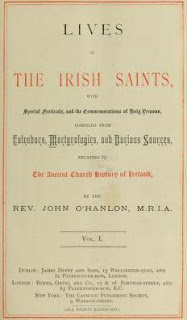
It is perhaps appropriate that the holy man we commemorate today is related to the people of Saint Ite of Killeedy, as January 15 is her feast day. Saint Breacc Fele, who also seems to have been known by the name ‘Mobrioccu’ (Mobrigue), was also of the Déise of Munster, as Canon O’Hanlon explains:
St. Breacc Fele, of Bealach-Fele.
[Probably in the Seventh Century]
On the 15th of January, the Martyrology of Tallagh enters the name of Brice fheli, of Bealach fheli. He is somewhat differently alluded to elsewhere; for we have a clue to his family given in a later calendar. We find recorded, in the Martyrology of Donegal, on this day, Breacc Fele, of Bealach Fele. He is here said to be of the family of Fiacha Suidhe, son to Feidhlimidh Reachtimhar. This holy man, Brecus, as the name is Latinized, was the son of Silaus, son to Dubtach, son of Fergna, son to Muredach, son of Sinell, son to Brecan, son of Aengus Lethain, son to Eugenius Breac, son of Artchorb, son of Fiach. Thus he had a common ancestor with St. Ita, and he belonged to the Desii race, in the south of Ireland. He lived three generations later than St. Ita. The place where he was venerated has eluded our search, if it be not Ballyfoile, the Anglicized form of the Irish word Bealeach Foele, i.e., “the pass or road of Foele.” It is now the name of a townland, in the parish of Kilmadum, and county of Kilkenny, according to some writer in the local newspapers His further remarks, probably somewhat erroneous, may serve to establish an identity between St. Mobrigue and the present St. Breacc Fele. His death is thus recorded in the Annals of the Four Masters at A.D. 730:—”St. Mobrigue, of Bealach-Fele, died.” The name of this saint is said to form part of the name for the next parish, i.e., Kill-ma-de-mogue. This probably means the Church of my Mogue or Mobrigue, adds the writer, but we believe incorrectly. The site of the original church of this saint, he continues, which is also most probably the place of his burial, is well known by the denomination of Kill-Mogue, on Mr. Comerford’s land, only a few fields from the old castle of Ballyfoile. It is shown by the same name on the Ordnance Townland Survey, where it is marked, “a burial place for children.” In the neighbourhood, this ancient cemetery is said to be used only for unbaptized children and strangers. We do not think it probable, as the writer avers, that Mobrigue—while it may possibly be contracted into Breacc—can at all be softened down to Mogue. He regards St. Mobrigue as the patron of Ballyfoile.
Content Copyright © Omnium Sanctorum Hiberniae 2012-2016. All rights reserved.
 OMNIUM SANCTORUM HIBERNIAE