Tag: Irish Saints

  • Saint Ite of Kileedy, January 15

    January 15 is the commemoration of Saint Ite of Kileedy, ‘the shining light of the women of Mumhan’, as Saint Oengus the Martyrologist calls her. She is one of a handful of Irish female saints who have surviving Lives and in his account of Saint Ite below, Father Albert Barry has drawn on this rich hagiographical tradition to present a picture of her sanctity and her miracles:

    0
    false

    18 pt
    18 pt
    0
    0

    false
    false
    false

    /* Style Definitions */
    table.MsoNormalTable
    {mso-style-name:”Table Normal”;
    mso-tstyle-rowband-size:0;
    mso-tstyle-colband-size:0;
    mso-style-noshow:yes;
    mso-style-parent:””;
    mso-padding-alt:0cm 5.4pt 0cm 5.4pt;
    mso-para-margin:0cm;
    mso-para-margin-bottom:.0001pt;
    mso-pagination:widow-orphan;
    font-size:12.0pt;
    font-family:”Times New Roman”;
    mso-ascii-font-family:Cambria;
    mso-ascii-theme-font:minor-latin;
    mso-fareast-font-family:”Times New Roman”;
    mso-fareast-theme-font:minor-fareast;
    mso-hansi-font-family:Cambria;
    mso-hansi-theme-font:minor-latin;
    mso-ansi-language:EN-US;}

    Saint Ite was
    born in the year 480, and was of the Deise
    family. St. Patrick
    had preached the
    Gospel to the Deise a few
    years before
    her birth. Patrick then
    went into the southern Deise (Co. Limerick), and began
    to build a Church at
    Ard-Patrick”, Tripartite. The Deise
    afterwards
    went southwards towards the sea (Co. Waterford).
    Ite was fond
    of fasting and prayer
    whilst she was still
    a child. The room where
    she slept seemed one night
    to be on fire, but
    when the inmates of the house rushed into it, they beheld a wonderful light shining from
    the face of the sleeping
    girl: and she looked like an Angel. 


    An Angel gave
    her three precious gems,
    telling her that
    the three
    Persons of the
    blessed Trinity would in
    future watch over her.
    Her father wished
    her to marry, but she would
    not, because she had consecrated her virginity to God. He was very
    angry with her, but she
    said to her mother, “Although my father now forbids me
    to give myself to Jesus Christ,
    he will one day tell
    me to go where I
    wish in order to give myself to God”. She
    fasted and prayed for three days that
    the
    holy will of God might be done
    in her. On the third
    day the devil came
    and said to her, “Alas, you will withdraw
    yourself and many
    others from me”. And an
    Angel
    at the same time said to her
    father, ”Why do
    you hinder your daughter
    taking the veil of virginity? Ite will be a great and
    holy virgin before God
    and His saints. You ought
    to let her go wherever she wishes. She will serve
    God in another part of
    this land.” Her father, therefore, at once allowed her to go away.
    Ite left her
    father’s house, and
    on her way heard the
    devils saying: Woe to us, the Angels
    of God help her: she
    will snatch many souls from
    us.” She went to
    a neighbouring church and there
    got
    the veil of virginity from a Priest,
    and, led by an Angel,
    went to the west
    of Hy-Connail and built
    a house for herself
    and some companions at Cluain Creadhail,
    at the foot of Sliabh-Luachra (Killeedy,
    Co. Limerick.)
    Ite and her
    Nuns prayed daily for the
    people of the place, and
    many blessings thereby flowed upon them. They,
    in turn, gave many
    gifts to her Convent.
    She had the gifts
    of prophecy and of working miracles,
    and she healed many sick persons by
    her prayers. She once told a
    holy
    friend that she had got these
    gifts from God, because from her youth
    she had always thought on holy things,
    and because she had so often prayed
    to the Blessed Trinity.
    Ite spent many
    days at a time without food,
    prayed much, and earnestly strove to bring
    up young maidens in the fear and
    love of God. Cuinnen of
    Conneire says of her:
    Ite loved much
    the bringing up of youth
    Humility without sadness:
    Her cheek to
    the floor she laid not:
    Ever, ever for the
    love
    of the Lord.
    Since she bound the
    girdle on her body.
    And I know it since I’ve heard
    it,
    She ate not
    a
    full or sufficing meal,
    Such was Mide.
    Aenghus, in his
    lives
    of the Irish Saints, also thus writes of her
    Ite ever
    bore
    great sufferings, and
    was
    much given to fasting,
    and was the shining light of the women
    of Mumhan.”
    She was not
    only a teacher of youth, but
    even gave
    wise counsel to
    holy and learned men.
    S. Breanan and S. Mochoemoc owed much to
    her teaching. S. Breanan one
    day asked her to tell him
    what
    were the three works most pleasing
    to God. She saidTrustful resignation to God of a sinless heart: a guileless
    religious
    life: generosity
    with charity. These three
    works are most pleasing to God.” He then asked
    her to say what
    were the three things most
    hate
    ful to Him. She answered: Hatred of men: wickedness in the heart: too
    great love
    of money. These three things are very hateful to
    God.”
    A Nun one
    day saw three bright balls of light over
    Ite’s head as she was praying
    to the Blessed Trinity.
    Ite prayed to
    God that she might, on a coming feast-day,
    get Holy Communion
    at the hands of a very holy Priest. Her prayer
    was heard, and she was
    led by an Angel to
    Clonmacnois, and there ate
    the heavenly Bread. The holy
    Priest who gave her Communion afterwards set out for Ite’s
    Convent, and when he
    had
    come to it, asked her
    to give sight to a blind Monk then
    with him. She did
    so, and asked the holy
    Priest to sing Mass
    for her. After Mass she gave
    him a present of the vestments, but he would not
    take
    them, saying that he had been
    forbidden by his Abbot to take any
    gift from her. Ite then said, Your holy
    Abbot will not be angry if you take this
    towel as a gift from
    me; I will tell you
    why.
    One day he came
    to the Convent of the holy
    virgin Caireche and she
    asked to be allowed to wash his feet.
    Then this holy virgin
    washed the feet of your Abbot and
    wiped
    them with a towel.
    I give it now to you, and he
    will be glad to get it when reminded
    of this fact”. The holy Priest
    then took the gift, and having
    got her blessing, went back to
    Clonmacnois.
    A man, broken-hearted,
    through the death of his son, came to
    the Convent, and weeping very much, begged her
    to bring him back to
    life. He said: “I
    will not give over weeping,
    nor will I leave this house
    until you bring him back to life.” She answered gently: What you ask is
    above my merits, and
    is a work fit only
    for the Apostles and holy
    men like them”. But he
    said: I am, above all,
    sorry because my son lost
    the use of his speech,
    so that he was not
    able to confess his sins;
    I, therefore, beseech you to
    get from the Holy Trinity that he may come back
    to life even for one day.”
    Ite then said: How long do you want him to live if
    the good God should
    have
    pity on you and bring back your son to
    life?”  The father answered: I will be glad if he lives even
    for one day.” Ite
    said:
    He will live for more
    than seven years from this
    time.” She prayed earnestly
    to God, and her prayer
    was heard, and the child
    came to life again.
    Her uncle died,
    and his sons by her wish
    came to the Convent. She said to them:
    My uncle, your father,
    is dead. Alas, he
    is now suffering for his sins. We ought
    to do something to lessen
    his sufferings. Let each
    one
    of you give bread
    and meat and butter to the poor every day for the next
    year
    for the good of
    his soul. Then come back to me.” They did as she bade them
    and then came back to
    see her. Ite said to them:
    Your father has been
    freed from much suffering
    through your alms and my prayers.
    Now go and do the same
    thing during the coming year
    and then come back again.”
    When they had come
    back at the end of
    the
    year Ite said: ”Your
    father is now freed from
    his sufferings, but give
    clothing
    to the poor
    and come back once
    more.
    They did so, and having come
    to her again, she told them that their
    father had at last gone to heaven:
    Your father now enjoys everlasting
    happiness through your alms, my prayers,
    but above all through
    the mercy of God; keep always from
    the sinful pleasures of this world, that you may not
    suffer for your sins
    as he did.” They thanked God
    and their holy cousin
    and went home.
    In the year
    546 the clan of the Corcoiche of
    Hy-Figeinte (Co. Limerick),
    made war on the people of Hy-Connaill. Ite told the
    soldiers to do penance for their
    sins before going to battle.
    They did so, and
    she prayed whilst they
    fought,
    and the small and weak army of Hy-Connaill,
    through her prayers, won the battle.
    One of her nuns fell
    into sin and God made
    it known to Ite. She
    said: Today one of
    our family has fallen
    into sin; I wish to
    know who among you has become the
    prey of the ravening
    wolf?”  Each denied it, but
    Ite drove the guilty
    one from the house. However, she
    took her
    back afterwards, and, helped by Ite, this nun,
    led henceforth a blameless life, and did great
    penance until her death.
    Ite suffered great agony from a
    cancer
    that ate away her side,
    but she bore it gladly from
    her love for Jesus Christ.
    In the year
    569,
    Ite became very sick, and
    crowds flocked from all sides
    to
    the Convent on hearing of
    her illness, and, kneeling
    outside, prayed for
    a happy death for her whom
    they loved so much.
    When she was
    dying she prayed earnestly to the holy Trinity
    to bless the Priests
    and people of Hy-Connaill, and with a
    prayer
    to the blessed Trinity
    on her lips she slept in
    the Lord.
    Holy Mass was
    solemnly sung for
    her,
    and she was buried in
    presence of a great
    crowd of weeping people. Many
    miracles were worked by
    her both then and afterwards, and she was
    taken by the people
    of Hy-Connaill as their patron
    and protector. She has ever since been called
    The Brigid of Munster.”
    Her feast-day is kept January 15th.


    Rev. Albert Barry, Lives of Irish Saints (Dublin, n.d.)


    Content Copyright © Omnium Sanctorum Hiberniae 2012-2015. All rights reserved.
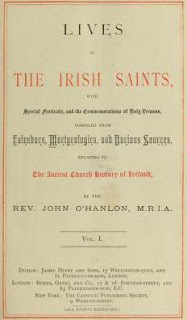
  • Saint Báetán of Inisbofin, January 14


    January 14 sees the commemoration on the Irish calendars of a
    seventh/eighth-century monastic saint, Báetán, abbot of Inis-mór. There a
    number of locations in different parts of Ireland which share this
    place name, but Canon O’Hanlon associates our abbot with the the seventh-century monastic foundation of St Colman at Inisbofin island, off the coast of County Mayo and suggests that Saint Baetan may have been one of the founder’s early successors:

    ARTICLE I.—ST. BAETAN OR BAODAN MOR, SON OF LUGHAIDH, ABBOT OF INISMORE, OR INIS-BO-FINNE, NOW BOFFIN OR BOPHIN ISLAND, COUNTY OF MAYO.

    [SEVENTH AND EIGHTH CENTURIES.]

    AMONG the commemorations this day, we read in the Martyrology of Donegal, concerning Baodan Mor, son to Lughaidh, and Abbot of Inis-mor. He is entered in the Martyrology of Tallagh, as Baetan, son of Lugeus, on the 14th of January. In the latter record, he is likewise said to have been a bishop. At the year 711, the death of Baetan, Bishop of Inis-Bo-Finne, is recorded in the Annals of the Four Masters. Those of Ulster place it at A.D. 712. Under the head of Inis Mor, Duald Mac Firbis enters Baeden, bishop, for January 14th. Colgan —offers a conjecture but without much confidence — that this St. Baedan may be identical with a St. Buadmael, a disciple of St. Benignus and of St. Patrick, who died at Kill Buadmael, near the River Shannon. Yet, it is plainly seen, the place of this saint and the date assigned for his death exclude such a supposition. The island of Inishbofin gives name to a parish in the barony of Murrisk, and county of Mayo. Some ancient monastic remains are to be seen here, adjoining St. Colman’s Well and Church Lough. The monastic institution is said to have been founded there by St. Colman, A.D. 667, and he died A.D. 674. St. Coenchomra is said to have succeeded him in the government of this monastery; and, in such case, it would be probable, the present saint Baetan was his immediate successor. St. Coenchomra was connected with another Inis-bo-finn. How long St. Baetan’s term of incumbency lasted, we have no dates preserved to aid in determining. There are two other islands, named Inis-bo-finne in Ireland; one of these is in the county of Donegal, near Tory Island, while the other is situated in Lough Ree, on the River Shannon. Neither of these islands, however, is of such celebrity as this Western Inis-bo-finne, which Dempster has sought even to connect with Scotland. Remote as its situation was, for centuries the voice of prayer and the song of praise to God rose above the murmurings of the wild Atlantic waves that surged around its shores.  

    The old oratory of St. Colman, on the Island of Innisbofifin, yet remains. The ruined quadrangle measures externally 61 feet in length by 23 feet in width. The walls are about three feet in thickness. The oriel window measures, on the outside, 2 feet, and on the inside, it is splayed to a breadth of 5 feet; while it is 6 feet 6 inches in height. On the eastern gable are two buttresses ; the buttress towards the south is 6 feet thick, and that towards the north is only 5 feet 6 inches. Small side-windows are broken away. In the south side wall and west gable are two doors of similar dimensions, viz., 5 feet in height by 4 feet in width. No mullions are to be found in the windows; while the arches of oriels and doors are very flat. The stones are placed edgewise, and the mortar in the walls is very adhesive. St. Flannan’s

    well is enclosed, about 100 paces from the ruin, with a stream running between both. The ruin is in a deep valley. The water of the more immediate north hill is carried clear of the church-site through a drain sunk by the monks, and it is effective to this day. No stones of the building are dressed; while the church stands on a natural rock-terrace 8 or 10 feet high. Around the ruins grow some few briars, the only shrub. It is a hoary, grey stone church, still in good preservation, so that one doubts if it be the original foundation of St. Colman. On one side of the ruin is an eminence called Knock. On the right, as represented in the engraving, is a sheet of water, called Lough Teampul, on the left is the Atlantic Ocean.

     
    There is a website for the island of Inisbofin with some illustrated pages on its Christian heritage here
    May the intercession of all the saints associated with this western isle be with us!
     
    Note: This post was first published in 2013 and revised in 2023 to include Canon O’Hanlon’s entry for the saint from Volume I of his Lives of the Irish Saints in full.

    Content Copyright © Omnium Sanctorum Hiberniae 2012-2015. All rights reserved.

  • Saint Ailill of Armagh, January 13

    0
    false

    18 pt
    18 pt
    0
    0

    false
    false
    false

    /* Style Definitions */
    table.MsoNormalTable
    {mso-style-name:”Table Normal”;
    mso-tstyle-rowband-size:0;
    mso-tstyle-colband-size:0;
    mso-style-noshow:yes;
    mso-style-parent:””;
    mso-padding-alt:0cm 5.4pt 0cm 5.4pt;
    mso-para-margin:0cm;
    mso-para-margin-bottom:.0001pt;
    mso-pagination:widow-orphan;
    font-size:12.0pt;
    font-family:”Times New Roman”;
    mso-ascii-font-family:Cambria;
    mso-ascii-theme-font:minor-latin;
    mso-fareast-font-family:”Times New Roman”;
    mso-fareast-theme-font:minor-fareast;
    mso-hansi-font-family:Cambria;
    mso-hansi-theme-font:minor-latin;
    mso-ansi-language:EN-US;}


    On January 13 we commemorate the memory of Saint Ailill, an early Archbishop of Armagh. Canon O’Hanlon’s account of the saint is rather heavy-going and indeed, he sounds somewhat weary by the final paragraph. The problem is that the sources appear to suggest that our saint may have had a previous association with the monastery of Moville, County Down. Other writers, particularly Father John Lanigan who wrote about the Irish saints in the 1820s, were convinced that Ailill of Armagh and Ailill of Moville were two distinct individuals. Furthermore, it appeared that if the Archbishop of Armagh was the same person as the monastic of Moville, then there was also the tradition that Ailill had been married to deal with. A final source of confusion was that Saint Ailill’s successor bore the same name and this is why our saint is referred to as Saint Ailill I in the Lives of the Irish Saints. Actually, his name is rendered in various forms in Canon O’Hanlon’s account, including Ailild, Alild as well as Ailill:

    St Ailild
    I., Archbishop of Armagh. [Fifth
    and Sixth Centuries.]

    At the
    13th
    day of January, Colgan has
    drawn up some accounts
    regarding this
    holy prelate, from the Acts
    of St. Patrick, and from
    other sources, while he
    has added some comments of his own
    to solve difficulties which
    are presented.
    Before St.
    Patrick’s arrival in
    Ireland, about
    A.D. 432, a chieftain named Trichem lived in an eastern
    part of
    Ulster. This
    assertion is
    capable of proof, from the
    circumstance of
    Dichuo, son to
    this Trichem, having bestowed
    on St. Patrick the site for
    Saul Monastery. Besides this, it
    is
    known that Magbile, Killchlethe, Down, and Neddrum,
    where the 
    sons of
    this Trichem had their possessions,
    are
    all situated in the eastern and maritime parts
    of Ulster.

    Trichem, or as the name is
    Latinized, Trichemius,
    was the descendant of a respectable ancestral pagan line;
    but he was likewise the parent of children no less
    distinguished in
    the early history of
    our
    Irish Church. This chieftain
    is stated to have been a
    scion of the noble
    Dalfiatacian family, from which race
    were derived many kings, not
    only of
    the Ultonian
    province, but even some
    who had been monarchs over Ireland. St. Ailild
    was the son of Trichem,
    son
    to Fieg, son of Imchad,
    son
    to Breassal, son of Sinchad, son to Fiatach, surnamed Finn. We find
    the holy archbishop, in after
    time, classed among
    the disciples of St. Patrick
     and if he deserve
    such a distinction, it must
    have been at
    rather a late period of
    the Apostle’s
    life,
    and while Ailild himself was very young.

    It has
    been very positively asserted, that our saint
    was not Trichem’s son, and Dr.
    Lanigan considers him to have
    been a different person from Ailill of
    Magbile, with whom,
    it is said, he was confounded. The only
    grounds on which the former
    opinion
    seems formed are,
    that Dichuo, the elder brother of Ailill, must have had
    a settled family, and have been at least forty years of age in
    the year 433, when he
    had been converted by
    St. Patrick. Hence, as argued,
    it could not have been probable he had
    brother capable of assuming
    episcopal functions in
    the year 513.

    Although Trichem had not the
    happiness of
    embracing the
    Christian
    faith, yet,
    through God’s holy providence, he was the father of
    a numerous and saintly offspring. He
    became the parent of six sons,
    who were not only distinguished
    for being among the first
    fruits of St. Patrick’s apostolic labours
    and preaching, owing to their reception of the baptismal and regenerating sacrament, but,
    moreover, they acquired a reputation for being enrolled among
    the early saints of Ireland’s Church. They are thus named, according
    to the order of their respective
    births, viz., Rius, or Rossius, Dichuo, Durthact, Eugenius, Niell, and Alill. In
    the Life of St.
    Patrick we are told, that
    Dichuo was not alone the first
    of his family, but of his
    whole nation, who embraced the Christian faith, when
    our great Apostle’s mission commenced.
    This example was
    afterwards followed
    by members of his
    household. The
    elder brother, Rossius, at
    first resisted the grace of conversion; and
    he even sought to interpose every obstacle
    to the success
    of
    St. Patrick’s mission. But his
    obstinacy and
    infidelity were
    finally overcome.

    Soon afterwards,
    having received the sacraments of the Church,
    he happily departed this life. The four
    younger brothers to these converts, already
    named, moved by the example
    of their seniors, and by miracles, manifested at the
    time of their conversion, were not left
    without those graces which enabled them to receive
    the
    light of Faith. They choose
    also that better part,
    by aspiring to the attainment
    of
    practices which
    render faith perfect. They
    were favoured from above with those
    Divine inspirations, which induced them to
    exercise virtues
    becoming the
    saints of Christ. Our martyrologists
    state that,
    whilst Dichuo had been venerated at Saul, St. Durthact
    was honoured
    at Nendrum, St Eugenius and
    St. Niell at Kil-cleith, and St.
    Ailild, at Maghile. This latter place
    is now known as Moville, situated in the barony
    of Ards, county
    of Down.

    St. Ailild,
    it has been remarked, is thought to
    have obtained the graces of all the
    sacraments. For,
    not only did he receive those
    graces which are common to
    all Christians, but, moreover, Holy Orders
    and Matrimony, which are
    distinctive ones,
    usually constituting
    a line
    of demarcation existing between clergy and laity.
    It has even been stated, that after St. Ailild had been married,
    he became the father of
    Carbre.
    This latter
    in time was parent to the celebrated St.
    Finnian, Abbot
    of Magbile.

    After his
    wife’s
    death, most
    probably, Ailild
    abandoned all
    secular cares by
    devoting himself entirely
    to
    God’s holy service.  When speaking
    about this
    saint, Harris remarks, that he was
    a married man
    at the time of his conversion. In
    order
    to account for a married man taking Holy
    Orders, this writer states,
    that Colgan tells us, he
    put away his wife first.
    Now Harris has shamefully
    perverted
    the meaning
    of Colgan, in
    reference to
    this subject. The Irish
    hagiologist is
    misrepresented and
    made to say, that Ailill put
    away his wife before taking Holy Orders. Now Colgan’s
    statement
    is, that the wife was dead,
    before he became a clergyman.  Harris then goes on to show,
    that the Irish clergy were
    not bound to celibacy in
    those times; but
    Dr.
    Lanigan takes him to task
    and roundly asserts, that in the whole history
    of the ancient
    Irish Church,
    there is no instance of
    any bishop having been exempt
    from the law of celibacy.

    In addition
    to what has been urged with so much force,
    it may be stated, in reply
    to what Harris has advanced, when trying to
    support his false position, that, as
    in the present instance, it is extremely
    probable
    some priests
    of the
    early Irish Church
    had
    been married previous to their ordination. Yet, in this case,
    either their
    wives died before they assumed
    orders, or they had
    consented to
    a voluntary separation
    from their husbands, so that
    these might enter upon
    a religious state. To persons
    thus circumstanced, the canon in
    question had
    reference;
    and, as at the present
    time, we are able to furnish many instances
    for illustration, especially as regard married converts to the
    Catholic religion,
    so at a period when St.
    Patrick commenced his mission in Ireland, it might have been deemed
    expedient to
    recruit
    the clerical
    ranks from persons who had
    been previously married, and who felt
    disposed to comply with
    established ecclesiastical
    discipline,
    before their
    reception of
    the higher orders.

    From the
    circumstance of this
    saint,
    as named
    in our Irish Menologies, having been venerated at Magbile, it
    has been assumed, by Colgan, that
    he might
    have been abbot
    over that
    place.
    This grave author,
    however, would not undertake to assert,
    whether from having
    been abbot there,
    St. Ailild had been assumed to Armagh’s
    archiepiscopal see,
    or whether having ruled over
    this latter church, he laid
    down the honours and responsibilities
    of
    pontifical
    dignity, to seek
    repose
    in Magbile
    Monastery.

    From all
    evidence adduced
    by Colgan, we might feel
    unable to arrive at any other
    conclusion,
    than that
    Ailild
    resided tor
    some time in Maghbile
    Monastery, as
    a simple monk.
    It is likely enough, that he received
    Holy Orders,
    and was afterwards promoted to Armagh see,
    without having previously or subsequently
    exercised the function of an abbot. But
    so far as the chronology
    of his
    episcopacy is
    concerned, no
    abbey of Maghbile was in existence, until after his death. Perhaps he
    was
    venerated there
    after having been called away
    from life. On the death
    of Duach or Dubtach I.,
    which took 
    place in
    the year 512
    St. Alild I. was appointed
    to succeed, as Archbishop of Armagh
    and Primate of Ireland. Our
    saint sustained the honours of this exalted station
    for a continuance of thirteen
    years. During this period, his merits and virtues were found fully equal
    to that great trust reposed
    in his keeping.
    Full of years
    and of
    virtues, he
    passed
    out of this
    life, on the 13th day of January, in the
    year of
    salvation, 525.

    He was
    succeeded
    in the
    Archiepiscopal See of
    Armagh, by St. Ailild  II.
    and from the concurrent
    circumstances of both distinguished
    persons bearing
    the same name, claiming the same family
    origin, and
    coming in an immediate order as regards succession in the
    same see, they have been incorrectly confounded. But the distinction
    of days, months and years, having reference to
    their
    departure from
    this life, will tend to correct
    such an error. Our
    annalists and
    hagiologists assign the second
    Ailild’s death
    to the 1st day of July,
    A.D.
    535.

    As already
    observed, those
    dates referring
    to
    the decease of St. Alild I.,
    are altogether different.
    The Natalis of Alild I.
    is held on the Ides
    or 13th of January,
    and that of Ailild II., on
    the 1st of July. For
    these statements,
    we may cite as authorities,
    the Martyrology of Tallagh, Marianus O’Gorman, the
    Commentator on St.
    Aengus, and the Irish Martyrology
    of Donegal.

    Despite a positive assertion of the learned and researchful Colgan, who appears
    to have had ample materials before him on which he might ground an opinion,
    a learned Irish
    historian presumes
    to question the statement, that
    Ailild I, Archbishop of Armagh,
    was the identical person, named Alild of Magbile. The
    latter writer asserts, that
    in
    Colgan’s acts
    of our saint, which he
    designates a
    strange and an incoherent medley,
    the Irish hagiologist has
    confounded into
    one person two saints, who ought to
    have been regarded
    as distinct
    in identity,
    and as
    living at different periods.
    While allowing Alild of
    Magbile to have been one of Prince
    Trichem’s
    sons, and
    a grandfather to St. Finnian
    of Magbile,
    Dr. Lanigan
    considers this
    St. Alild to have been
    always a layman. From
    confounding the
    latter with St. Alild, Archbishop
    of Armagh, this historian asserts an impression
    was thence derived that the metropolitan prelate had been
    married before his ordination. Again Dr.
    Lanigan maintains, that Alild, Archbishop of Armagh, was not
    nearly connected with Dichuo, St.
    Patrick’s early
    convert,
    while the
    prelate
    in question was a
    native of Clanbrassil, this being
    a
    district, far distant
    from Lecale, in which Dichuo’s family resided. This writer will
    not allow there
    is any foundation for
    a statement, that Alild, Archbishop of Armagh, or
    even Dichuo,
    came from a princely extraction.
    But the argument he principally urges, to sustain his opinion, is the assumption
    of Dichuo having had a
    settled family in the year
    432, when in all probability
    he could not have been less than forty years
    of age,
    and consequently
    the improbability of
    his having had a brother
    capable
    of discharging
    episcopal duties in
    513.
    The objections of Dr. Lanigan are sufficiently
    plausible and
    pertinent, but
    not
    entirely convincing nor unanswerable,
    especially when
    weighed with received accounts regarding
    our saint. According to his usual
    theory of computation, this
    historian says, Ailill
    I. died about, or in the
    year 526,  after having
    governed Armagh
    See nearly thirteen years. The same writer supposes, that Ailill I., dying so
    early in the
    year as the 13th of January, it is very
    probable, his
    incumbency did not last
    fully
    thirteen years, although
    having
    its commencement in 513.
    In the body of his
    text, to which the above observation
    is appended, the learned
    Doctor tells us, that the first Alild died
    on the 13th of January,
    A.D. 526, after an incumbency
    of thirteen years.

    No doubt
    much remains to be discovered
    regarding
    the Life of St.
    Alilid I., under these peculiar circumstances; and probably,
    at some future time, certain
    involutions of facts
    now presented may receive adequate solution. For the
    present, therefore,
    too much unwarranted assertion or mere speculation might be
    risked, were the writer of this notice
    to enter
    upon further
    details
    concerning him, and
    the contemporary events of his
    period.


    Content Copyright © Omnium Sanctorum Hiberniae 2012-2015. All rights reserved.