Tag: Irish Saints

  • Saint Comgan of Gleann Ussen, February 27

    On February 27 we commemorate an Abbot of Gleann Ussen, modern Killeshin, County Laois. There is some confusion around the identity and period in which Saint Comhghán (Comgan, Comhdan) flourished. Some of this has arisen due to conflicting accounts about his pedigree in the Irish genealogies, but also because of the attachment of the suffix ‘cend-inis’ to his name in some of the calendars. This is found in the entry in the Martyrology of Oengus for 27 February:

    With the suffering of Abundus,
    Great his gifts of poems ;
    The feast of Comgan, Cend Inis,
    The finding of the head of
    John [the Baptist].

    In the nineteenth century Margaret Stokes translated this epithet as meaning ‘without reproach’, but some of the earlier hagiographers appear to have believed that Cend Inis (Ceann Innis or Kean-Indse) was a place in Munster associated with the saint and assigned him to the period of the seventh century. Canon O’Hanlon, however, believes that he actually belongs to the ninth century and is more firmly associated with Gleann Ussen. As he explains:

    That St. Comgan was connected with Gleann-Ussen appears, from the authority of the Menelogium Genealogicum, the Martyrologies of Tallagh, of Cashel and of Marianus O’Gorman. This was the name of a remarkable glen, situated in the territory of Hi-Bairche, about two Irish miles to the west of Carlow. There exists a considerable portion of the ruins of an ancient church, called Cill Ussin, anglice Killeshin.

    At Killeshin, St. Diarmaid or Diermit is said to have built or presided over a church or monastery; and, this must have been as late as the ninth century, if we are to identify him with that Diarmaid, Abbot of Gleann-Uissean, whose death is recorded at A.D. 874. Now, Comgan is generally allowed to have succeeded him ; but, at what particular date is not clearly ascertainable, for we cannot find any well-known allusion to him in our Annals.

    We find him placed after St. Diarmaid, in the government of Killeshin Monastery, and he cannot have enjoyed this position, before the close of the ninth century. Probably this was about the time, when our St. Comgan was abbot over that establishment.

    At this day, he is commemorated in our Irish Calendars. We find the simple entry, Comgan, of Gliuni Usin, inserted in the Martyrology of Tallagh, at the 27th of February. St. Oengus the Culdee, likewise, has placed his festival in the Feilire. The Martyrology of Donegal reads:

    27. B. TERTIO KAL. MARTII. 27.
    COMMAN, Mac Ua Theimhne.

    COMDHAN, [i.e., Diarmaid,] of Glenn-Uissen, son of Diarmaid, son of Deghadh, of the race of Cormac Cas, son of Oilill Oluim ; and Ethne, daughter of Feidhlimidh, son of Tighernach, was his mother.

    The Kalendar of Cashel, the Martyrology of Marianus O’Gorman, and the Martyrology of Cathal Maguire, have entered his festival, at the 27th of February. This holy man appears to have been greatly venerated, in Ireland, where his Office, containing nine Lessons, was formerly recited.

    At the iii. of the March Kalends, or at the 27th of February, we learn from the Kalendar of Drummond, that in the Island of Hibernia, the Natalis of the holy Confessor Comgan, who went to Christ, was celebrated. No further biographical statements, in reference to him, have been preserved.

    In his authoritative 2011 Dictionary of Irish Saints, Pádraig Ó Riain upholds Saint Comhghán’s identification with Killeshin and that cen dinnis means without  reproach. He has been confused with another saint Diarmuid of Gleann Uisean, but they are two distinct individuals. Ó Riain suggests that the importance of Gleann Uisean is reflected in its early twelfth-century ‘chief teacher’ Duibhlitir Ua hUathghaile who wrote a version in Irish of the Sex Aetates Mundi, the Six Ages of the World. Saint Comhghán himself appears in a list of saints whose aid is sought for the men of Leinster in a poem attributed to Saint Moling. Saint Comhghán thus seems to be a good example of a saint who was once  ranked as an important saint of Leinster with a notable monastic foundation, but who is now shrouded in obscurity.

    Note: This post was first published in 2012 and revised in 2024.

    Content Copyright © Omnium Sanctorum Hiberniae 2012-2015. All rights reserved.
  • Saint Enna of Clonfert, February 26

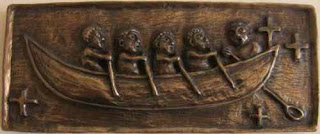
    Saint Enna, a possible companion of Saint Brendan the Navigator and his successor at Clonfert is commemorated on February 26 on the Irish calendars. There is some discrepancy, however, between the Irish Annals recording the death of this saint at 1st March and his feast being celebrated on the 26th February according to the calendars. Canon O’Hanlon explains:

    Various denominational forms have been applied to this saint, and it has been conjectured, that he was originally called Ena, Enna, or Ennius. Thence it was probably resolved into Mo-Ena, Mo-Enna, or Mo-Ennius. He has also been called Moenus and Mainus. Among the old Irish oe and ai had a like sound, and Mo is merely a prefix, which indicates some special affection. This saint is also called Moinne, Moune, Muinni, or Moen. He is said to have been a Briton, who accompanied St. Brendan of Clonfert, on his return to Ireland, after that celebrated seven years navigation of the ocean, during which he visited the great Western Island, or Continent, and after he had lived some time in Armoric Britain. In the Island of Inis-mac-Hy Chuinn, both master and disciple are said to have dwelt. Whether or not, Moena had been elevated to the episcopal dignity, before leaving the country of his birth, may be questioned ; but, when seventy-seven years old, St. Brendan is said to have founded Clonfert. St. Moen lived with him, and during his sojourn there, a certain youth, who had come with his parents, died. Three days after this occurrence, and when the body was quite rigid, St. Brendan said to Bishop Moena, “Place my staff on the body of the dead brother.” Obeying this command, the youth came to life, and thus miraculously preserved, that brother, confirmed in the faith, was sent home to his native country in Britain. Colgan makes St. Brendan the founder and first Bishop of Clonfert, about the year 553, and he says, that St. ‘Brendan abdicated, having placed St. Moena in his room’. Other writers make St. Moena the first bishop, over this see. A great pestilence, called in the Irish language, Samthrusc, Samthrose, or Sawthrusc, prevailed, in the year 551 or 553, according to various Irish Annals, and it is generally resolved into a Lepra or Leprosy. It might have been that disease, which carried off the youth already mentioned.

    It is very probable, that our St. Enna or Moen was Bishop of Clonfert. Yet, a difficulty occurs, from his festival having been marked, not at the 1st of March, but at the 26th of February. In the “Annals of the Four Masters,” in the third year of Aedh, Monarch of Ireland, we find the death of St. Maeineann, Bishop of Cluain-fearta-Breanainn, recorded at A.D. 570, and it is said to have occurred, on the 1st of March. We find, in the Ulster Annals, under A.D. 571, the death of the first bishop of Clonfert thus remarked, ‘ Moena, Bishop Clonfert-Brenain, went to rest.” St. Brendan, it is stated, was then alive,and this agrees with most of our Annalistic accounts. The Annals of Tighernach state, at A.D. 572, that Maenu, Bishop of Cluanfert Brendan rested. The day of Moena’s death is placed, on the 1st of March. Under the form of Monan, Bishop Forbes assigns him a festival, at the latter date, or at the 26th of February; while, at the same time, a doubt of his identity is properly expressed. In the Martyrology of Tallagh, we find St. Moenna venerated, on the 26th of February. A Manuscript Antiphonarium, classed B. i, 4., belonging to Trinity College, Dublin, at this day, Kal. iiii. Martii, notes him as a Bishop and Confessor, in the Calendar, with an Office of Nine Lessons. In the Martyrology of Donegal, Maonna occurs, at the same date. In that Calendar, prefixed to the Martyrology of Christ Church, Dublin, this holy man is commemorated as a bishop. His feast was celebrated with an Office, consisting of Nine Lessons, as we are there likewise informed.

    Attempts have been made, to shew that the cultus of this saint had extended to different parts of Ireland. A St. Moenna is venerated in Jesu-Mond, diocese of Ossory, on the 26th of February. This concurrence would seem to make the present saint its patron.

    Content Copyright © Omnium Sanctorum Hiberniae 2012-2015. All rights reserved.

  • Saint Cuimine the Fair, February 24

    24. F. SEXTO KAL. MARTII. 24.

    CUIMMEIN FlONN, son of Ernan, son of Fiachna, abbot of Ia-Choluim Chille. He was of the race of Conall Gulban, son of Niall, AD. 668. [He wrote the Life of Colum Cille in 134 chapters, which begins, ‘Vens abbas et plurimorum pater caenobiorum.’]

    Saint Cuimine (Cummein Fionn, Cumineus Albus, Comine, Cumaine, Cummine, Cumine, Cummein) thus had a family connection to Saint Columcille and was nephew to Segenius, or Seghine, the fifth abbot of Hy, or Iona. Canon O’Hanlon informs us that:

    On the death of the Abbot, St. Suibhne, A.D. 657, St. Cuimine Ailbhe immediately succeeded him. The present saint visited Ireland, in the year 661, according to the Annalist Tighernach. The holy subject of this memoir was a man of great erudition, it is observed, and he adorned either Scotia with his gifts.

    St. Cumine Ailbe departed this life, as is generally thought, on the 24th of February. The Annals of Clonmacnoise, it has been stated, place his death at the year 605, but 665 must have been intended, as the true entry. The Ulster Annals and those of the Four Masters, assign it to A.D. 668. According to the Annals of Tighernach, it happened A.D. 669. All the Irish Calendars, quoted by Colgan, agree in marking the 24th of February as the day of his death. The entry, ‘Cuimin find mac Fiachna mic Feradaigh, Abb. Iae’, is found in the Martyrology of Tallagh, at the same date. In the Martyrologies of St. Oengus, of Marianus O’Gorman, of Charles Maguire, and of Donegal, is recorded, on this day, the festival of Cuimmein Fionn, son of Ernan, son to Fiachna, Abbot of Ia Choluim Chille. Besides these notices, at the vii. of the March Kalends, which is the 24th of February, the Kalendar of Drummond states, that the Abbot Cummain, in Ireland, went to Christ. In Scotland this holy abbot was highly venerated. Thus, in the Dunkeld Litany, he is invoked as Cumminach.

    Note: I have posted a translation of the Life of Saint Colum Cille by Saint Cuimine in two parts here and here.

    Content Copyright © Omnium Sanctorum Hiberniae 2012-2015. All rights reserved.