Tag: Irish Saints

  • Saint Fraech of Cluain Collaing, December 20

    December 20 is the feast of Saint Fraech (Froech, Froegius, Fraegius), known as Cruimhther or Presbyter Fraech of Cluain Collaing, now Cloone, County Leitrim. The entry in the Martyrology of Donegal records:

    20. D. TERTIO DECIMO KAL. JANUARII. 20.
    CRUIMHTHER FRAECH, of Cluain Collaing, in Muintir Eoluis. He was of the race of Conmac, son of Fergus, son of Ross, son of Rudhraighe.
    The Martyrology of Gorman notes:

    Presbyter Fraech the facile [easy], a constant champion.

    Saint Fraech was obviously the founder of a monastery in this locality and although no Life of Cruimhther Fraech survives, he features in the various Lives of Saint Berach of Kilbarry, whose feast is commemorated on February 15. Charles Plummer’s translation of one of these Lives of Saint Berach gives us the basic details:

    16) Now St. Berach was born in the house of his mother’s brother, Fraech the Presbyter, son of Carthach, in Gort na Luachra (the Close of the Rushes), near Cluain Conmaicne. And in that place there is (now) a mother-church and a cross, and the stone on which St. Berach was born. And Presbyter Fraech subsequently offered this estate to Berach. Presbyter Fraech too it was who baptized St, Berach, and fostered him till he was old enough to study.

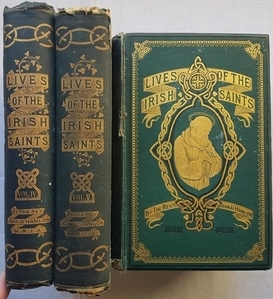
    Canon O’Hanlon in his Lives of the Irish Saints expands upon the connection between Saint Fraech and his nephew in his account of Saint Berach on February 15 (Volume II, pp. 536-537):
    According to the Irish Life of our saint, his father’s name was Nemnald… Fionmaith, sister to Cruimhther Fraech, of Cluain Conmaicne, in Muinter-Eolais, was his mother…
    Their holy relative, named Froegius, or Froech, lived in a certain district, and there he occupied a cell. After reciting matins and lauds, he went out, about the middle of the night, and looking in the direction of Connaught, he beheld a globular and bright luminous halo surrounding the house of Nemnald, and of his wife, Fionmaith. Wondering what such a spectacle portended, Froech said to one of his disciples, “Go to the house of my brother-in-law, Nemnald, and inform me, if my sister hath given birth to a boy: if so, bring him to me.” Obeying this order, the messenger at once set out for the house, where, on his arrival, he found a very beautiful infant with Fionmaith. Having learned from the messenger those instructions, given by Froech, the child was accordingly sent to him. When the latter saw how highly gifted, by nature, his infant nephew was, he directed that baptism should be administered, in the church, so that the neophyte should be washed with the water of regeneration, and that thus he might be presented to Christ.
    The first name given to the child was Fintan, until he had been brought to the font, by his uncle, St. Froech who baptized him. The parents had been required to know, what name ought to be imposed on their child, when they replied, it must be Berach. This being agreed to, Froech said afterwards, “Rightly has this name been given to him, for he shall be a saint, and his place shall be in Heaven.” We are furnished with an interpretation, for the name of Berach; namely, that it has the signification of one, who takes a direct and an exact aim, at an object, or as reaching one, so to speak, with the point of a sword… When baptized, the mother naturally desired her infant to be sent home; yet, Froech said to her, “Know you, my dear sister, that no further care of this boy shall belong to you, for with me shall he remain, since God, who created him, is able to cause his growth, without being suckled by a mother.” To this strange request Fionmaith assented, and in a truly miraculous manner, Froech became a foster-father to the child. The latter grew up by degrees, and the Almighty seemed to supply every want, incident to his condition. By Froech, also, was Berach taught the rudiments of learning, when a mere infant. As the child grew up, he evinced the most affectionate regard towards his uncle. His piety and his love for learning were very admirable, so that his time was wholly engaged with prayer and study. His intellectual and pious disposition, even at this early age, boded his future eminence and great sanctity. He laboured to imitate his holy relative, and in the course of time, no other child of earth seemed to equal him, in the practise of good works.

    Content Copyright © Omnium Sanctorum Hiberniae 2012-2015. All rights reserved.
  • Saint Rodaighe of Ghreallaigh Bhunna, December 16

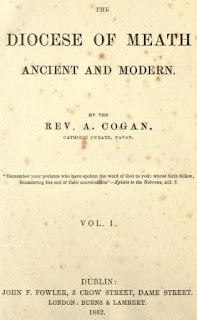
    December 16 is the feast of a County Meath saint, Rodaighe of Ghreallaigh Bhunna. Diocesan historian Father Anthony Cogan remarks of this saint and his locality:

    The ancient name of this place was Ghreallaigh Bhunna, Grellech, and Anglicised Girley. The patron saint is St. Rodaighe, abbreviated Raed, whose festival was celebrated on the 16th of December. In the list of guarantees and sureties given in the Irish Charters in the Book of Kells, on the occasion of the purchase of land near Donaghmore, at Navan from O’Riaman by the priest of Kells and his kinsmen, occur, “and the Erenagh of Grellech (Girley), and the Sech-nabb (i.e. the viceabbot), and the crozier of Reodaidhe”. There was therefore in the early period a monastery at Girley of which St. Raed was abbot. Up to a few years ago his holy well was frequented, in the language of the peasantry, “nine clear days before Christmas”. See the Miscellany of the Irish Archaeological Society, vol. i., p. 135. Martyrology of Donegal at 16th of December.

    The Miscellany records in its notes:
    ” Grellech Now called in Irish Greille, and anglicised Girley by metathesis. It is the name of a parish lying a short distance to the south of Kells.
    Reodaidhe. — This saint is still vividly remembered in the parish of Girley, near Kells, of which he is still regarded as the patron, but his name is now shortened to Raed. In the Irish Calendar of the O’Clerys he is set down as St. Rodaighe of Greallach-buna, at 16th of December, thus:
    “Dec. 16. St. Rodaighe of Greallach-buna, the son of Failbhe, son of Ronan, of the race of Niall of the Nine Hostages.”
    The Editor could learn nothing of the crozier of this saint in the parish of Girley.
    The Miscellany of the Irish Archaeological Society. Vol. 1 (Dublin, 1846), 135.

    Content Copyright © Omnium Sanctorum Hiberniae 2012-2015. All rights reserved.
  • Saint Flann of Bangor, December 15

    December 15 is the feast of Saint Flann, a seventh/eighth century successor to Saint Comgall as abbot of Bangor. The Martyology of Oengus says that at this date we commemorate ‘the feast of Flann the modest ruler, the abiding successor at Bangor.’ His death in the eighth century is recorded in the Annals  which also link him to Antrim:

    A.D. 722. ” St. Flann, of Aentrebh (Antrim), Abbot of Beannchair, died.”
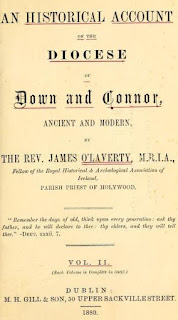
    One of the most glowing tributes to the monastic foundation over which Saint Flann ruled was written by Saint Bernard of Clairvaux in his Life of Saint Malachy. The quotation below has been taken from the diocesan history of Down and Connor by Father O’Laverty:
    “There had existed in this place, under the founder Comgellus, a most noble institution, inhabited by many thousands of monks, the head of many monasteries, a place truly sanctified and so fruitful in saints, which brought forth fruit so abundantly to God, that one of the sons of that holy congregation, Luanus by name, had himself alone founded one hundred monasteries, which I mention for this reason, that the reader may from this single instance form a conception of the number to which the remainder of the community amounted. In short, so widely had its branches extended through Ireland and Scotland, that these times appear to have been expressly foreshadowed in the verses of David—’ Thou visited the earth, and hast plentifully watered it,’ &c. Nor was it only into the countries I have mentioned, but even into distant lands, that crowds of saints, like an inundation, poured, one of whom, St. Columbanus, penetrating into these our regions of Gaul, built the monastery of Luxieu, and there became a great multitude. So great do they say it was, that the solemnisation of the Divine offices was kept up by companies, who relieved each other in succession, so that not one moment, day or night, was there an intermission of their devotions.”