Tag: Irish Saints

  • Saint Blathmac of Iona, January 19

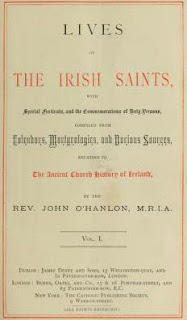
    January 19 is the feast of a martyred monk of Iona, Saint Blaitmaic (Blathmac). Last year I posted on the martyrdom of this brave monk at the hands of the Vikings, using John Marsden’s book ‘The Fury of the Northmen’ to put the event into its historical context. He believes that the saint was subjected to a particularly gruesome form of blood sacrifice. That post can be found here. It contains extracts from the biography of the saint written by Walafrid Strabo within a couple of decades of the event, and Marsden also makes some interesting points about the transfer of saints’ relics at this time. This year, however, I offer a paper from the Irish Ecclesiastical Record which summarizes the life and death of Saint Blaitmaic. Although the contribution is unsigned, the author is in fact none other than dear old Canon O’Hanlon and represents his entry for the saint at January 19 in the first volume of Lives of the Irish Saints.

    ST. BLAITMAIC, OF IONA, MARTYR.
    SOME individuals are heroic in action; others in patient suffering. This noble saint, whose memory is held in honour on the 19th day of January, justly deserves the meed of praise for his fortitude under both aspects. Blaitmaic’s biography has been elegantly composed, in Latin hexameter verses, by Walafridus or Galafridus Strabo, a learned Benedictine monk, who died A.D. 847. This celebrated writer was an accomplished mediaeval poet. His greatly admired composition was written at the instigation of a venerable superior, Felix, and it appeared most probably some short time after the tragic but glorious death of the noble subject, suggesting Strabo’s fine poem.
    We are unable to state on whose authority events associated with the life of Blaitmaic depend, as they are metrically narrated by Strabo; but it is probable, they had been taken from some relation given by monks connected with Iona monastery. These informants, too, might have had a personal knowledge concerning the martyred Christian hero, and even of the circumstances attending his death. His interesting Acts have been frequently written in various forms, as well in prose as in verse.
    St. Blaitmaic or Brah Mac, which name, according to Strabo and Bollandus, means ” the beautiful son,” seems to have been gifted with singular graces even from his very infancy. This child, the delight of his parents, was of Royal extraction, and of noble birth. He was born in Ireland, most probably, about the middle of the eighth century. St. Blaitmaic was prospective heir to his father’s possessions, the ornament and hope of his family and country.
    At an early age he was distinguished for almost every virtue and merit. He is described as being of sound judgment, prudent, a great lover of holy purity, and humble, notwithstanding his exalted birth. The innate nobility of his soul surpassed that of his race. Accomplishments were not wanting to add a royal grace to his character ; sober and circumspect, he was pleasing in mien, and agreeable in disposition . Although remaining in the world he was not one of this world’s votaries. He had resolved upon devoting himself wholly to religious services, but kept this secret locked up within his own breast, until such time as he could most conveniently put his resolution into practice. Without his father’s knowledge, Blaitmaic withdrew privately to a monastery, where he practised all exercises of a monastic life, until his retreat was discovered.
    Hereupon, the fond parent, who loved his son according to the instinct of worldlings, repaired to this monastery; and he brought a band of friends and acquaintances, whose exertions and entreaties it had been supposed must have exercised great influence in changing Blaitmaic’s purpose. Besides the chiefs and people, a bishop and several abbots united their persuasions with those of his father to induce the Saint to resume his former rank. But the pious prince resisted all these solicitations, and persevered in his happy course of life.
    He looked upon himself as a servant to all the religious in the monastery, although esteemed beyond expression by his fellow-cenobites. He was distinguished by religious silence, and the observance of monastic discipline: by attentive study of the sacred Scriptures and books of ecclesiastical science, he edified all through his conduct and conversation. In due time, he was made superior of the religious community; and this band of religious he governed more by example than by precept. Christ Jesus was the sole object of his praise and glory, as of his discourse and allusions. Peace was his shield, prayers were his coat of mail; patience was his field for victory, and the word of God his sword; mildness characterized his conduct towards the monks; he became all things to all of them, that he might gain all to Christ. He was ever hopeful and loving; practising every virtue and avoiding every imperfection; and ever referring his actions to the great Author of our being. Thus his example brightened as a beacon before the eyes of his disciples; and these latter progressed towards perfection under the directing zeal of their saintly superior.
    Our Saint burned with a desire of martyrdom; and to attain this object, he had often attempted to visit strange lands, but had been prevented by his people. On a certain occasion, Blaitmaic thought to effect his retreat under cover of night, and through a secret path. He was accompanied by a small band of disciples; but the fugitives were arrested and brought back. However, his wishes were at length gratified; for he contrived to escape from his native country. Blaitmaic directed his course to Iona, “the sacred isle” of Columba. The Danish ravages had been frequently directed against the shrines and altars of unprotected religious that peopled this known island. But, in a knowledge of this fact, Blaitmaic grounded his hopes for securing to himself the palm of martyrdom.
    He had been gifted from on high with a spirit of prophecy. Hence, before a hostile irruption, which took place after the commencement of the ninth century, Blaitmaic predicted to his companions, in Iona monastery, a storm which was about to burst upon them. This seems to have occurred during the incumbency of Diarmait, the twentieth abbot in succession to the great St. Columkille.
    Before the northern pirates, with their fleet, had reached the shores of Columba’s sacred isle, Blaitmaic called the monks together, addressing them as follows: ” My friends, consider well the choice which is now left you. If you wish to endure martyrdom for the name of Christ, and fear it not, let such as will remain with me arm themselves with becoming courage. But those who are weak in resolution, let them fly, that they may avoid impending dangers, and nerve themselves for more fortunate issues. The near trial of certain death awaits us. Invincible faith, which looks to a future life, will shield the brave soldier of Christ, and the cautious security of flight will preserve the less courageous.”
    These words were received by the religious with resolutions suited to the confidence or timidity of each individual. Some resolved to brave the invaders’ fury, together with their holy companion ; some betook themselves to places of concealment until this hostile storm had passed.
    On the morning of January the 19th, A.D. 823, 824, or 825, St. Blaitmaic, robed in vestments of his order, had been engaged in celebrating the Holy Sacrifice of the Mass. Whilst he offered up the Immaculate Host, he stood as a self-immolated victim, prepared for sacrifice. The band of his faithful religious, anticipating a coronal of martyrdom, knelt around ; with tears and prayers they besought mercy and grace before the throne of God. This, truly, must have been a sublime spectacle, and one never yet surpassed in the records of human heroism. Whilst engaged in these services,the loud shout of their destroyers was heard thundering without the church. The Pagan and pirate Danes rushed in through its open doors, threatening death to the religious, and almost immediately afterwards these barbarous threats were put in execution. The monks, expecting this irruption, had the precaution to remove a rich shrine, containing St. Columba’s relics, from its usual place. They buried it under ground, so that it might thus escape the profanation of those savage invaders. That rich prize was what the Danes chiefly sought. They urged Blaitmaic to show them the place of its concealment. But our Saint, who knew not the particular place where it was buried, with unbending constancy of mind opposed himself to this armed band. Although unarmed himself, he put forth some futile efforts of strength to stay the ravages of his enemies. He cried out, at the same time, “I am entirely ignorant regarding those treasures you seek for, and where they are buried. But, even had I a knowledge of all this, my lips should yet be closed. Draw your swords, barbarians, take my chalice, and murder me. Gracious God, I humbly resign myself to Thee!” The barbarians immediately hewed him into pieces with their swords, and with more diabolical rage, because they were disappointed in their expectations for obtaining spoil. At this time the Abbot Diarmait was probably absent from Iona, and the holy martyred priest it would seem, worthily represented their Superior’s authority among the religious. The body of St. Blaitmaic was buried in that place where his glorious crown of martyrdom had been obtained, according to his biographer Strabo; and many miracles were afterwards wrought in favour of several persons, through the merits and intercession of this great soldier of Christ.
    We have not been able to discover whether our Saint ever enjoyed any superior dignity at Iona; but it would seem, from the preceding narrative, that he exercised considerable influence over the minds of his brethren on that island. We are told that in the Irish language this Saint is called Blathmhac. The first syllable of this compound name has an equivocal signification. Blath, when pronounced long, has the literal meaning ” a flower,” and the metaphorical signification “beautiful;” when pronounced short, it is rendered into the English words “honour” or “fame.” The word Mhac is Anglicised “son.” Truly was this heroic man named. For not alone was he the son and heir apparent to his father’s temporal possessions, but he became one of God’s glorified children, secured in the enjoyment of a heavenly inheritance. He plucked the flower of martyrdom with unbending constancy, and he blooms with distinguished brilliancy, “as the apple-tree among the trees of the woods.” His memory deserves to be honoured in the Church, since he achieved a distinguished reputation. This is one, likewise, which no concurrence of events can ever tend to tarnish or destroy.
    Irish Ecclesiastical Record, Volume 9 (1873), 502-508.

    Content Copyright © Omnium Sanctorum Hiberniae 2012-2015. All rights reserved.

  • Saint Dunchad O'Braoin of Clonmacnoise, January 16

    Today we commemorate a monastic saint of the 10th century, Dunchad O’Braoin, abbot of Clonmacnoise, who was also an anchorite and pilgrim. Canon O’Hanlon supplies the details of his life, which includes an account of two of his miracles:
    The acts of this saint have been written by Colgan at the 16th of January. A short life, in the possession of MacCarthy Riabhach, and a still shorter one, in the Chronicle of Clonmacnois, furnished materials for its composition, and he has added some critical notes. Dunchad O’Braoin was a scion of an illustrious family of the Nialls, and he was born in the district called Breghmuine. This is now known as the barony of Brawny, in the county of Westmeath. He was a religious, who embraced the monastic state at Clonmacnois. His love for literature was aided through his zeal. There he made wonderful progress in piety and learning. His humility, too, was most exemplary, for he wished to shun entirely the attentions and applause of men. Secreting himself as much as possible, he lived the retired life of a holy anchorite. He is said to have shut himself up in a sort of prison. Tuathal, who had been both abbot and bishop of Clonmacnois, died A.D. 969. Dunchad was chosen as his successor in the abbacy. Having been brought from his retreat, this humble man was forced to accept the responsible charge, for which he had been selected.
    Among the bishops at Clonmacnois, Harris has placed Dunchad on his list, but only conjecturally, at A.D. 969. Yet, there is no foundation whatsoever,for such an arrangement. Certain words, quoted from Colgan, prove nothing more than that Dunchad had been placed over the monastery as abbot. Throughout his acts, or wherever else he is spoken of, Dunchad is never called bishop. Governing the monastery for some time merely as abbot, he desired a more retired state of life. He withdrew from the management of monastic affairs after some time. By many persons he was much admired in that part of Ireland. The titles of abbot and of anchoret are invariably applied to him. This saint is called a holy and devout anchorite, and he is regarded as a pilgrim. Such designations are applied to him in the Annals of Clonmacnoise, at A.D. 981.
    Through his prayers, Almighty God restored to life the infant son of a woman. This mother left her dead child at the entrance of our saint’s cell. She then retired so as not to be seen, but she hoped that the saint would pray, and procure the infant’s resuscitation. With this request he complied. This miracle is alluded to by Tighernach, author of the Annals of Clonmacnois. This writer lived in the eleventh century. Tighernach says, that Dunchad was the last of the Irish saints, through whose intercession God had restored a dead person to life.
    Another miracle was wrought in favour of this holy man. For one festival day of St. Andrew, the Apostle, when Dunchad had been exhausted from the effects of severe fasting, he began to desire some nourishing diet. He prayed to God for such relief; and then a youth, who served him, went out into a field to collect straw. There two most beautiful men appeared to him, and after a salutation said, “Thy master Dunchad, the servant of God, hath asked the Lord we serve for food and drink, and behold both are here for you to bring him.” Then taking the straw from this youth, they placed nourishing meats, and a vessel, containing mead or beer, mixed with honey, on his shoulders. This load he carefully brought to Dunchad, and related what had occurred. The blessed man gave special thanks to God, who had commiseration on his weakness, and who had relieved him by so evident a miracle.
    In the year 974 or 975, he withdrew to Armagh, where sequestered and unnoticed he hoped to spend his days. His reputation however soon spread throughout that city. So much respect was paid to him there, he was determined to leave it, that he might avoid further notoriety. His intentions being discovered, the principal inhabitants of Armagh deputed some venerable persons of the clergy to request that he should stay with them one year longer. The clergy alone were able to change his resolves.
    He complied with their petition, and continued to reside at Armagh. At the year’s end he again prepared for departure. But a similar request was made. This repetition was annually continued, it is stated, and so he was induced to prolong his stay in that city. St. Dunchad O’Braoin there ended his days, and he died on the 16th of January—corresponding with the 17th of the Calends of February—A.D. 987. The year 988 is said, however, to be more correct. That most distinguished historian of Ireland, Eochaidh O’Flannagain, has allusion to this holy man in an Irish stanza, thus rendered into English by Dr. O’Donovan :—
    ” The seat of Macha [i.e. Queen Macha] the treacherous, voluptuous, haughty,
    Is a psalm-singing house possessed by saints ;
    There came not within the walls of her fort
    A being like unto Dunchadh O’Braein.”‘
    We are told, furthermore, that at the end of his thirteenth year of pilgrimage to Armagh, he passed out of this life. The amiable as well as the humble character of this holy man may be estimated from the disposition he evinced, to yield his opinions to the wiser judgments of virtuous persons, in the order of his living, lest he might seem to be overwise in his own conceits.

    Content Copyright © Omnium Sanctorum Hiberniae 2012-2015. All rights reserved.

  • 'Gem of Our Church, Fair Ita'

    F. Anger, St Itha (1901)

    January 15 is the feast of Saint Ita, ‘the Brigid of Munster’ and patroness of the Diocese of Limerick. A post on her life can be found here, but below is the text of a late nineteenth century poem in honour of the saint. It was published in the periodical founded by Father Matthew Russell S.J., The Irish Monthly.  The poem is typically Victorian in its sentimental piety, but still worth reading on the feast of this great Irish woman saint. The illustration is a near-contemporary one taken from the work of the Reverend Sabine Baring-Gould, Virgin Saints and Martyrs, published in 1901.

    ST. ITA.
    Patroness of the Diocese of Limerick
    [Jan. 15]

    SING, sing ye a maiden holy,
    And pure as the driven snow,
    A saint of our sainted island
    Serving God long ago.
    Oh, she had riches and suitors
    Where royal Decies stood,
    But gave up all for a lover
    Who shed for her His Blood.

    Sing, sing ye a maiden holy,
    And pure as the driven snow,
    A saint of our sainted island
    Serving God long ago.

    “Depart”, cried a voice, “from kindred,
    And from thy father’s lands;
    Make haste to a distant region,
    Where dark-browed Loochar stands.
    Wild warriors there shall build thee
    A home by the mountain side;
    Hy-Connaill bloom as a garden,
    And bless thee far and wide. “

    Sing, sing ye a maiden holy,
    And pure as the driven snow,
    A saint of our sainted island
    Serving God long ago.

    And clansmen and maidens gathered
    Around that white-robed dove;
    And the land served God as a virgin,
    All, all of that virgin’s love.
    O, gem of our Church, fair Ita,
    Maid of our worship and love,
    Pray for our priests and people,
    Saint of the heavens above.

    Sing, sing ye a maiden holy,
    And pure as the driven snow,
    A saint of our sainted island
    Serving God long ago.


    R. O. K., St. Ita,  The Irish Monthly,  Vol. 23, No. 259 (Jan., 1895), p. 26.

    Content Copyright © Omnium Sanctorum Hiberniae 2012-2015. All rights reserved.