Tag: Irish Saints

  • 'Gem of Our Church, Fair Ita'

    F. Anger, St Itha (1901)

    January 15 is the feast of Saint Ita, ‘the Brigid of Munster’ and patroness of the Diocese of Limerick. A post on her life can be found here, but below is the text of a late nineteenth century poem in honour of the saint. It was published in the periodical founded by Father Matthew Russell S.J., The Irish Monthly.  The poem is typically Victorian in its sentimental piety, but still worth reading on the feast of this great Irish woman saint. The illustration is a near-contemporary one taken from the work of the Reverend Sabine Baring-Gould, Virgin Saints and Martyrs, published in 1901.

    ST. ITA.
    Patroness of the Diocese of Limerick
    [Jan. 15]

    SING, sing ye a maiden holy,
    And pure as the driven snow,
    A saint of our sainted island
    Serving God long ago.
    Oh, she had riches and suitors
    Where royal Decies stood,
    But gave up all for a lover
    Who shed for her His Blood.

    Sing, sing ye a maiden holy,
    And pure as the driven snow,
    A saint of our sainted island
    Serving God long ago.

    “Depart”, cried a voice, “from kindred,
    And from thy father’s lands;
    Make haste to a distant region,
    Where dark-browed Loochar stands.
    Wild warriors there shall build thee
    A home by the mountain side;
    Hy-Connaill bloom as a garden,
    And bless thee far and wide. “

    Sing, sing ye a maiden holy,
    And pure as the driven snow,
    A saint of our sainted island
    Serving God long ago.

    And clansmen and maidens gathered
    Around that white-robed dove;
    And the land served God as a virgin,
    All, all of that virgin’s love.
    O, gem of our Church, fair Ita,
    Maid of our worship and love,
    Pray for our priests and people,
    Saint of the heavens above.

    Sing, sing ye a maiden holy,
    And pure as the driven snow,
    A saint of our sainted island
    Serving God long ago.


    R. O. K., St. Ita,  The Irish Monthly,  Vol. 23, No. 259 (Jan., 1895), p. 26.

    Content Copyright © Omnium Sanctorum Hiberniae 2012-2015. All rights reserved.
  • Saint Flann Fionn Cuillin, January 14

    The saints commemorated on the Irish calendars for January 14 are all somewhat obscure. Last year I looked at the life of Saint Baetan of Inisbofin, who appears to have been a successor to Saint Colman at the island monastery founded in the wake of the Paschal dating controversy. O’Hanlon lists another saint for this day, whose feast, like that of Saint Baetan, is well attested in the sources, but about whom we also have few other details, save that he seems to have flourished in the Cork area:

    St. Flann Fionn Cuillinn, of a place near Cork.

    Hereafter it may be possible for local investigators to discover the sites of holy places, the names alone being on record. The Irish MS. Calendar of the O’Clerys, which is kept in the Library of the Royal Irish Academy, mentions a saint, named Flann Fionn Cuillinn, at this day. He is said to have been from or of a place near Cork. We may suppose the place, called Cuillen or Cullen, must have been convenient to this southern city. A festival in honour of Flann fion i Cuillin i Fail Corcaighe, occurs in the Martyrology of Tallagh, on the 14th of January. Besides the foregoing entries, we find set down in the Martyrology of Donegal, on this day, Flann Finn of Cuillinn, in the vicinity of Corcach. This holy man must have flourished during or before the eighth century, since his festival, at this date, has been inscribed by St. Oengus the Culdee, in his Irish Metrical Calendar.

    Pádraig Ó Riain’s 2011 Dictionary of Irish Saints wonders if he might be the same person as Saint Flann of Derrynaflan, the site where the wonderful chalice and altar vessels were found in County Tipperary. 

    Content Copyright © Omnium Sanctorum Hiberniae 2012-2015. All rights reserved.

  • Saint Cummine mac Duibh of Drum Druith, January 12

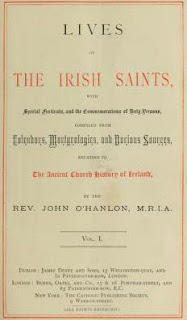
    Canon O’Hanlon’s Lives of the Irish Saints records at January 12 a Saint Cummine (Cummeine, Cummain) who illustrates many of the difficulties faced by hagiologists in trying to discover the identity of some of our native saints:

    St. Cummein or Cuimmine, Son of Dubh, of Drum-Druith.
    A festival in honour of Cuimmine mac Duibh, of Druim Druith, is registered in the Martyrology of Tallagh, at the 12th of January. The place to which he belonged has not been identified. The Martyrology of Donegal likewise mentions, as having a festival on this day, Cummein, son of Dubh, of Drum-Druith. There is a Cuimin, son of Dima Dubh, belonging to the race of Fiachra, son to Eochaidh Muighmhedhoin. Finding a saint of this name interred at Bobbio, in the north of Italy, and not being able to discover with any certainty his having been different from the present holy man, Colgan has some memoranda regarding him inserted at the 12th of January. The name of Cummine first occurs at this date in our Calendars; and for no better reason is the Cummine or Cumian of Bobbio here introduced.
    The German scholar, Michael Richter, in his recent volume on Bobbio, the Italian foundation of Saint Columbanus, rules out this connection and assigns the Bobbio saint’s feastday to July 9. Cummine is a relatively common name in the Irish sources, the most famous saint of this name being the scholarly Cummine the Tall.

    Content Copyright © Omnium Sanctorum Hiberniae 2012-2015. All rights reserved.