Tag: Irish Saints

  • Saint Mac Laithbhe of Donoughmore, May 20

    May 20 sees the commemoration of yet another obscure Irish saint whose only memorial is the recording of his feast day on the Irish calendars. In the case of Saint Mac Laithbhe ‘son of Laithbe’ even the recording of an associated locality is of no help as ‘Donoughmore’ is too generic a place name in Ireland to assist in identifying him, as Canon O’Hanlon explains:

    St. Mac Laithbhe, of Donoughmore.

    At the 20th of May, we find a record of this saint, in the published Martyrology of Tallagh, as Mac Laithbhe Domnaighmoir. This latter word was the name of a place. Many localities, called Donoughmore, are known in various parts of our Island; so that it is difficult to discover that one, with which he had been connected. Marluithaes de Momech-mou is noted by the Bollandists, at the 20th of May, and for this feast, the Tallagh Martyrology is quoted;  but, we suspect, the reference has been taken incorrectly from that source. The Martyrology of Donegal,  on this day, registers Mac Laithbhe, of Domhnach-mor. as having been venerated.

    However, on May 27 we find the feast of Saint Eithearn of Donaghmore. He is associated with Domhnach-mór-mic-Laithbhe ‘the great church of the son of Laithbe’ near Slane, County Meath. It has been established that churches which include the word Domhnach (Lord), in their names are among the earliest in Ireland and are linked to the mission of Saint Patrick. It seems that Eithearn is the son of Laithbe described in the church’s title.  Slane is, of course, a locality with well-established Patrician credentials.  Pádraig Ó Riain, in his 2011 Dictionary of Irish Saints, suggests that as May 27 falls within the octave of the May 20 feast of Saint Mac Laithbe, that both days thus probably commemorate the same man, Eithearn, son of Laithbe. 

    Note: This post, first published in 2014, has been revised in 2022.

    Content Copyright © Omnium Sanctorum Hiberniae 2012-2015. All rights reserved.

  • Saint Richella, May 19

    On May 19, one of the earliest surviving Irish calendars, the Martyrology of Tallaght, records the name of an Irish female saint, Ríceall, latinized as Richella. Canon O’Hanlon discusses three saints of this name, one of whom tradition says was a sister to Saint Patrick. It proves impossible, however, for him to definitively identify the saint Richella commemorated on this day. More recently, Pádraig Ó Riain in his 2011 Dictionary of Irish Saints, confirms that there are three holy ladies of similar name, whose root is the word , king, all of whom are difficult to disentangle. Canon O’Hanlon in his entry for the saint below lays out the evidence from the seventeeenth-century hagiologist, Father John Colgan:

    ST. RICHELLA, VIRGIN.

    In the Martyrology of Tallagh published and unpublished —we find this saint’s festival set down, on the 19th of May. Marianus O’Gorman and Charles Maguire mention this holy virgin, likewise, in their Calendars, and at the same date. According to the accounts of ancient writers, St. Patrick had a sister bearing the name. But, as there were two other Richellas, in our list of Irish Saints, it may be difficult to determine the virgin, whose festival is this day commemorated. One of these was St. Richelia, the daughter of Attractus, and of King Leagaire’s race. Her descent will be found, in the “Menelogium Genealogicum,” cap. 3. The other was Richella, or, according to others, Richenna, called also Reynach, or Regnacia. She was daughter to Fintan, and sister to St. Finnian of Clonard, as may be seen in a Life of the latter, published by Colgan. Her Life will be found, at the 18th of December.

    There was a certain church or monastic establishment, in the territory of Lugne, within the Connaught province, and there a St. Richella is said to have lived. Kill-Richille, in the diocese of Clonfert, was probably connected with the residence of a saint bearing this name; yet, it is not easy to determine that particular Richella—if indeed she was one among the three mentioned—who had been venerated in either of those places. In a list of St. Patrick’s five sisters, the name Cinnenus is substituted for Richella, by Ussher; and Colgan found, likewise, in an old fragmentary vellum Life of St. Patrick, the name of a fifth sister to the Irish Apostle, as Cinnenus, and not Richella. But, as the form of the name Cinnenus is not applicable to a female, Colgan thinks we ought rather read, Cinne noem, signifying St. Cinna. Now, it would seem, that Richinne has the signification regia Cinne; wherefore, Colgan argues, it is possible, the doubtful word may be properly resolved into Richinne or Richella. The same researchful hagiologist tells us, he could not discover, whether or not Richella became a mother. It might come within the range of possibility, also, that Barbanus, or Banbanus, of Mag-slecht, and a kinsman of St. Patrick, had been her son; although, Colgan did not know, whether this relationship had been through a brother or sister, or in what collateral line. This, however, is only a very groundless conjecture; and, also, any attempt to represent our saint as a sister to the illustrious St. Patrick must prove equally futile. In the Irish Tripartite Life of St. Patrick, it may be observed, the saint left by him, over the church at Domhnach-Maighe-Slecht, is called Mabran Barbarus. The Bollandists notice the feast of Richella, an Irish virgin, at the 19th of May. Little is known, however, regarding her place in our ecclesiastical history.

    Content Copyright © Omnium Sanctorum Hiberniae 2012-2015. All rights reserved.

  • Saint Siollan of Devenish, May 17

    On May 17 we commemorate Saint Siollan, a seventh-century abbot of the monastery at Devenish Island, County Fermanagh. Canon O’Hanlon’s account of the saint and his lakeland home begins and ends with a romantic flourish:

    St. Siollan, Bishop of Daimhinis, or Devenish Island, County of Fermanagh.
    [Seventh Century.]

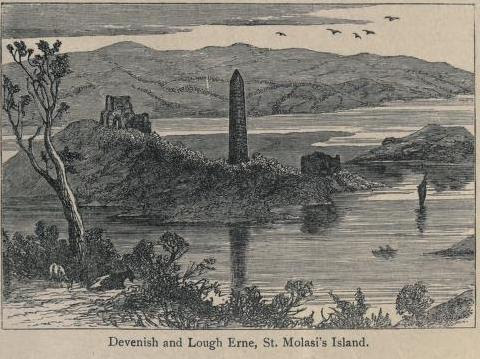
    It is a sight never to be forgotten, when Lough Erne seems, as it were, holding her mirror to the relics around St. Molaisse’s monastery. The round tower—simple, erect, and exquisitely tapering skywards—looks a fit emblem of hope, as the descending sun illumes its cap with golden light; while, down in the silent depths of the lake—less distinct, of a deeper and more dreamy shade—extends the reflection, as if veiling the mysterious past. The name Sillan, a Bishop—without any further designation—occurs in the Martyrology of Tallagh, at the 17th of May. We have Sillanus Episcopus, likewise, in the Franciscan copy of the Tallagh Martyrology, at the 17th of May. The Bollandists also enter his festival, on the same authority. In the Acts of St. Berach, allusion is made to a holy man, named Sillanus, who was miraculously restored to life, at a place called Rath-ond, but, of whose history little more seems to be known. A conjecture is offered, by Colgan, that he may be identical with the present holy man, yet this is hardly probable. The following identification is doubtless the true one, where at this date the Martyrology of Donegal records the veneration of Siollan, Bishop [of Daimhinis]. This has the English signification of “deer island.” His place of habitation was on the historic and beautiful Island of Devenish, so picturesquely situated, on Lower Lough Erne, about two and a-half miles below the town of Enniskillen, and in the county of Fermanagh…

    …The death of St. Molaisse, the founder of Devenish, is assigned to A.D. 563, and he was succeeded by St. Natalis, or Naal, the period of his demise not being stated. The next in succession, as revealed in our Annals, was St. Sillan. His term of incumbency seems assignable to the seventh century, and with the abbatial it is likely he exercised episcopal functions. We learn, that the present bishop died, on the 17th of May, A.D. 658, according to the Annals of the Four Masters. Under the head of Daimhinis, Duald Mac Firbis enters, Siollan, bishop of Daimhinis. Summer finds Devenish clothed in rank, luxuriant herbage. Except in the grey walls and the solitary hut of a herd, no trace of man is there to be seen. But, when the grass dies, and when winter has stripped this ancient home of its cattle, food, and verdure, the old gardens of the community can be traced, in many a boundary line. Even the presence of herbs and plants, which, though old in the soil, are not found in other islands of the lake, or on the surrounding hills, is indicated by the solitary habitant who acts as guide, and who lives upon this insulated spot.

    Content Copyright © Omnium Sanctorum Hiberniae 2012-2015. All rights reserved.